
Bridging the Gap: How Network Analysis Meets Sentiment to Decode Social Media Trends
Sentiment Analysis of Events in Social Media
This paper proposes a unified framework that bridges Network Analysis and Natural Language Processing to analyze social media events. It combines Mention-Anomaly-Based Event Detection (MABED) and Online LDA (OLDA) with sentiment classifiers like SVM and Logistic Regression to determine the overall public opinion of detected bursty topics.
TL;DR
Researchers from University Politehnica of Bucharest have developed a hybrid framework that doesn't just detect when an event is trending on social media, but also how the crowd feels about it. By combining MABED/OLDA for event detection with Logistic Regression/SVM for sentiment analysis, the study offers a scalable way to monitor the emotional pulse of "bursty topics" in real-time.
The Problem: Blind Spots in Social Mining
In the world of social media analytics, there has historically been a divide:
- Network Analysts look at diffusion: How fast is a hashtag spreading? What is its reach? They often treat text as a secondary summary.
- NLP Researchers look at polarity: Is this tweet positive or negative? They often ignore the social structure and timing that give the message its weight.
The authors argue that a "content-aware" network approach is needed. If a topic is spreading fast, we need to know immediately if the sentiment is toxic or celebratory to understand its true impact.
Methodology: The Two-Step Pipeline
The proposed architecture (shown below) integrates a TwitterMining engine with a processing pipeline that handles two distinct tasks.
1. Event Detection (The "What")
The system uses two heavy-hitters:
- MABED: Focuses on "mention anomalies," making it robust against general spam.
- Online LDA (OLDA): A probabilistic model that updates its understanding of topics over time slices, capturing the evolution of discussions.
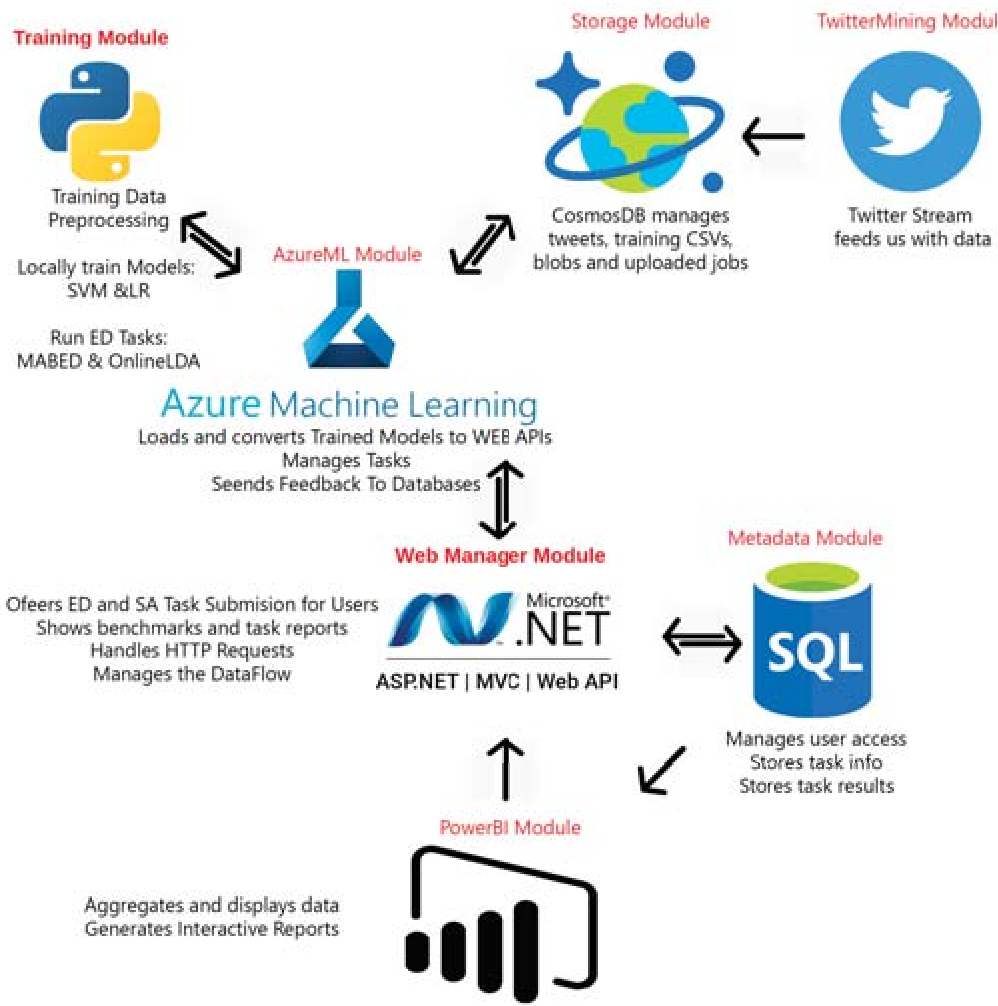
2. Sentiment Classification (The "How")
Once an event is isolated, the system extracts all related tweets and processes them through:
- Feature Engineering (SFE): This is the "secret sauce." Instead of just counting words, the authors expand contractions (e.g., "don't" → "do not") and bond negations to the words they modify, significantly improving accuracy in short-form text.
Experiments & Results
The researchers tested their method on the massive Sentiment140 dataset. A critical takeaway was the trade-off between accuracy and computational cost.
- The Efficiency Gap: While Linear SVM reached an AUC of 0.877, it took 62 days to train on the full dataset. In contrast, Logistic Regression (LR) achieved a comparable 0.804 AUC in just 11 minutes.
- Event Readability: OLDA produced more human-readable topics, but MABED was superior at detecting a broader range of distinct events.
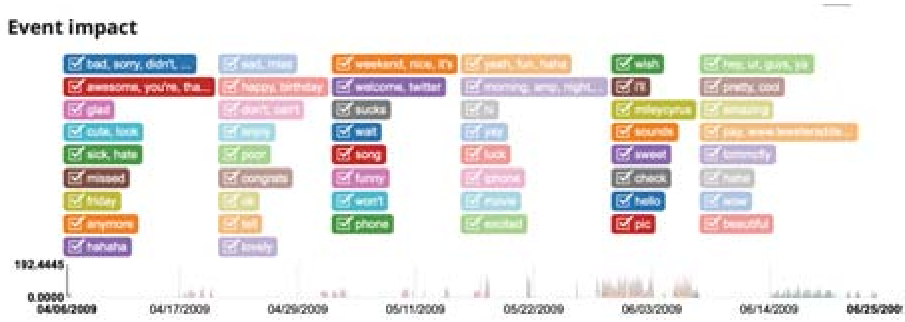 Figure: MABED visualizing the magnitude and lifespan of different detected events.
Critical Insights
- Scale Matters: For social media monitoring, the marginal gain of SVM is not worth the massive increase in training time. LR is the clear winner for production-grade systems.
- Preprocessing is King: Simple lemmatization and cleaning (CT/SFE) proved more important than the choice of classifier. Handling the noise of 140-character tweets is the primary hurdle.
- Real-World Utility: By identifying the sentiment of a bursty topic, organizations can distinguish between a viral marketing success and a public relations crisis in minutes.
Conclusion
This research provides a robust blueprint for integrating textual meaning with network dynamics. While future work will likely involve Deep Learning (Transformers) to capture deeper nuances, the use of efficient statistical models like MABED and LR remains a gold standard for high-throughput, real-time social sensing.
Main Takeaway: Don't just track the volume of a trend; track its heart.