
Decoding Political Sentiment: Machine Learning Insights from Turkish News Columns
Sentiment Analysis of Turkish Political News
This paper investigates sentiment classification in the Turkish political news domain using supervised machine learning. By comparing Naïve Bayes, SVM, Maximum Entropy (ME), and N-Gram Language Models, the authors achieve accuracies ranging from 65% to 77%, identifying ME and N-Gram models as the top performers for this morphologically rich language.
TL;DR
Analyzing sentiment in political columns is far more complex than movie reviews due to indirect language and subjective bias. This study evaluates four machine learning algorithms on Turkish news, finding that Maximum Entropy and Character-based N-Gram models are surprisingly effective, outperforming the industry-standard SVM in the Turkish linguistic context.
Context & Motivation
Most sentiment analysis research is "spoiled" by easy data: short, highly subjective product reviews with explicit labels (stars). The political news domain is a different beast. Columnists often use sophisticated, indirect language to mask their bias, and what is "positive" for one reader is "negative" for another.
Furthermore, Turkish is a morphologically rich language. A single word can contain multiple suffixes that alter its entire sentiment, making standard "bag-of-words" approaches less effective than they are in English.
Methodology: The Core Engine
The researchers compared four distinct algorithmic approaches to see which could handle the nuances of the Turkish political landscape:
- Naïve Bayes (NB): The baseline for speed and simplicity.
- Support Vector Machine (SVM): Often the SOTA for text, but struggled here with longer, more complex texts.
- Maximum Entropy (ME): A model that makes the fewest assumptions about the data.
- N-Gram Character Language Model: Instead of looking at words, it looks at sequences of characters (N=8), which helps in capturing sentiment-carrying suffixes in Turkish.
Feature Engineering
The authors didn't just dump text into models. They tested:
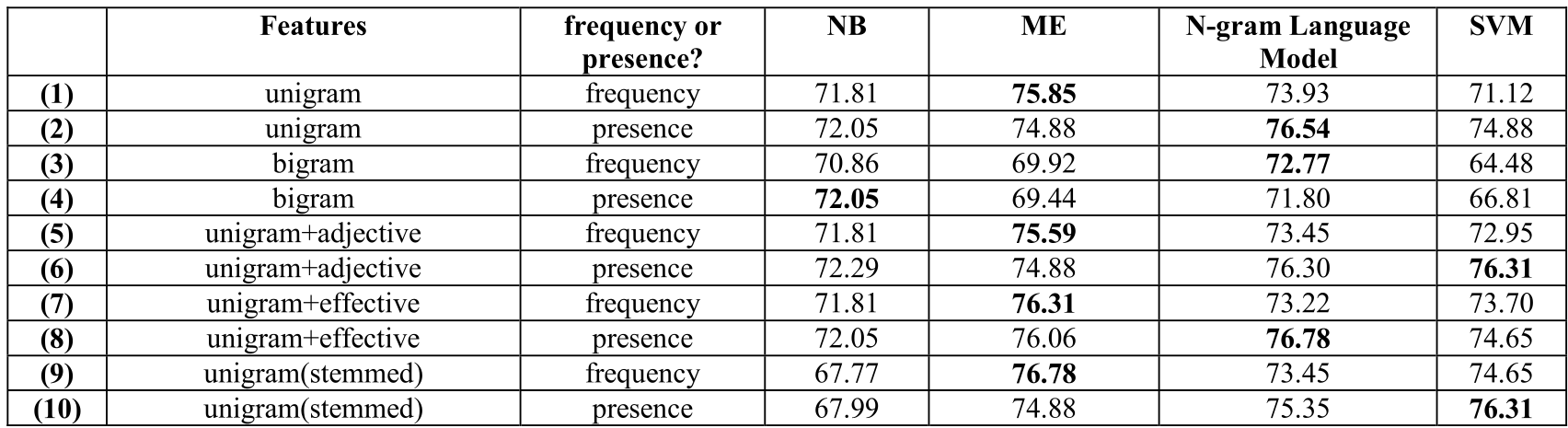
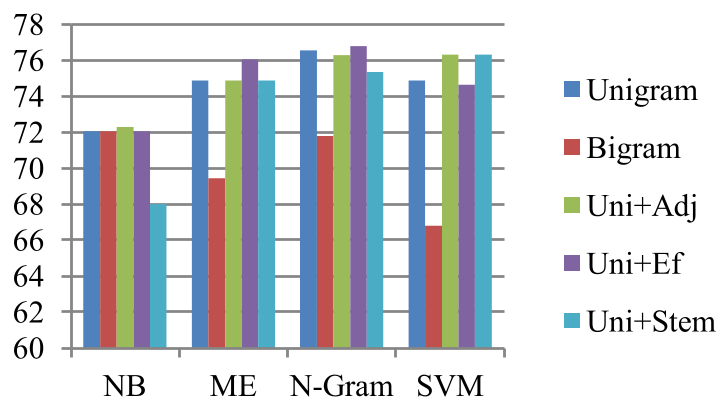
- Unigrams vs. Bigrams: Interestingly, bigrams (2-word sequences) actually reduced performance.
- Stemming: Using the Zemberek framework to find root words.
- Presence vs. Frequency: Does it matter how many times a word appears, or just that it is there? (Spoiler: Just the presence is usually enough).
Experimental Battleground
The study used 400 manually annotated columns from 6 newspapers. A key baseline was established using a "manual lexicon" of 197 positive and 300 negative words, which only achieved 59% accuracy.
Key Findings:
- The Winner: The N-Gram Character Model (N=8) reached 76.54% accuracy. Its ability to look at character sub-sequences allows it to implicitly "understand" Turkish morphology better than word-level models.
- Maximum Entropy was a close second, particularly excelling when frequency data was included.
- The SVM Disappointment: While SVM is the king of movie reviews, it performed significantly worse here, likely due to the length and high variance of columnists' writing styles.
Turkish vs. English: The Morphological Gap
The authors conducted a fascinating cross-linguistic test. Using the same methods on English political news, they found that accuracies were consistently 2% to 11% higher in English.
Why? In English, sentiment is usually fixed in specific words. In Turkish, sentiment is often "hidden" in modal affixes and complex negation structures. This proves that "one size fits all" NLP doesn't work; morphologically rich languages require specialized strategies like character-level analysis or advanced morphological parsing.
Critical Insight & Future Outlook
This paper highlights that for "Professional" domains like news analysis:
- Subjectivity Detection is Crucial: Future models should first filter out objective "fact-based" sentences before attempting sentiment classification.
- Beyond Words: The success of the N-gram character model suggests that we should focus on sub-word units when dealing with complex grammar.
- Entity-Level Sentiment: The next frontier isn't just "is this article positive?" but "is this article positive towards Party A but negative towards Person B?"
Conclusion
While 77% accuracy is lower than what we see in review-mining, it represents a significant step forward for Turkish NLP. It moves us closer to automated media bias monitoring and a deeper understanding of political discourse.