
TSAM: Decoding Public Opinion Through the Lens of Micro-Blogging
Sentiment analysis on tweets for social events
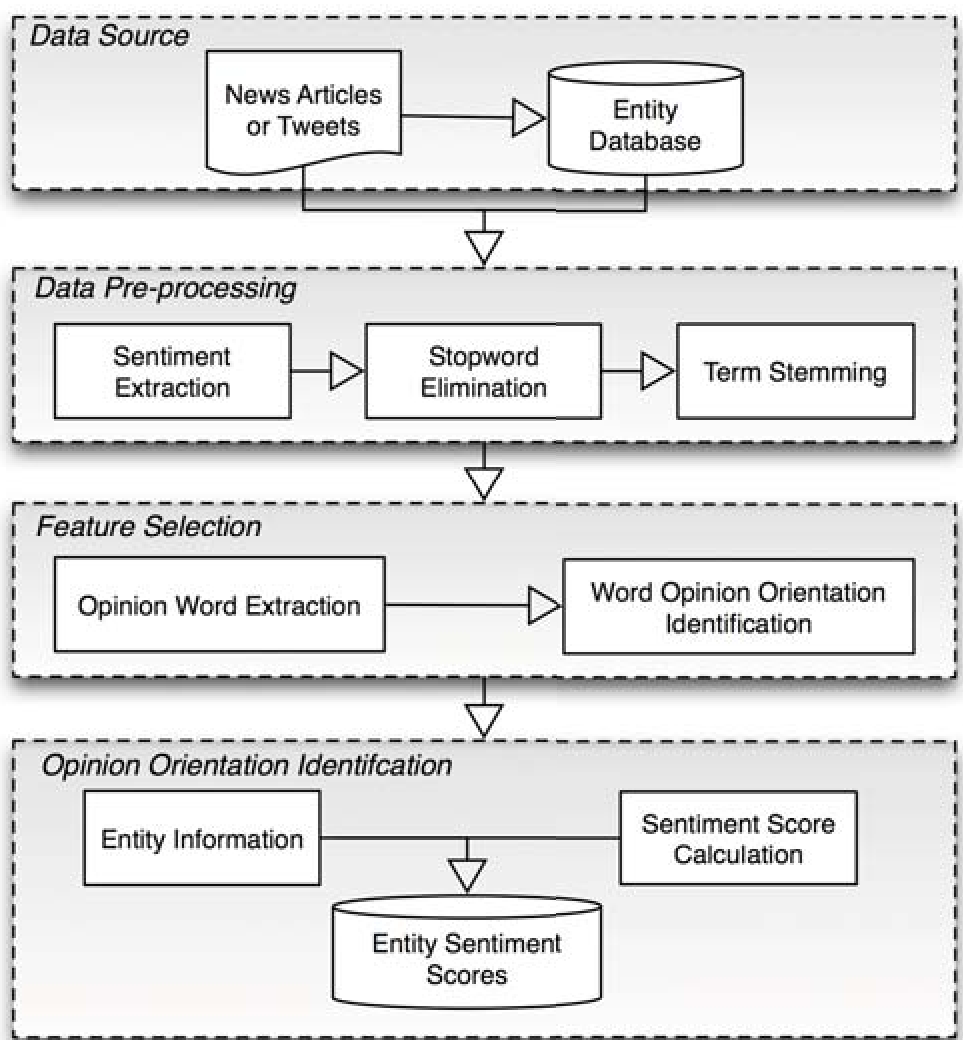
This paper introduces the Tweets Sentiment Analysis Model (TSAM), a lexicon-based framework designed to monitor societal interests and public opinion regarding social events. Using the 2010 Australian federal election as a case study, the model classifies tweet sentiments toward specific political candidates (Julia Gillard and Tony Abbott) by calculating proximity-weighted sentiment scores.
TL;DR
The Tweets Sentiment Analysis Model (TSAM) provides a fast, cost-effective alternative to traditional polling by analyzing real-time sentiment on Twitter. Using proximity-weighted scoring and the Wilson opinion lexicon, it successfully tracked public sentiment during the 2010 Australian Federal Election, proving that the "thought stream" of social networks is a viable source for large-scale social studies.
Background & Motivation: The Problem with Traditional Polls
In the landscape of social science and political forecasting, traditional methods like telephone polling are increasingly seen as "dinosaurs"—slow, high-friction, and costly. While Sentiment Analysis (Opinion Mining) has matured in the context of product reviews (Amazon, Yelp) and movie ratings, these models often fail when applied to the chaotic environment of Twitter.
Tweets present unique challenges:
- Informality: Significant spelling errors and lack of grammatical structure.
- Brevity: 140-character limits (at the time of the study) mean information is dense and often lacks context.
- Diversity: Unlike a specialized review site, a single Twitter feed can jump from religion to politics to personal updates in seconds.
The authors argue that a specialized model is needed to filter this noise and extract meaningful insights about specific "entities" (e.g., politicians).
Methodology: The TSAM Framework
TSAM moves away from simple "bag-of-words" classification and introduces a more nuanced, distance-aware scoring system.
1. Feature Extraction
The model utilizes the Wilson opinion lexicon, which categorizes words not just by polarity (positive/negative) but by reliability (strong vs. weak subjectivity).
- Strong Positive: +1.0
- Weak Positive: +0.5
- Strong Negative: -1.0
2. Proximity-Weighted Scoring (The SSSF)
The core technical insight of the paper is the Sentence Sentiment Scoring Function (SSSF). In a complex tweet mentioning multiple entities, a sentiment word (e.g., "awesome") should carry more weight for the entity it is physically closest to.
The formula (Equation 1) explicitly divides the word's orientation score by its distance from the entity:
3. Aggregation and Intensity
Scores are normalized at both the sentence level and the entity level, resulting in a final score between +1 and -1. These are then mapped to five categories of intensity: Strong Positive (SP), Positive (P), Neutral (Neu), Negative (N), and Strong Negative (SN).
Experiments: The 2010 Australian Election
The researchers tested TSAM on a dataset of 57,000 tweets tagged with #ausvotes during the two weeks following the 2010 Australian election announcement.
Key Findings:
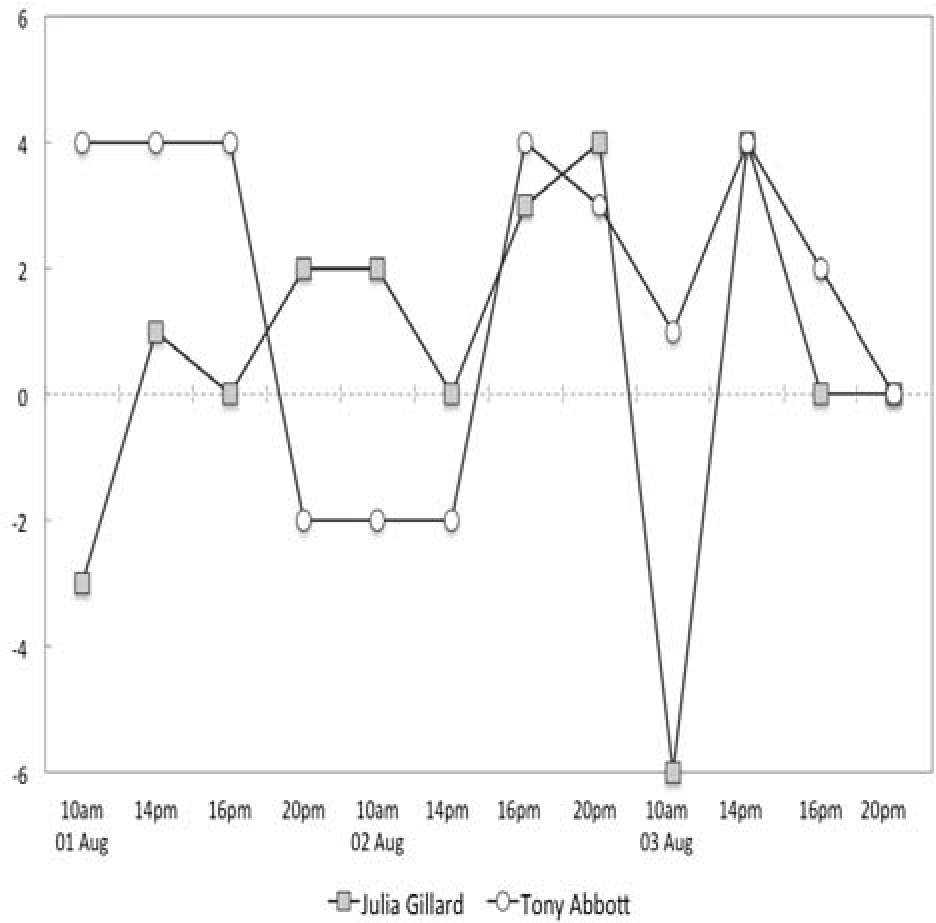
- Comparative Analysis: The system could directly compare the public perception of Julia Gillard vs. Tony Abbott.
- Temporal Tracking: By analyzing tweets over a three-day window, the researchers demonstrated that TSAM could visualize the "ebb and flow" of public opinion in near real-time.
Critical Insight: Why Lexicons Still Matter
While modern researchers might default to Large Language Models (LLMs) for this task today, this paper highlights a critical "Inductive Bias": Distance Matters. The physical proximity of a descriptor to a target is a powerful heuristic that remains relevant even in the age of Attention mechanisms.
Limitations and Future Work
The authors candidly acknowledge several hurdles:
- Named Entity Resolution: The model struggled to realize that "Julia Gillard" and "Julia Goolia" (a nickname/spelling error) referred to the same person.
- Part-of-Speech (POS) Neglect: The current iteration handles all parts of speech equally, which can lead to noise.
- Beyond Binary Sentiment: Moving from simple "Positive/Negative" to "Discrete Emotions" (Happiness, Sadness, Anger) is the next frontier.
Conclusion
The TSAM paper serves as a foundational blueprint for automated societal monitoring. It demonstrates that with a well-constructed lexicon and a simple geometric heuristic (distance), we can turn the "chaos" of social networks into a structured, predictive tool for social science.