
Voices of Autism: Deciphering the Emotional Landscape of China's Nonverbal ASD Community
"Voices of Autism": Sentiment Analysis in Three Chinese Websites on Nonverbal Autistic Children
This study presents a comparative sentiment analysis of online discourse regarding nonverbal autistic children across three distinct Chinese web platforms. Using the DUTIR and NRC emotion lexicons, the researchers analyze linguistic patterns and emotional weights from parents, news media, and experts.
TL;DR
This research investigates how various stakeholders in China—parents, news reporters, and experts—talk about nonverbal autistic children online. By applying sentiment analysis and word frequency mining to three major Chinese websites, the study uncovers a stark contrast between parental emotionality, media reporting, and professional criticism. Despite the challenges, an overarching theme of "hope" and "education" persists across the digital landscape.
Problem & Motivation: The "Silent" Minority in a Loud Digital World
Autism Spectrum Disorder (ASD) has gained significant attention in China, yet a specific subgroup—nonverbal autistic children—remains under-researched in the computational linguistics space. These are children who may never acquire spoken language, placing an immense emotional and financial burden on families.
The authors identified a critical gap: most existing text-mining research focuses on English-speaking communities or general ASD symptoms. In China, where intervention resources are scarce, the "voices" of those caring for nonverbal children are scattered across social media (Douban), news portals (Cautism), and professional networks (Spe-edu). Understanding these voices is crucial for tailoring interventions and government policy.
Methodology: Bridging Linguistics and Data Science
The researchers constructed a pipeline to bridge the gap between raw web data and emotional insights.
- Data Collection & Filtering: Using Python and BeautifulSoup, the team extracted thousands of posts. They used a specific keyword group (e.g., "无语言" - nonverbal, "语言发育迟缓" - language delay) to filter out general ASD chatter and focus on the nonverbal community.
- Linguistic Processing: Stanford CoreNLP was utilized for word segmentation and Part-of-Speech (POS) tagging.
- Sentiment Mapping: The study compared two lexicons:
- DUTIR: A native Chinese lexicon with 27,466 entries.
- NRC: A translated English-to-Chinese lexicon.
 Figure 1: The study focused on three distinct sources representing Parents (Douban), Media (Cautism), and Experts (Spe-edu).
Key Insights: Who Says What?
The word frequency analysis (Word Clouds) revealed fascinating professional and personal biases:
- Parents (Douban): Frequent use of words like "Happy" (开心) and "Like" (喜欢), highlighting a focus on the child's daily emotional state and small victories.
- Reporters (Cautism): A medicalized view. Words like "Disability" (残疾) and "Scarcity" (缺乏) dominate, suggesting an introductory, problem-oriented narrative.
- Experts (Spe-edu): Clinical and prescriptive. Terms like "Stimuli" (刺激), "Award" (奖励), and "Treatment" (手段) are prominent, focusing on Applied Behavior Analysis (ABA) and pedagogical methods.
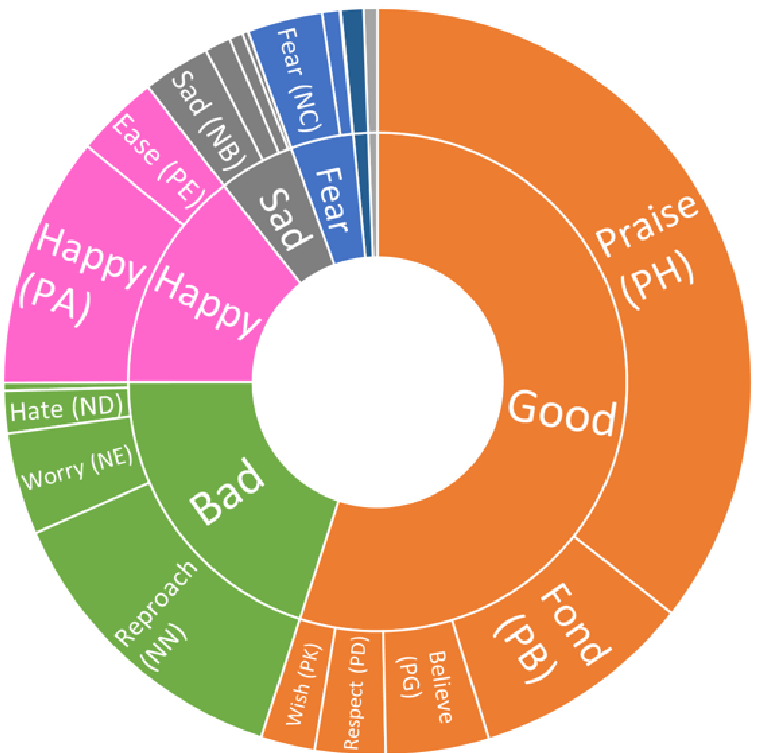 Figure 2: Sentiment distribution showing a high prevalence of "Praise" and "Positive" outlooks, but with underlying "Worry" and "Reproach".
The Lexicon Debate: DUTIR vs. NRC
A significant technical takeaway from this paper is the critique of the NRC Emotion Lexicon in Chinese contexts. The authors found that because NRC is a direct translation of English terms, it struggles with synonyms. For instance, "cute," "lovable," and "lovely" all translate to "可爱" in Chinese, but they carry different emotional intensities and polarities in the original NRC English set, leading to redundant and inaccurate scoring in Chinese. DUTIR proved far more robust for native language nuances.
Critical Analysis & Conclusion
While the study provides a rare window into the Chinese ASD community, it faces limitations in "context-aware" filtering. Some expert journals were captured because they mentioned "nonverbal" in the abstract, even if the core research was on a different topic.
Takeaway: This research proves that sentiment analysis is not just about "positive vs. negative." It’s about understanding the Intentionality behind the words. Parents need emotional support; experts are calling for better systemic interventions (indicated by their "reproachful" tone toward current resources), and the media needs to move beyond viewing ASD solely as a "disability."
Future work could involve training deep learning models (like BERT) specifically on clinical Chinese text to capture the "hidden" emotions that keyword-based lexicons might miss.