
Sentiment Community Detection: Beyond Structural Links to Ideological Clusters
Sentiment community detection in social networks
This paper introduces a novel framework for "Sentiment Community Detection," a task designed to identify closely related groups of users in social networks who share similar opinions. By integrating link structure with user sentiment (positive/negative or 5-star ratings), the authors formulate the problem as a correlation clustering task solved via Semidefinite Programming (SDP) and random rounding.
TL;DR
Social network analysis has long focused on who is connected to whom, but it often misses the what—the actual opinions shared within those connections. This paper proposes a methodology to detect Sentiment Communities: groups of users who are not only socially linked but also hold similar views toward a specific topic. By modeling sentiment as an edge weight and applying Semidefinite Programming (SDP), the authors provide a way to segment polarized markets and visualize the "hidden" emotional structure of the web.
The Problem: The Blind Spot of Link-Based Clustering
Most community detection algorithms (like Louvain or Infomap) treat all edges equally. If two users are friends, they belong to the same cluster. However, in the real world, a "friendship" or "follower" link can exist between two people who disagree vehemtly (e.g., political rivals or product critics).
The paper argues that for applications like Market Segmentation and Public Opinion Analysis, structural connectivity is not enough. We need to distinguish between a community that is a "united front" (homogeneous sentiment) and one that is a "battleground" (heterogeneous sentiment).
Methodology: Sentiment as a Connectivity Constraint
The authors define a graph where represents users, represents social links, and represents sentiments (Polarity or Star Ratings).
1. From Sentiments to Agreement Weights
The core innovation lies in how edge weights are defined:
- Binary Case: If two linked users have the same polarity (e.g., both Positive), . If they differ, .
- Graded Case (5-Star): The weight is calculated based on the distance , essentially penalizing links between users with large rating gaps.
2. Optimization via SDP
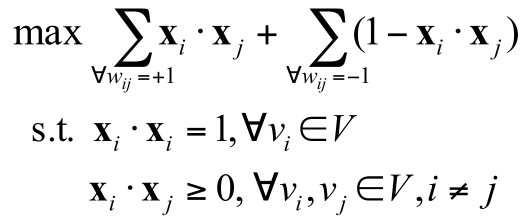
The objective is to maximize the sum of agreements. Because this is an NP-hard correlation clustering problem, the authors relax it into a Semidefinite Programming problem. Each user is mapped to a vector on a unit sphere. The goal is to make vectors of similar-sentiment users point in the same direction.
Experiments: Epinions Case Study
The researchers tested their method on Epinions review data for the iPhone 3GS and BlackBerry 8100.
Key Findings:
- Polarization Mapping: In the iPhone 3GS network, the algorithm clearly separated the "fans" from the "critics." As seen in Figure 1, the positive community (green) was larger and more densely connected, reflecting the product's high popularity at the time.
- Granular Substructures: By increasing the number of clusters, the method could identify nuanced subgroups within the BlackBerry 8100 community (Figure 2), revealing a more fragmented sentiment landscape.
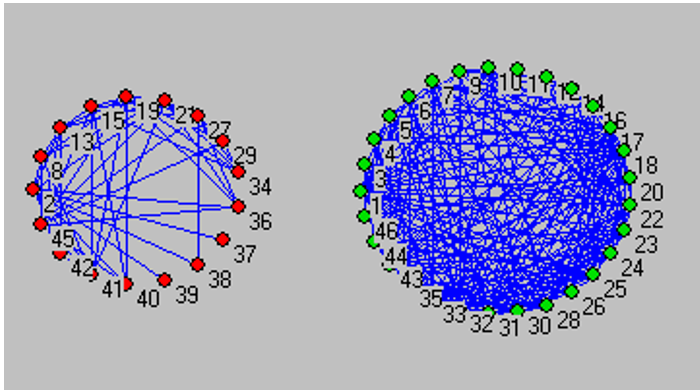 Figure 1: Visualizing the dominant positive vs. minority negative clusters for iPhone 3GS.
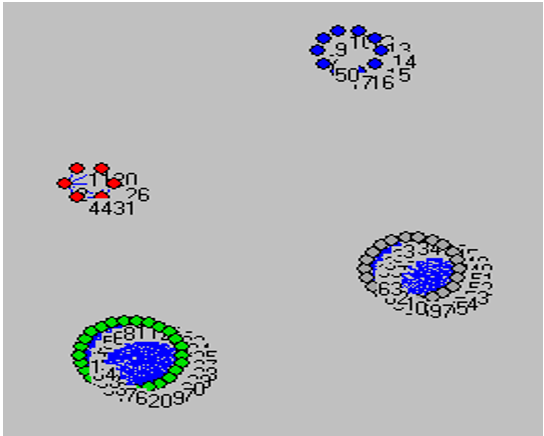 Figure 2: Identifying complex sentiment subgroups in the BlackBerry dataset.
Critical Insight & Limitations
Why it works
The beauty of this approach is its Inductive Bias: it assumes that a community is only "legitimate" if it shares both a structural bond and a common sentiment. This prevents the "over-filtering" that occurs if you only look at sentiment or only look at links.
The Limitations
- Sentiment Sparsity: The method relies on users having explicit ratings. In modern contexts, we would need highly accurate NLP models to infer sentiment from raw text first.
- Computational Complexity: SDP is generally more computationally expensive than heuristic-based clustering (like Louvain), making it challenging for billion-scale graphs like Facebook or X without hierarchical decomposition.
Conclusion
This study serves as a foundational step toward Ideological Social Analysis. By integrating sentiment as a first-class citizen in community detection, it allows businesses to see beyond the "who" and understand the "why" of social clusters. In an era of increasing online polarization, these tools are more relevant than ever for understanding echo chambers and the diffusion of public opinion.