
SentiBot: Are Humans More Opinionated Than Bots? Leveraging Sentiment for Social Media Integrity
Using sentiment to detect bots on Twitter: Are humans more opinionated than bots?
The paper introduces SentiBot, a novel sentiment-aware architecture for identifying Twitter bots by integrating semantic sentiment features with traditional network and syntactic metrics. Using a large-scale dataset from the 2014 Indian election, the authors demonstrate that sentiment-related variables are highly effective in distinguishing human accounts from sophisticated bots that have bypassed Twitter's native filters.
TL;DR
Researchers have developed a sentiment-aware architecture called SentiBot that uses the "emotional fingerprint" of accounts to identify bots on Twitter. By analyzing 7.7 million tweets from the 2014 Indian election, the study found that humans express stronger opinions, change their minds more often (flip-flopping), and disagree more with the crowd than bots. Integrating these sentiment features improved detection accuracy (AUROC) by 15% over traditional methods.
Background: The Limits of Graph Theory
Identifying malicious bots—accounts used to skew public perception or spread spam—has traditionally been a game of "follow the leader." Researchers looked at Syntactic features (how many hashtags?) or Graph-theoretic properties (who follows whom?).
However, these methods fail in two scenarios:
- Limited Visibility: Most applications only see a "local" slice of Twitter based on specific topics (e.g., an election).
- Sophisticated Mimicry: Modern bots use realistic names and profiles, slipping through Twitter's automated net.
The authors of this paper proposed a radical shift: Look at the "Why" and "How" of what is being said, rather than just the network structure.
Methodology: The Sentiment Fingerprint
SentiBot processes data through a multi-stage pipeline involving sentiment extraction, network mapping, and an ensemble of machine learning classifiers.
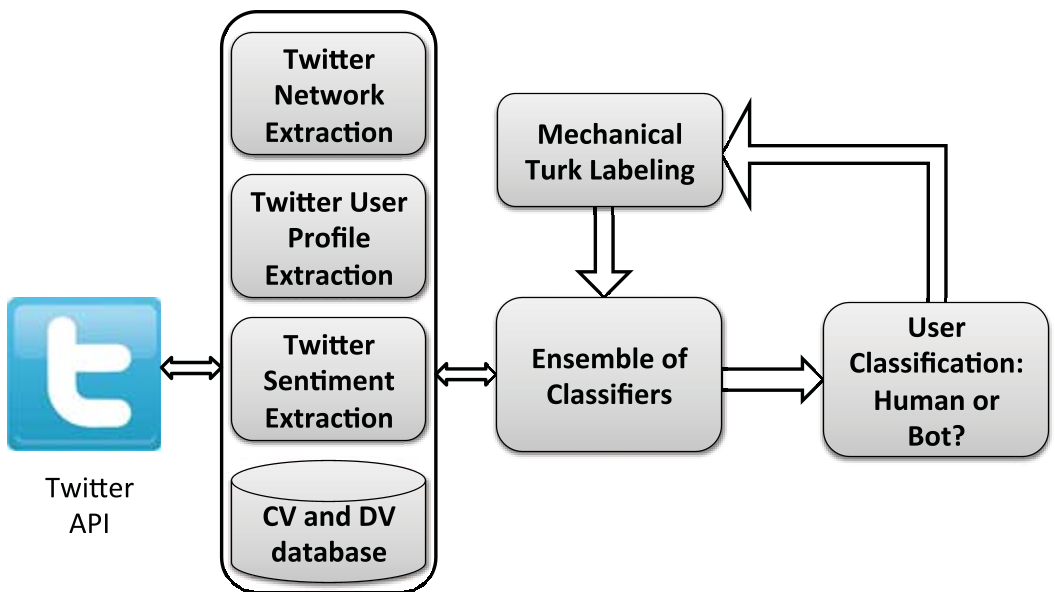
The core innovation lies in the Sentiment-based Contextual Variables:
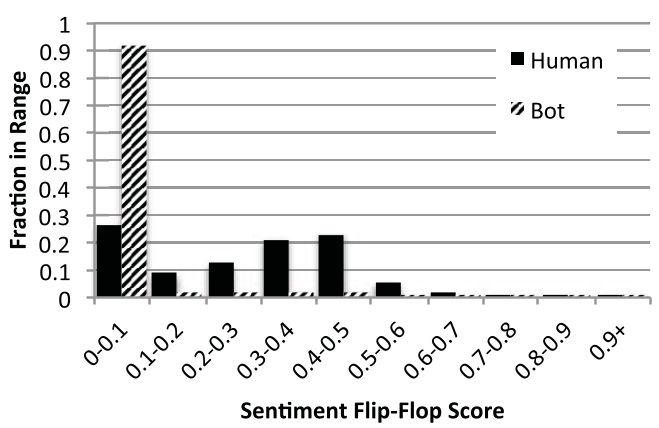
- Sentiment Flip-Flops: How often does a user switch from positive to negative on the same topic?
- Sentiment Strength: Are the opinions moderate or extreme?
- Dissonance Rank: Does the user agree with their friends (Neighborhood Agreement) or the general public?
The authors used a dataset of 550,000 users and 7.7 million tweets. To train the model, they utilized Amazon Mechanical Turk for human labeling, ensuring a "ground truth" that included the subtle bots Twitter's own algorithms missed.
Key Insights: Humans vs. Bots
The experiment yielded a fascinating psychological profile of the average Twitter user versus an automated script:
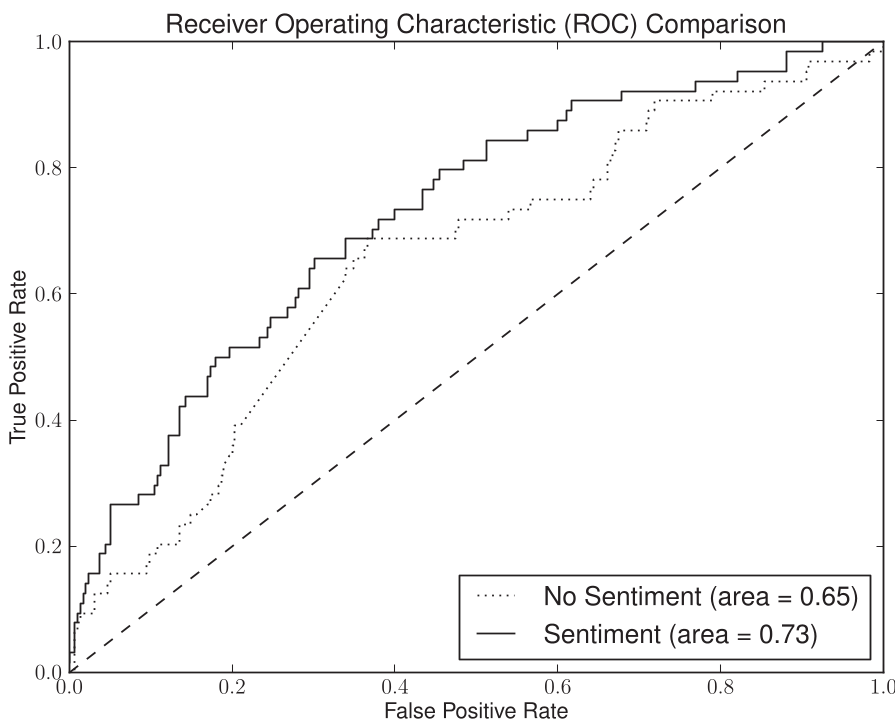
- Humans Flip-Flop; Bots Don't: 92.5% of bots rarely changed their sentiment on a topic. Humans, meanwhile, are dynamic—their opinions evolve or react to news.
- Humans are Extreme: When humans are happy or angry, they use high-intensity language. Bots tend to stay in the moderate, neutral-to-low sentiment range.
- Humans are Contrarians: Humans exhibit a much higher "Dissonance Rank," meaning they frequently disagree with the general population. Bots often stay "on message" or remain neutral.
 In the chart above, the black bars represent sentiment-related features. Note that 19 of the top 25 features rely on sentiment analysis.
Experimental Performance
The researchers compared a "Standard Classifer" (syntax/network only) with the "SentiBot Classifier."
- Baseline AUROC: 0.65
- SentiBot AUROC: 0.73
The sentiment-aware model was particularly effective at "strict" thresholds (low false-positive rates), nearly doubling the true-positive rate compared to non-sentiment methods.
Critical Analysis & Conclusion
This work demonstrates that semantics matter. While bots can easily replicate a network structure or a posting frequency, replicating the messy, high-variance, and passionate nature of human sentiment is significantly harder.
Limitations: The study relies on a commercial sentiment engine which may have its own biases or language limitations. Additionally, as "Cyborg" accounts (human-assisted bots) become more common, the "flip-flop" and "strength" markers may become harder to distinguish.
The Takeaway: If you want to find a human in a sea of bots, don't just look at who they know—look at how much they care, and how often they change their minds. For modern social media platforms, sentiment-aware detection is no longer optional; it is a prerequisite for identifying the next generation of social influence operations.