
Sentiment Detection in Economics: Beyond Lexicons to Machine Learning
Sentiment Detection in Economics Texts
The paper investigates sentiment detection in economic texts using a variety of supervised machine learning and deep learning algorithms. By leveraging the Reuters dataset of subjective economic sentences, the authors evaluate models like SVM, Logistic Regression, and Naive Bayes to classify sentiments into positive, negative, and neutral categories, achieving a peak accuracy of approximately 77.11% with SVM.
TL;DR
This study tackles the complex task of classifying sentiment in economic texts—a field where a single word's meaning can shift based on market context. By testing seven different machine learning architectures against the Reuters economic dataset, the researchers found that Support Vector Machines (SVM) lead the pack with 77.11% accuracy, though the "80% glass ceiling" remains a challenge due to limited and unbalanced data.
Problem & Motivation: The Context-Dependency of Economic Language
In general sentiment analysis (e.g., movie reviews), "down" is usually negative. In economics, "interest rates are down" could be positive for a homebuyer but negative for a bank. This context-dependency makes traditional rule-based methods or generic lexicons insufficient. The authors argue that manual inspection of thousands of reviews is impossible, necessitating an automated, supervised learning approach that can "learn" the specific vocabulary of financial markets.
Methodology - The Core
The researchers focused on a supervised pipeline where the transformation of raw text into mathematical vectors is as important as the classifier itself.
Feature Extraction Pipeline
- N-grams: Exploring unigrams, bigrams, and trigrams to capture the statistical structure of economic phrasing.
- TF-IDF (Term Frequency-Inverse Document Frequency): Scaling words to emphasize those that are meaningful within a specific review but not so common they appear everywhere (like "the" or "and").
- Vectorization: Using
CountVectorizerto build a vocabulary that transforms sentences into sparse matrices for the models.
Model Architecture
The study compared a "committee" of classifiers:
- Logistic Regression & SVM: Classic linear classifiers known for high performance on high-dimensional text data.
- Naive Bayes: A probabilistic approach based on Bayes’ Theorem.
- Ensemble Methods: Random Forest and Gradient Boosting, which combine multiple decision trees to reduce variance and bias.

Experiments & Results
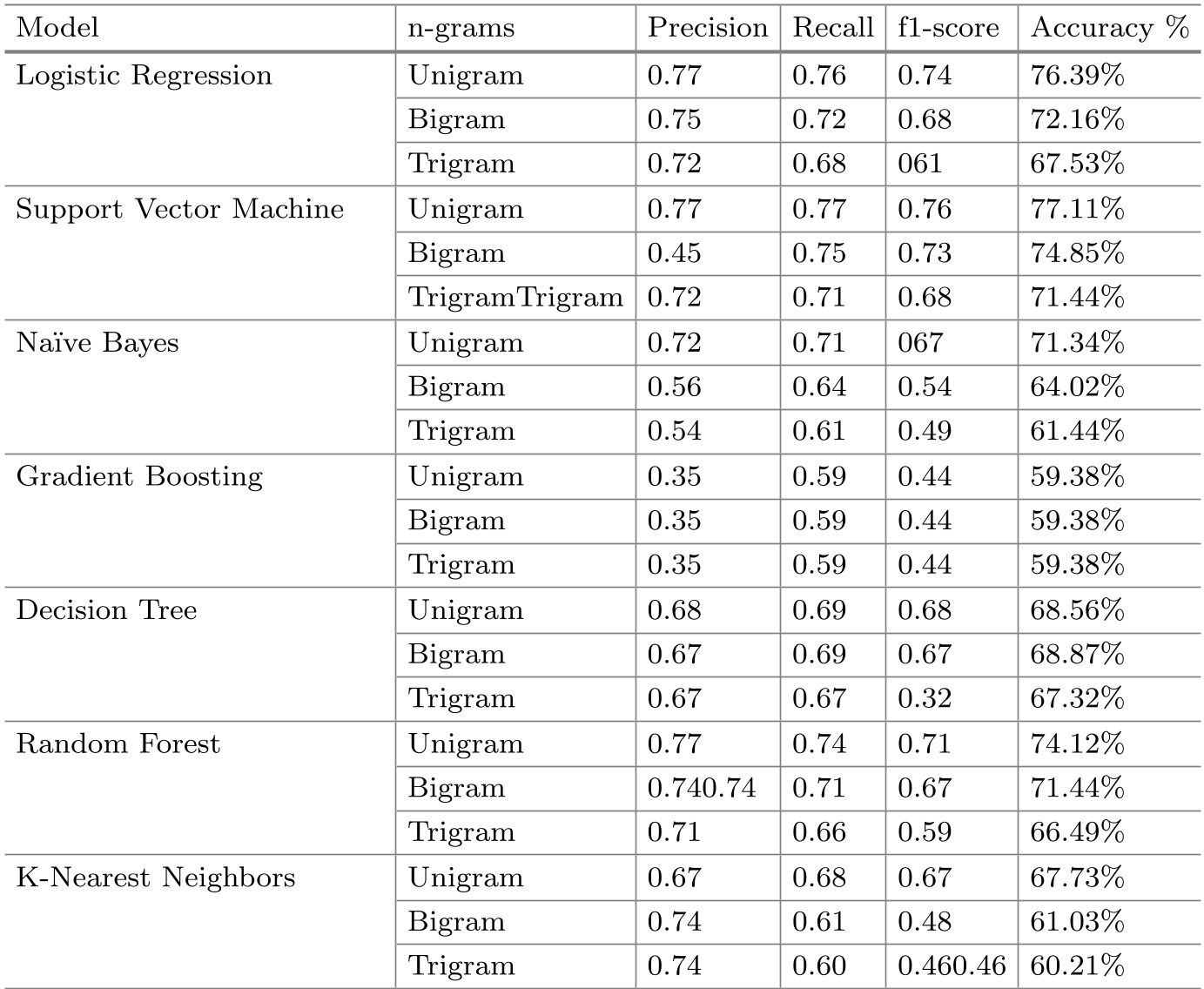
The performance was measured across multiple metrics: Precision, Recall, F1-score, and Accuracy.
The SOTA Comparison
As shown in Table 1, the SVM with Unigrams emerged as the champion. Interestingly, increasing the complexity of N-grams (moving to trigrams) often decreased accuracy across most models, suggesting that in smaller datasets, complex features may lead to overfitting or data sparsity.
Visualizing Sentiment
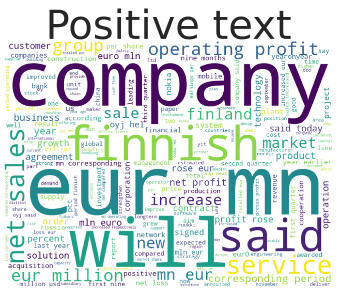
The authors used Word Clouds to visualize the "drivers" of sentiment. Keywords like "profit," "growth," and "rise" dominated positive sentiments, while words like "loss," "deficit," and "fall" were central to negative classifications.
Critical Analysis & Conclusion
Takeaway
While the models performed well, they struggled to exceed the 80% accuracy threshold. The paper identifies data quantity and balance as the primary bottleneck. In economic datasets, "Neutral" or "Positive" news often outweighs "Negative" news, leading to biased models that struggle to identify rare but high-impact negative economic events.
Limitations & Future Work
The reliance on traditional machine learning means these models lack the "deep" semantic understanding found in modern Transformers (like BERT). The authors suggest that future research should integrate better word embeddings and potentially explore unsupervised pre-training to leverage the vast amount of unlabeled economic data available on the web.
Final Insight: In the domain of finance, SVM remains a robust baseline, but the future lies in addressing the scarcity of labeled data rather than just tweaking the algorithms.