
mGT-Sentiment: Leveraging Probabilistic Graphs for Sentiment Detection in Social and Learning Networks
Sentiment detection in social networks and in collaborative learning environments
The paper introduces a probabilistic sentiment detection method using a "Mixed Graph of Terms" (mGT) derived from Latent Dirichlet Allocation (LDA). It aims to classify sentiment in diverse contexts including movie reviews, social media posts, and collaborative learning environments, achieving SOTA accuracy on standard benchmarks.
TL;DR
Researchers have developed a novel sentiment detection framework that uses Latent Dirichlet Allocation (LDA) to construct a Mixed Graph of Terms (mGT). Unlike traditional classifiers that treat words as independent features, this approach maps the probabilistic "neighborhood" of terms to capture sentiment. It achieves a remarkable 88.50% accuracy on movie reviews and proves particularly potent in tracking student emotions in collaborative e-learning environments.
Problem & Motivation: Beyond Keyword Matching
Sentiment analysis in the wild—on Facebook, Twitter, or Moodle—is notoriously difficult. Users use slang, informal structures, and context-dependent meanings.
- The Data Hunger Gap: Traditional Supervised Learning (like SVM) requires massive labeled datasets to generalize well across domains.
- Semantic Blindness: Simple "Bag of Words" models often miss the latent relationships between terms that signal a specific emotional orientation.
- The E-Learning Pain Point: In online education, instructors can't see "bored" or "confused" faces. They need an automated "mood-meter" to detect when students are struggling in real-time.
The authors' insight was to move from linear classification to a structural approach: building a graph that represents the "DNA" of a specific sentiment within a knowledge domain.
Methodology: The Mixed Graph of Terms (mGT)
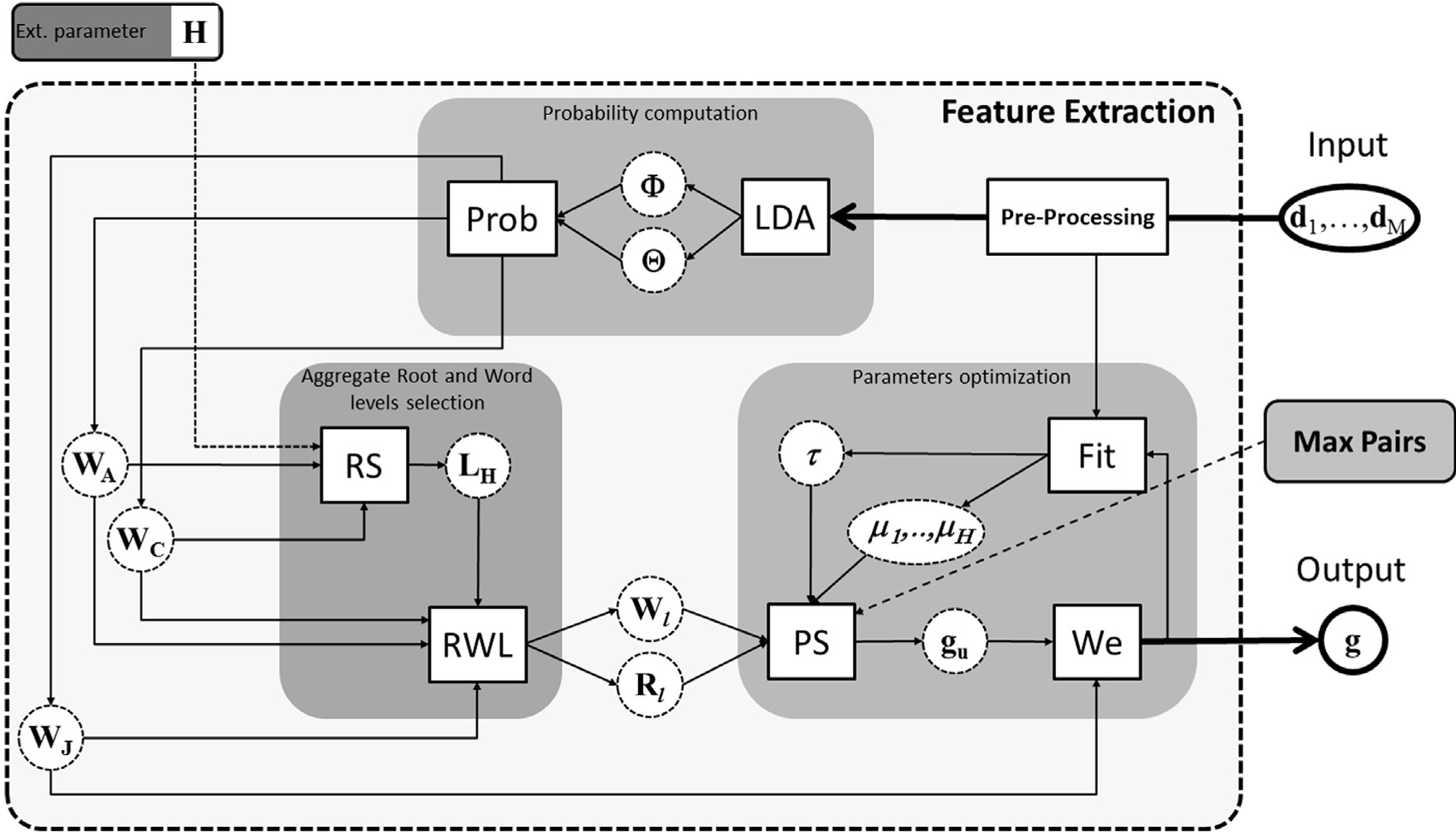
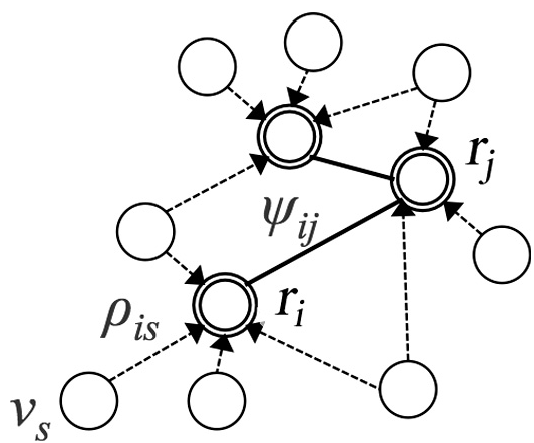
The core of the system is the mGT Building Module. It defines two types of nodes:
- Aggregate Roots (AR): The "centroids" of topics, words whose occurrence is most implied by others.
- Aggregates: Words strongly correlated with these roots from a probabilistic standpoint.
The Architecture
The workflow begins with a standard LDA module that extracts topic-document and word-topic distributions. From these, the system calculates conditional and joint probabilities to select the most discriminative word pairs.
The classification isn't just a binary check; it uses a formula involving four ratios (A, B, C, D) that measure:
- Presence of Root Nodes and Aggregate Nodes.
- Presence of co-occurrence probabilities for both sets.
Experiments & Results: SOTA Performance
The mGT approach was compared against several established baselines.
Benchmark: Movie Reviews
The method achieved the highest accuracy reported in the study (88.50%), surpassing traditional SVM and Bayesian methods. Crucially, the accuracy stabilized after using only 50% of the training data, indicating high data efficiency.
| Methodology | Accuracy (%) |
|---|---|
| SVM (Pang et al.) | 82.90 |
| Naïve Bayes | 81.50 |
| mGT Approach (LDA) | 88.50 |
Real-World Application: E-Learning Mood Tracking
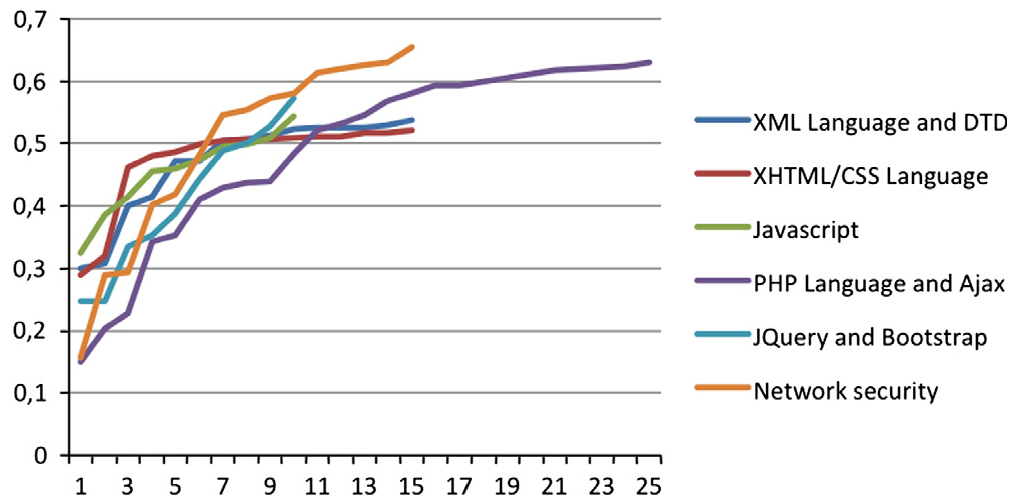
The system was deployed on a Moodle platform for a Web Technology course. By analyzing student forum posts and chats, the "Sentiment Grabber" visualized shifts in class mood. As shown below, once the instructor adjusted the teaching style based on detected negative sentiment (disorientation), the positive sentiment trended upward.
Critical Analysis & Conclusion
Takeaway
The mGT method represents a sophisticated bridge between statistical topic modeling and graph theory. Its primary strength lies in its probabilistic robustness—it doesn't just look for "happy" or "sad" words; it looks for the structural way "happy" or "sad" clusters are formed in a specific domain.
Limitations
- Domain Specificity: An mGT built for movie reviews might not work for political tweets without retraining.
- Lexical Dependency: While language-independent in theory, the use of WordNet for synonyms adds a layer of dependency on external linguistic resources.
Future Outlook
The authors suggest integrating SentiWordNet to further refine the weights. In the era of LLMs, this mGT structure could potentially serve as a "semantic anchor" to help grounded model reasoning or provide interpretable explanations for why a specific sentiment was detected.