
Decoding the Emotional Pulse of a Disaster: Insights from the Gulf Oil Spill
Analysis and Visualization of Sentiment and Emotion on Crisis Tweets
This research presents a framework for analyzing and visualizing sentiment and emotion within crisis-related social media data, specifically focusing on the 2010 Gulf Oil Spill. The authors developed a suite of SVM-based emotion classifiers including a custom disaster-specific taxonomy and a prototype collaborative visualization tool for temporal emotion tracking.
TL;DR
During large-scale crises, social media becomes a chaotic repository of both information and intense emotion. This paper investigates the 2010 Gulf Oil Spill through the lens of machine learning and data visualization. By developing specialized SVM classifiers and a temporal visualization prototype, the researchers demonstrate that we can track public sentiment shifts—such as the "Accusation" and "Disgust" spikes—and correlate them with real-world political events and response efforts.
Problem & Motivation: Why General Sentiment Analysis Fails
In a disaster, a tweet is more than just text; it is a sensor reading of human distress. However, existing "off-the-shelf" sentiment tools are often calibrated on movie reviews or generic product feedback. When applied to the high-stakes environment of a crisis (like Hurricane Sandy or the Gulf Oil Spill), these models suffer from a dramatic loss in accuracy.
The authors identified that crisis data is uniquely characterized by:
- High Emotional Density: A higher frequency of "Negative" and "Anger" labels compared to daily life.
- Domain-Specific Vocabulary: Sarcasm and technical jargon regarding negligence (e.g., directed at BP) require specialized taxonomies.
- Data Imbalance: Support or happiness is rare, making it difficult for models to "learn" these categories without biased training.
Methodology: Building a Crisis-Specific Taxonomy
The researchers expanded Ekman’s six basic emotions (Joy, Anger, Fear, Sadness, Surprise, Disgust) by adding two crucial categories observed in the data: Accusation and Supportive.
They used the ALOE (Affect Labeler of Expression) tool to train binary Support Vector Machine (SVM) classifiers. To handle the brevity of tweets, the authors looked at "author context"—if a user posted another tweet within the hour, that content was used to help label the primary tweet.
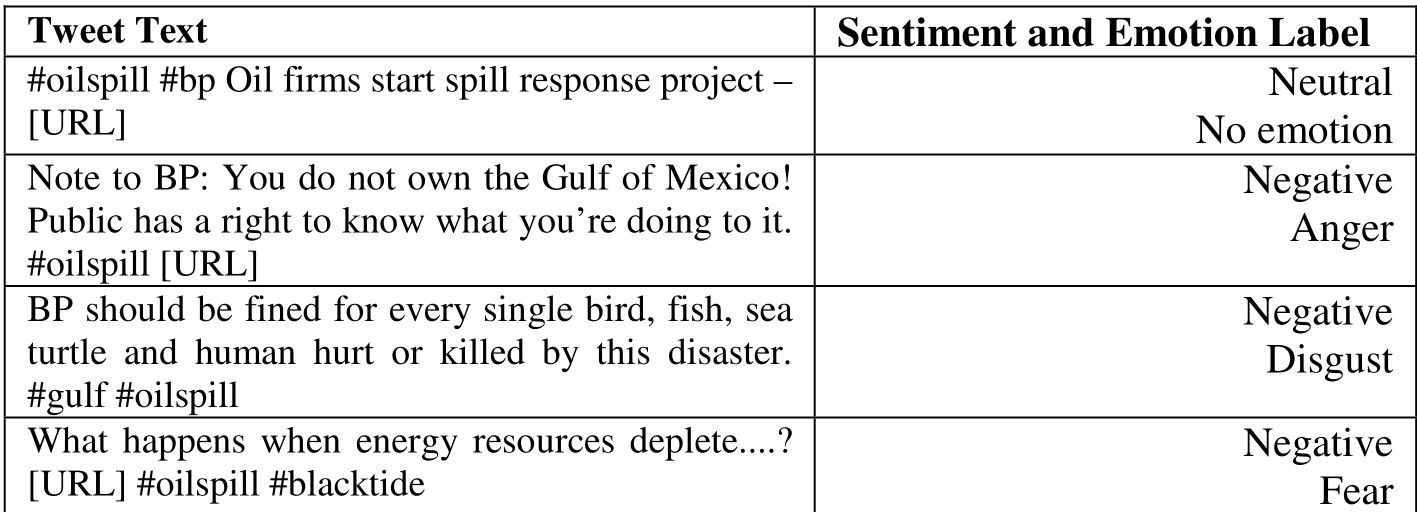 Table 1: Examples of how disaster themes map to specific emotional labels.
Results: Visualizing the Impact of Leadership
While the SVM classifiers faced challenges with precision (often due to high false-positive rates in imbalanced categories), the Accuracy for sentiment was robust, particularly for "Positive" (91%) and "Negative" (76%) tweets.
The true "Aha!" moment came from the Collaborative Visualization. By plotting these emotions on a temporal stacked area chart, the researchers observed that public discourse isn't just a static reaction to a disaster—it reacts to the response. For instance, after President Obama delivered a speech concerning the spill, the frequency of "Accusation" and "Disgust" labels in the dataset plummeted, suggesting a temporary calming effect or a shift in public focus.
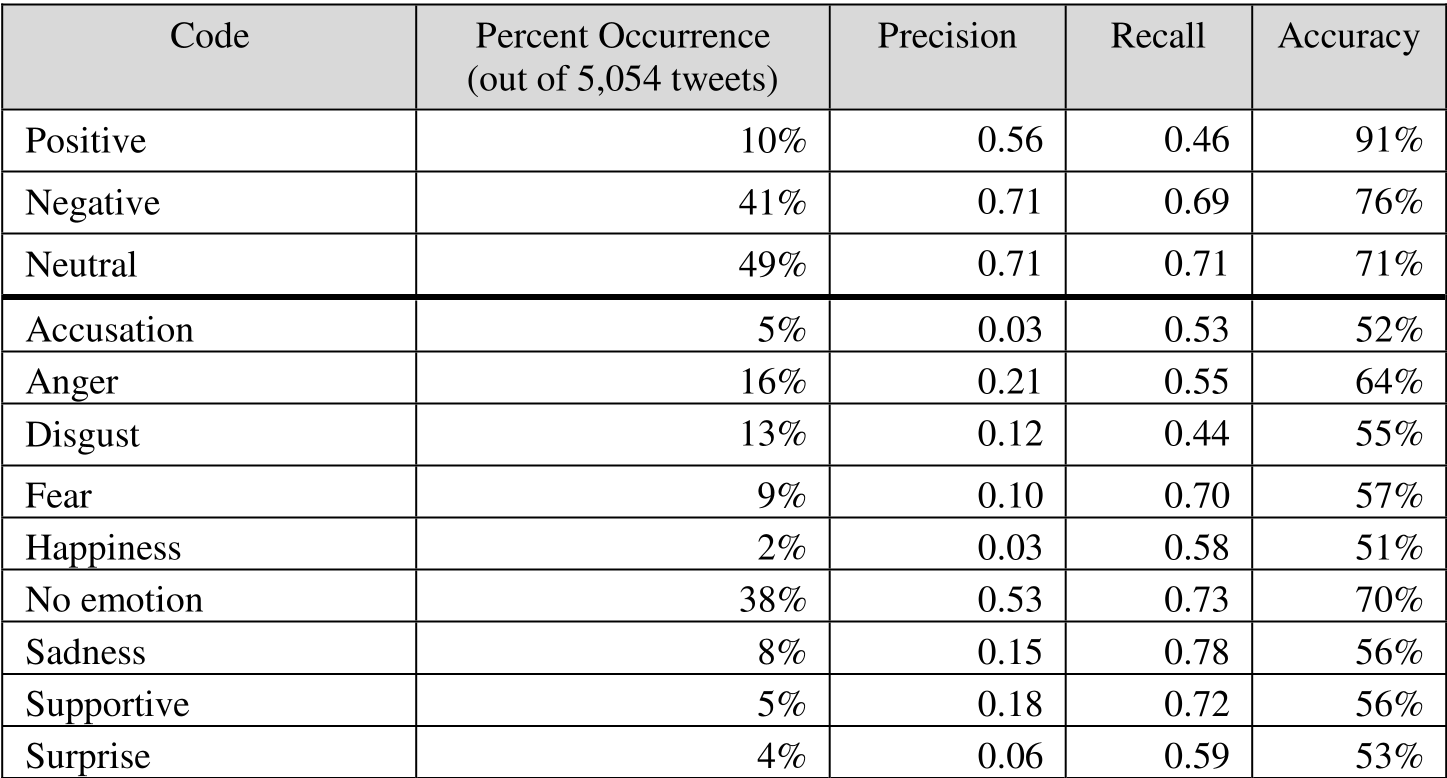 Table 2: Performance metrics showing high accuracy in sentiment classification vs. challenges in rare emotion categories.
Critical Analysis & Conclusion
Takeaway
This work underscores that Context is King. For crisis informatics, we cannot rely on general-purpose AI. We must build models that understand the specific "flavor" of fear and anger that emerges during ecological and human-induced disasters.
Limitations & Future Work
The study acknowledges a major hurdle: Low Precision. The "Accusation" classifier, for example, had a precision of only 0.03, meaning it flagged many tweets incorrectly. This is a classic "needle in a haystack" problem.
Future iterations of this tech would benefit from:
- More Labeled Data: Moving beyond the 0.7% of the database currently coded.
- Modern Architectures: Replacing SVMs with Transformers (like BERT or GPT-based models) which are better at capturing the semantic nuance of "Accusation."
- Real-time Integration: Turning the prototype into a live dashboard for emergency responders to monitor mental health and public unrest in real-time.
By bridging the gap between raw data and human emotion, this research provides a roadmap for more empathetic and effective crisis management systems.