
Decoding the Digital Smirk: Why Emoticons are the Pulse of Social Media Sentiment
Sentiment expression via emoticons on social media
This paper investigates the role of emoticons in social media sentiment analysis using a massive dataset of 1.5 billion tweets. It identifies "strong" vs. "ambiguous" emoticons and evaluates their impact on machine learning classifiers, achieving a baseline accuracy of 78% with emoticons included.
TL;DR
This study by IBM Silicon Valley Lab analyzes 1.5 billion tweets to prove that emoticons are far more than just decorative suffixes. While a few icons like :D and :( are rock-solid sentiment indicators, many others are deeply ambiguous. Removing them from text doesn't just lower accuracy—it can render 50% of sentiment-bearing tweets completely unreadable to AI.
Problem & Motivation: The "Noisy Label" Trap
In the early days of NLP, emoticons were used as a "cheat sheet" for sentiment. If a tweet had a :), it was positive; if it had a :(, it was negative. Researchers used this for "distant supervision" to label millions of data points instantly.
However, the authors point out a critical flaw: human emotion is messy. Is :P playful or mocking? Is :/ neutral or annoyed? By treating emoticons as simple binary flags, we ignore the inductive bias of social media language, where the emoticon often carries the entire emotional weight of a 140-character message.
Methodology: Beyond the Surface
The researchers didn't just count icons; they mapped the "semantic neighborhood" of symbols.
- Human Perception Survey: 31 participants rated the polarity of the 34 most frequent emoticons.
- Semantic Clustering: Using word2vec, they projected emoticons into a 500-dimensional vector space. By applying k-means clustering, they observed which words "hang out" with which icons.
- Ablation via Removal: They manually annotated tweets, then "blinded" the annotators and the models by removing the emoticons to see how much signal was lost.
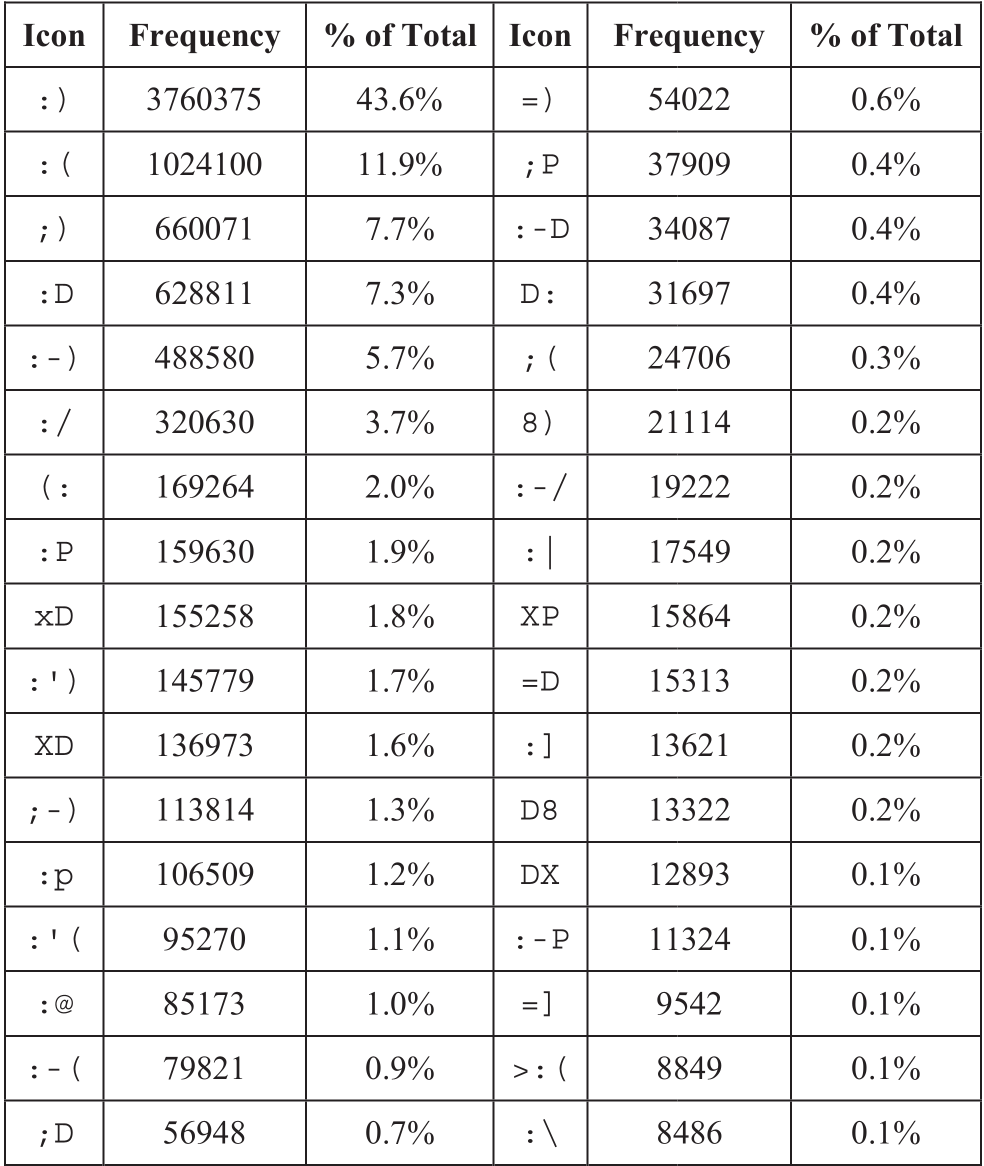 Table 1: The dominance of the standard smile is clear, but the long tail of specific icons suggests a specialized "visual vocabulary."
Core Insights: The "Sole Carrier" Phenomenon
The most striking discovery came from comparing text with and without icons.
- The Vanishing Sentiment: When emoticons were removed, the number of tweets identified as "Positive" dropped from 343 to 162.
- The "Other" Black Hole: Most of these tweets didn't become "Negative"; they became "Other" (Neutral/Unclear).
This suggests that in nearly half of all sentimental microblogs, the text itself is neutral ("I am going home"), and the emoticon is the only thing providing the emotional valence (":)" vs. ":(").
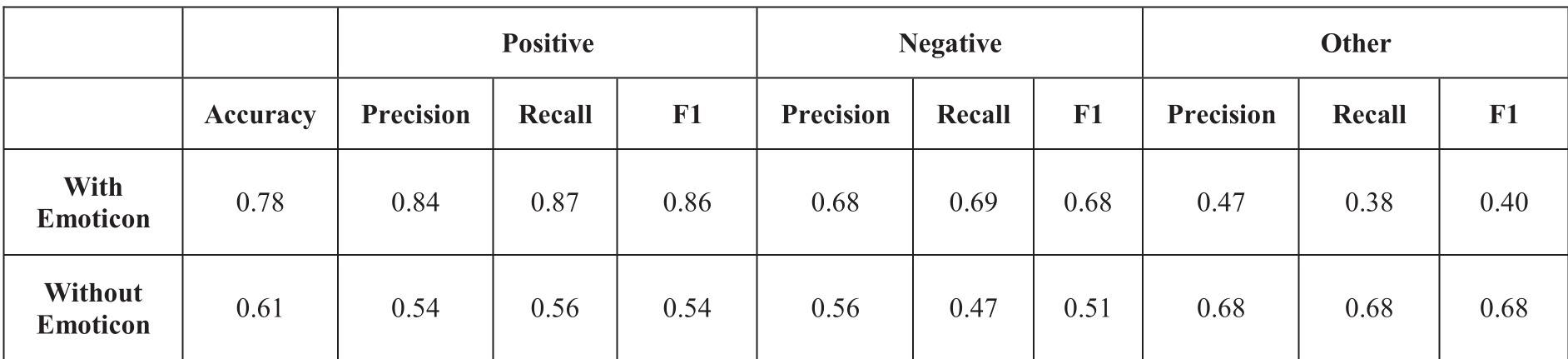 Table 5: The performance gap. Accuracy plummets by 17% when the model is "blinded" to emoticons.
Critical Analysis & Conclusion
Takeaway
If you are building a sentiment engine for social media, removal of emoticons is a catastrophic data loss. However, you cannot treat them as a flat dictionary. You must categorize them into "Reliable Anchors" (High agreement) and "Contextual Signals" (Low agreement).
Limitations
The study was conducted in 2015/2016, focusing on ASCII emoticons (like :)). In the current era, Emojis (Unicode symbols like 😊) have largely superseded these. Emojis carry even more nuanced metadata (skin tones, specific objects), which likely amplifies the "ambiguity" problem discussed here.
Future Outlook
Future Sentiment Analysis should treat emoticons/emojis as a separate "modality" rather than just text tokens—perhaps using a gated mechanism that allows the emoticon vector to modulate the entire sentence representation.