
Emotional Tf-IDF: Bridging the Gap Between Semantics and Sentiment via Emoticons
Sentiment Lexicon Enrichment Using Emotional Vector Representation
The paper introduces "Emotional Tf-IDF," a novel vector representation for sentiment analysis that maps words into an 8-dimensional emotional space based on emoticons. By leveraging SVM classification on Facebook comments, the method achieves a state-of-the-art F-score of 84.21% through a dynamic lexicon enrichment strategy.
Executive Summary
TL;DR: This research tackles the volatility of social media language by replacing traditional word counts with "Emotional Tf-IDF," an 8-dimensional vector space built on emoticons. By dynamically enriching this lexicon as new data arrives, the authors boosted sentiment classification accuracy on Facebook comments to an F-score of 84.21%, outperforming standard Word2Vec and Tf-IDF approaches.
Background Location: This work sits at the intersection of Lexicon-based and Machine Learning-based sentiment analysis. It acts as a bridge, using the "ground truth" of emoticons to supervise the statistical learning of word representations in highly informal contexts.
Problem & Motivation: The Social Media "Moving Target"
Standard NLP features like Bag-of-Words (BoW) suffer from two fatal flaws in social media analysis:
- Semantic Blindness: They treat words like "great" and "good" as unrelated indices rather than points in a sentimental continuum.
- Static Nature: Social media slang evolves daily. A static dictionary becomes obsolete the moment a new trend or emoji emerges.
The authors observed that while words are ambiguous, emoticons (e.g., :D, >:(, <3) are universal anchors of intent. They hypothesized that by measuring the co-occurrence of words with specific "emotional states" represented by these symbols, they could create a robust, self-updating sentiment map.
Methodology: The Core Mechanism
The methodology unfolds in three sophisticated stages:
1. Defining the Emotional Space
Instead of a simple "positive vs. negative" binary, the authors define 8 emotional states: Satisfied, Happy, Gleeful, Romantic, Disgusted, Angry, Sad, and Disappointed. Each state is a cluster of specific emoticons.
2. Emotional Tf-IDF Calculation
The weight of a word for an emotional state is calculated as: This formula rewards words that appear frequently with specific emotions but are not so common across the entire corpus that they lose their discriminative power.
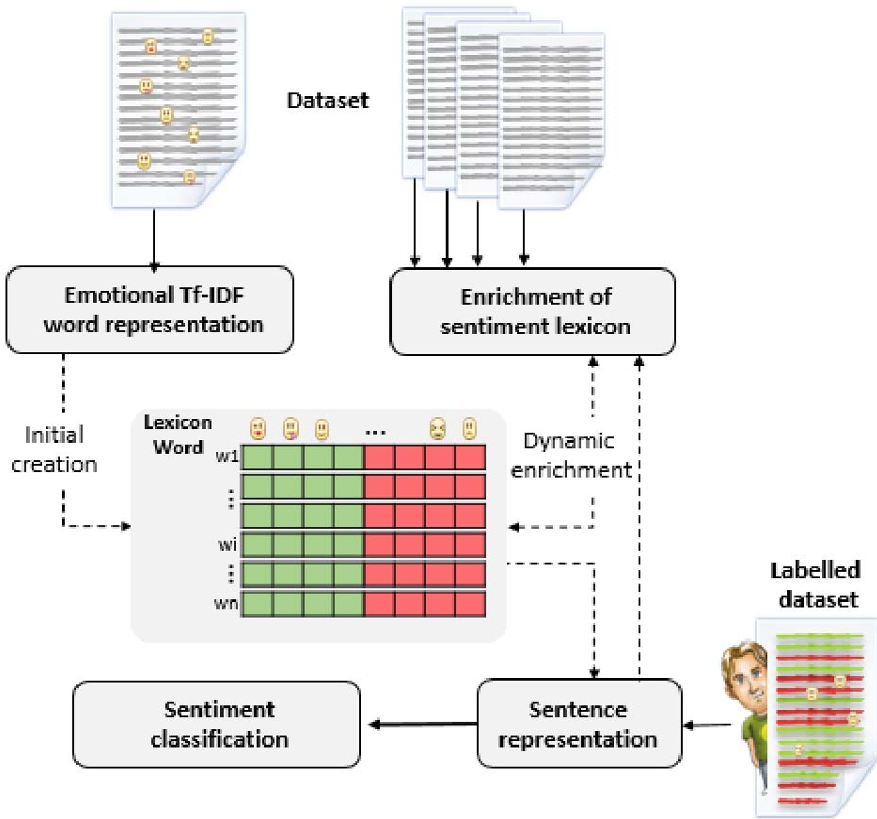 Figure: The categorization of emotion symbols into 8 distinct feature dimensions.
3. Dynamic Lexicon Enrichment
This is the "secret sauce." When a new comment arrives without emoticons, the system doesn't fail. It uses the distance between unknown words and known words to project the new words into the emotional space: New words inherit the emotional properties of their neighbors, allowing the lexicon to grow from 17k to over 100k words dynamically.
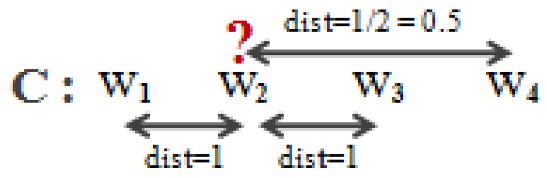 Figure: The mechanism for calculating the relation between unknown words and existing lexicon entries.
Experiments & Results
The authors tested their approach on a corpus of Tunisian political Facebook comments—a challenging dataset due to its multilingual nature (Arabic, French, and Dialect).
Performance Benchmarks
| Feature Representation | F-score |
|---|---|
| Bag of Words (Binary) | 63.07% |
| Word2Vec (Skip-gram) | 71.09% |
| Emotional Tf-IDF (Initial) | 81.08% |
| Emotional Tf-IDF (Enriched) | 84.21% |
Key Findings
- Negation Matters: Handling negation (e.g., "not happy") provided a massive leap in performance (from ~60% to ~81% F-score).
- Enrichment is Crucial: Moving from the initial emoticon-based seed to the enriched lexicon provided an additional 3.13% boost, validating the dynamic update strategy.
- The "Word2Vec" Surprise: Interestingly, the proposed Emotional Tf-IDF outperformed Word2Vec. This suggests that for sentiment-specific tasks, specialized emotional dimensions are more effective than general-purpose semantic embeddings.
Critical Analysis & Conclusion
The Takeaway is clear: Don't ignore the "non-textual" metadata in social media. Emoticons are essentially free labels. By anchoring word vectors to these labels, we can overcome the sparsity and volatility of online language.
Limitations:
- The study relies on translation to French for unification, which might lose subtle dialectal nuances.
- The 8 emotional states are pre-defined; an unsupervised clustering of emojis might reveal even more granular sentiment categories.
Future Outlook: This methodology is a precursor to modern "Prompt-based" or "Zero-shot" sentiment analysis, but it remains highly efficient for production environments where heavy Transformers might be too slow for real-time stream analysis.