
Sentiment Pen: Decoding the "Bio-Signatures" of Emotion in Your Handwriting
Sentiment Pen: Recognizing Emotional Context Based on Handwriting Features
The paper introduces Sentiment Pen, a digital handwriting analysis system that identifies emotional states (Valence and Arousal) through fine motor features. Using a digitizing stylus and tablet, the researchers developed Support Vector Classifiers (SVC) that achieve up to 70% accuracy for user-dependent and 66% for user-independent emotion recognition across four emotional quadrants.
TL;DR
Can your pen tell if you're angry or happy? The Sentiment Pen project proves it can. By analyzing the micro-movements of a digital stylus—such as tilt, pressure, and speed—researchers from Keio University and the University of Tokyo have developed a system that recognizes emotional states with up to 70% accuracy. This research transitions handwriting from a mere communication tool into a non-intrusive physiological sensor.
The Motivation: Why Your Stylus Should Care How You Feel
In face-to-face communication, tone of voice and facial expressions provide the "metadata" for our words. In the digital world, this context is stripped away. Current affective computing solutions often rely on cameras (facial recognition) or wearable sensors (heart rate), which can be invasive or socially awkward.
The authors' insight is grounded in neurology: handwriting is a fine motor task governed by procedural memory. Because it is largely subconscious, it is susceptible to the "noise" created by our Autonomic Nervous System (ANS). When our emotional state shifts, our neurotransmitter balance changes, subtly altering the way our muscles execute strokes.
Methodology: Mining the Micro-Movements
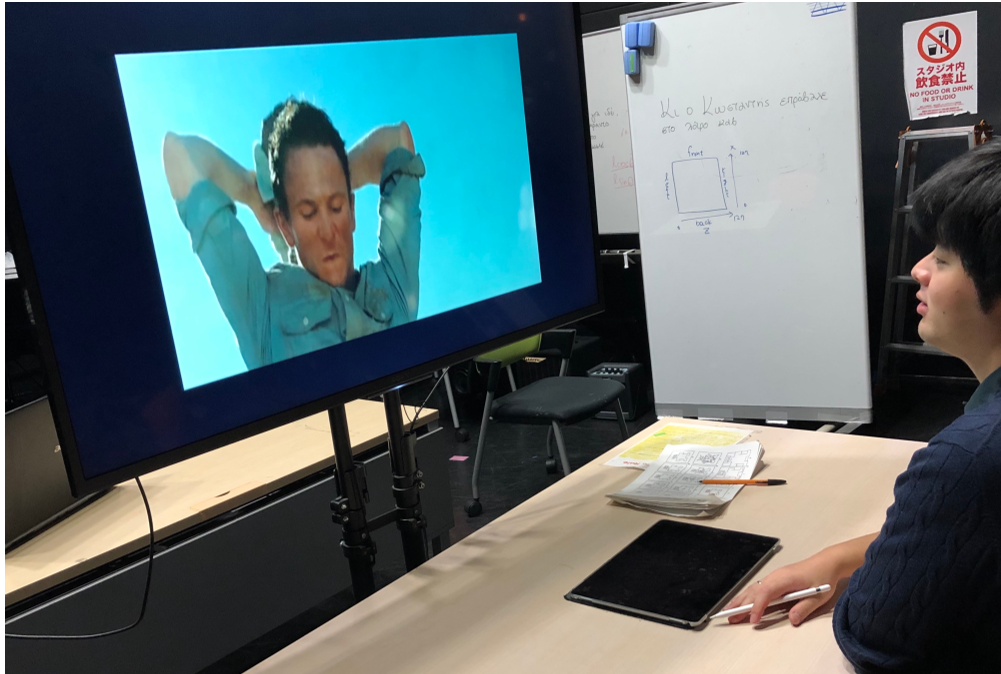
The researchers used an iPad Pro and Apple Pencil to capture high-fidelity data. Beyond simple X-Y coordinates, they focused on 16 critical features, including:
- Altitude and Azimuth: The angle of the pen relative to the screen.
- Force (Pressure): How hard the user is pressing.
- Kinematic Variance: Standard deviation of speed and acceleration within 25ms windows.
The Stroke Length Breakthrough
One of the most interesting technical contributions is the length-based separation. By splitting data into "short" and "long" strokes, the classifier performance jumped. Short strokes (like dots or small connectors) seem to carry different emotional signatures compared to long, sweeping lines found in doodling.
| Feature Name | Description |
|---|---|
| ALT_ANGL | Altitude of the stylus (tilt) |
| FORCE | Average pressure applied |
| SPEED_STD | Variation in stroke speed |
| TIME_FROM_LAST | Inter-stroke latency |
Experimental Results: SOTA in Affective Input
The team tested their Support Vector Classifier (SVC) against the Circumplex Model of Emotion, which maps feelings across two axes: Valence (Pleasantness) and Arousal (Intensity).
- User-Dependent Results: When tuned to an individual, the system reached 70% accuracy.
- User-Independent Results: Even when tested on "unseen" users, the accuracy remained impressive at 66% for specific tasks.
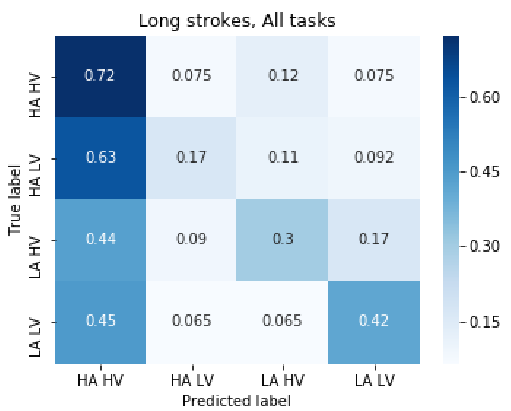 Figure: The charts illustrate how task-specific models (Tasks 1, 2, 3) generally outperform task-independent ones, highlighting the importance of context.
Critical Analysis & Future Outlook
While 70% is a strong proof-of-concept, the researchers acknowledge limitations. The current model requires specific tasks (like writing specific word lists) to reach peak accuracy.
The Takeaway: The Sentiment Pen opens a new door for "Implicit Interaction." Imagine an e-learning platform that detects a student's frustration through their digital notes and offers help, or a messaging app that automatically attaches an "angry" or "joyful" tag to a handwritten note. Moving forward, applying Deep Learning (LSTMs or GRUs) to these temporal trajectories could likely push accuracy toward the 85-90% range required for commercial deployment.
Potential Applications:
- Mental Health: Long-term monitoring of motor-emotional signatures for depression or anxiety.
- Digital Arts: Adjusting brush textures or colors in real-time based on the artist's perceived mood.
- Smart Assistants: Context-aware notifications that delay interruptions if the user "writes" stressed.