
The Friendship Paradox in Motion: Smart Sentinel Selection for Temporal Networks
Sentinel Nodes Identification for Infectious Disease Surveillance on Temporal Social Networks
This paper introduces two novel temporal-network surveillance strategies, 1st-AN (Top-one active neighbor) and 2nd-RN (Second-order recent neighbor), designed to identify "sentinel nodes" for early infectious disease detection. By leveraging the Friendship Paradox, the methods successfully outperform traditional static and temporal baselines in detecting outbreaks ahead of the general population.
TL;DR
Early detection is the "Holy Grail" of public health. This paper proposes two new strategies—1st-AN and 2nd-RN—that use local temporal information to pick the best individuals (sentinel nodes) for monitoring. By identifying people who are more "active" or "recently connected" than average, these strategies detect outbreaks significantly earlier than traditional methods, even without knowing the full social map.
Motivation: Why Global Knowledge is a Burden
Current disease surveillance systems often assume we have a "God's eye view" of every social interaction. In reality, mapping a whole population is time-consuming and often inaccurate. Furthermore, most existing temporal strategies were actually designed for vaccination (stopping the spread), not surveillance (early warning).
The authors' core insight is based on the Friendship Paradox: "Your friends, on average, have more friends than you do." This research extends this to time: your friends are likely more active and are connected via more recent paths than you are, making them the perfect "canaries in the coal mine."
Methodology: High-Activity and Second-Order Paths
The researchers developed two specific algorithms to find these influencers:
- Top-one Active Neighbor (1st-AN): We pick a random person, look at their friends, and monitor the friend who has the highest frequency of interactions.
- Second-Order Recent Neighbor (2nd-RN): We pick a random person, find a friend, and then look for that friend's most recent contact.
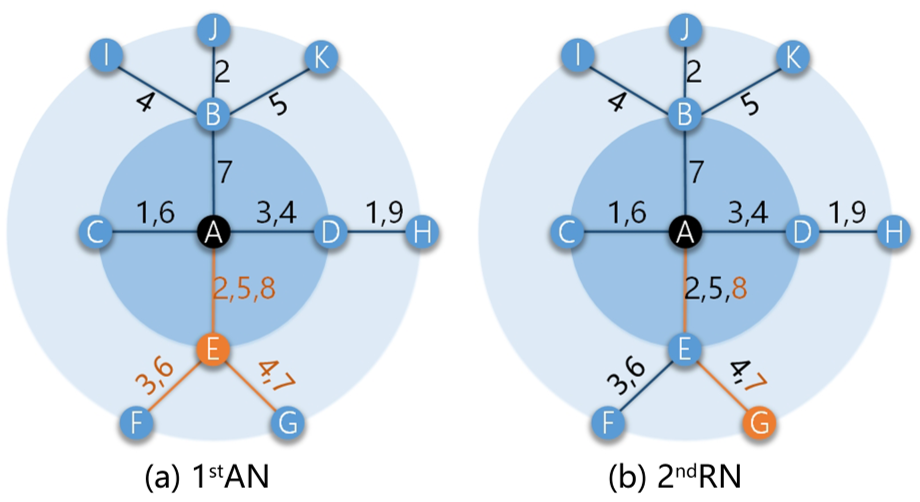 Figure 1: Comparison of 1st-AN (selecting for frequency) vs 2nd-RN (selecting for temporal recency).
Experiments: Beating the Baseline
The strategies were tested on a Synthetic Temporal Network (STN) and two real-world social networks (SN1, SN2). Using the Susceptible-Infected (SI) model, they measured Lead Time—the gap between when the sentinels get infected and when the general population does.
Key Findings:
- Superiority: Our strategies consistently outperformed the "Recent," "Frequent," and static "Acquaintance" methods across various network types.
- The Power of Small Samples: Interestingly, the lead time increases as the size of the sentinel set decreases. This means monitoring a smaller, more elite group of "paradoxical" nodes is more effective and cost-efficient.
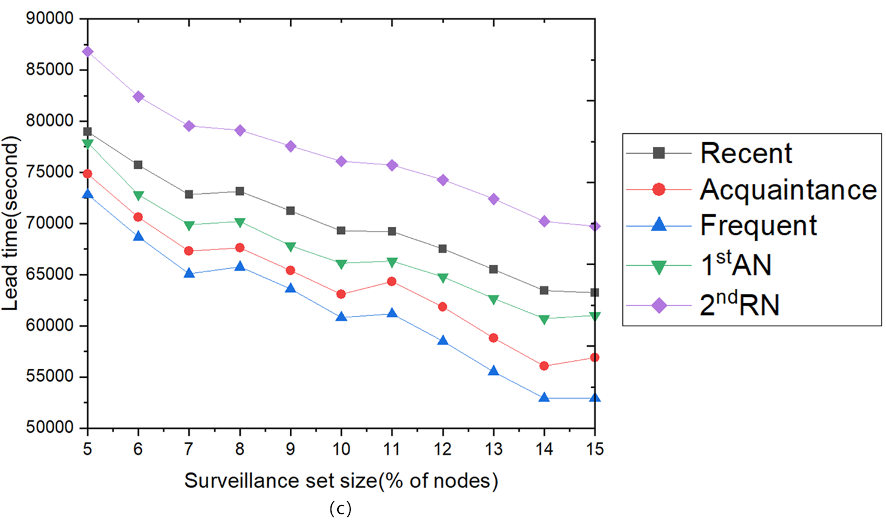 Figure 2: Lead time vs. surveillance set size. Note how 1st-AN (Green) and 2nd-RN (Purple) maintain a significant advantage.
Critical Analysis & Future Outlook
The study proves that local network properties can substitute for global knowledge if you understand the underlying sociological paradoxes.
Limitations: The performance varies by network structure. 1st-AN shines in synthetic, more "stable" environments, while 2nd-RN is the king of "bursty," real-world social dynamics.
Future Work: The next leap in this research will likely involve higher-order interactions (groups rather than pairs) and the exploration of "burstiness" (the tendency of humans to interact in intense clusters of time) to further refine when and who we should monitor to stop the next pandemic before it starts.
Conclusion
By simply asking "who is the most active friend of a random person?" health officials can gain precious days of lead time. This research provides a mathematically grounded, yet practically simple framework for the next generation of digital disease detection.