
Mining the DNA of Style: How Sequential Data Mining Unlocks Linguistic Patterns
What about Sequential Data Mining Techniques to Identify Linguistic Patterns for Stylistics?
The paper proposes a data mining framework for stylistic analysis of French corpora (Poetry, Letters, and Fiction) using emerging sequential patterns (ESP). By applying algorithms like Clospan and dmt4 with gap constraints, the authors identify linguistic constructs that are statistically characteristic of specific literary genres.
TL;DR
Determining what makes "Poetry" feel different from "Fiction" has long been a qualitative task for linguists. This paper introduces a corpus-driven data mining approach that uses Sequential Pattern Mining (SPM) and Emerging Patterns to automatically discover the hidden "grammatical skeletons" of different French literary genres. By allowing "gaps" between words and mixing Parts-of-Speech (POS) with raw text, the authors identify markers that n-grams simply cannot see.
Problem & Motivation: Beyond the N-gram
In the world of corpus linguistics, we usually look at n-grams—contiguous sequences of words like "in the woods." However, style is rarely just about contiguous words; it's about rhythm and structure. Previous attempts to capture this used "collocational frameworks" (e.g., the + ? + of), but these were often manually chosen by researchers, introducing bias.
The authors argue that to truly understand style, we need a method that is:
- Corpus-Driven: The patterns must emerge from the data, not from a linguist's intuition.
- Discontinuous: It must handle "gaps" (e.g., "the [adjective] cat" vs "the [very fluffy] cat").
- Interpretable: Unlike deep learning models that give a classification score but no explanation, data mining outputs specific, readable patterns that a linguist can actually analyze.
Methodology: The Core Architecture
The researchers built a pipeline consisting of three major steps: Pre-processing, Sequential Mining, and Emerging Pattern Selection.
1. The Multi-Level Itemset
Instead of just looking at words, they treat every word as an itemset containing:
- The raw word (Form)
- The dictionary form (Lemma)
- The grammatical category (POS Tag)
This allows the algorithm to find patterns like (the) (NC) (that) (V) (and) (V), where NC stands for any common noun and V for any verb.
2. Emerging Patterns (ESP)
This is the "secret sauce." An emerging pattern is one that appears significantly more frequently in one corpus (e.g., Poetry) than in others (e.g., Fiction).
 Figure 1: The proposed workflow for extracting stylistic markers.
Experiments & Results: What Does Poetry Look Like?
The authors tested their method on three massive French datasets from the 1800s. By setting a gap constraint (allowing 1–3 words to sit between pattern elements), they discovered structures that n-grams would have missed entirely.
Quantitative Impact
Using Emerging Patterns drastically pruned the noise. For the Poetry corpus, while there were tens of thousands of frequent sequences, only about 30% were truly "Emerging," allowing linguists to ignore generic French phrases and focus on stylistic signatures.
Qualitative Findings
Table 4 in the paper highlights specific "signatures" of French poetry:
- The Comparative Sieve:
des * plus * que(some [N] more [ADJ] than). - The Parallel Action:
on * et * on(we [V] and we [V]).
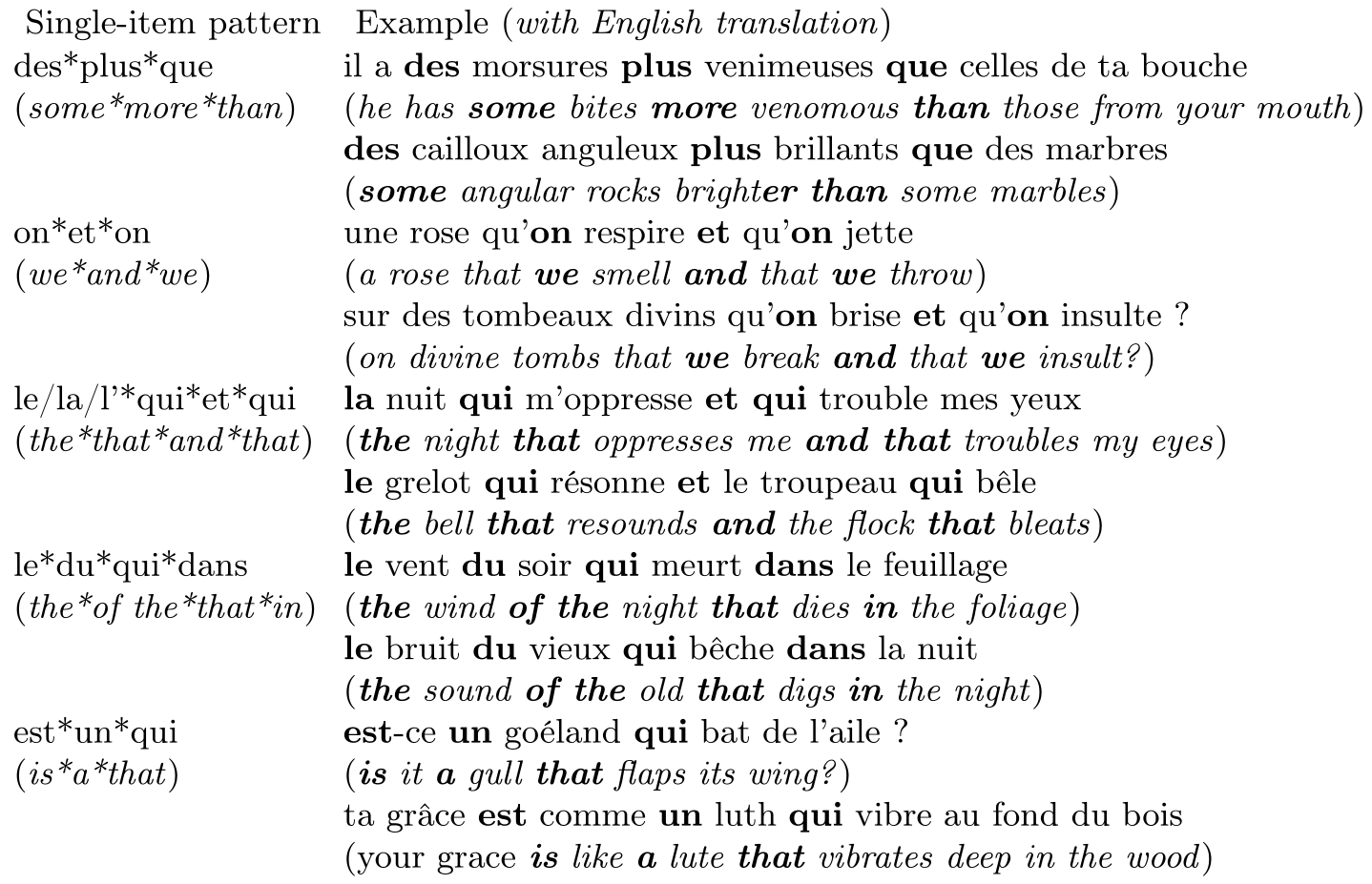 Figure 2: Examples of identified characteristic patterns in Poetry.
The study found that itemset patterns (mixing POS tags and words) provided a much richer "abstraction" of style. For instance, they could identify that poets frequently use two verbs connected by "and" under the governance of a single relative pronoun "qui" (that)—a hallmark of descriptive lyrical flow.
Depth Insight: Why It Works
The beauty of this approach lies in the Growth Rate. By calculating how much more common a pattern is in one genre versus another, the algorithm naturally filters out the "functional" parts of language (like "of the" or "is a") that appear everywhere, leaving behind the "artistic" choices.
Critical Analysis & Conclusion
Takeaway
This paper serves as a bridge between Data Mining and Humanities. It proves that stylistic "fingerprints" are not just about vocabulary, but about the flexible, abstract structures of grammar that we often perceive only subconsciously.
Limitations & Future Work
The primary hurdle remains the Combinatorial Explosion. Even with pruning, the system generates over 24 million itemset patterns. The authors suggest that future versions need:
- Max-support constraints: To filter out overly common linguistic "filler."
- Linguistic Membership constraints: To specifically target patterns containing specific elements (like only those containing Verbs or Adjectives).
By automating the discovery of these "stylistic fossils," the authors have provided a powerful new microscope for the field of digital humanities.