
Game Theory Meets the Crowd: Scaling Multi-Class Labeling via Ulam-Rényi Strategies
Sequential Multi-Class Labeling in Crowdsourcing
This paper introduces a sequential questioning framework for M-ary multi-class labeling in crowdsourcing, utilizing a Partially-Observable Markov Decision Process (POMDP) to design questions based on previous worker responses. The authors propose the Ulam-Rényi Sequential Questioning Strategy (URSQS), which treats unreliable crowd workers as "liars" in a coding game to achieve high classification accuracy under budget constraints.
TL;DR
Crowdsourcing platforms often struggle with "noisy" labels from non-expert workers. This paper moves beyond static, pre-planned questions by introducing a sequential questioning strategy. By treating the interaction between the crowdsourcer and the workers as a q-ary Ulam-Rényi game, the authors provide a framework that adapts questions in real-time based on previous answers, significantly boosting accuracy while staying within strict budget limits.
The Feedback Gap in Crowdsourcing
In a typical crowdsourcing setup (e.g., Amazon Mechanical Turk), a solicitor might ask 10 different people "Is this a Golden Retriever?" and take a majority vote. Advanced methods like DCFECC use Error-Correcting Codes to make this more efficient, but they remain "blind" to the process—they don't change the 5th question based on the answers to the first 4.
The authors argue that this lack of feedback is a massive waste of information. However, building an adaptive system is hard because it requires solving a Partially-Observable Markov Decision Process (POMDP). In a multi-class problem with possible labels, the number of potential questions you could ask is astronomical, making standard AI solvers choke.
Methodology: The Coding Game Intuition
The core "Aha!" moment of this paper is viewing crowdsourcing through the lens of the Ulam-Rényi game.
1. The Liar's Game
Imagine you are trying to guess a number between 1 and 100. You can ask questions, but the person answering is allowed to lie up to times. This is the Ulam-Rényi game. In crowdsourcing, a worker's unreliability isn't malicious "lying," but it is statistically similar.
2. Architecture: Solving the Intractability
To bridge the gap between theory and execution, the authors propose two main tools:
- URSQS (The Heuristic Strategy): Instead of solving the full POMDP, they use a weight-based heuristic. They assign weights to "belief states" (how likely each label is) and use Mixed-Integer Quadratic Programming (MIQP) to pick the question that most effectively balances the uncertainty across possible answers.
- URT Sampling: For those who still want to use standard POMDP solvers (like PBVI or POMCP), the authors provide a "smart sampling" method. Instead of picking questions at random, they sample questions that are at the "nodes" of an optimal Ulam-Rényi search tree.
Experimental Battleground
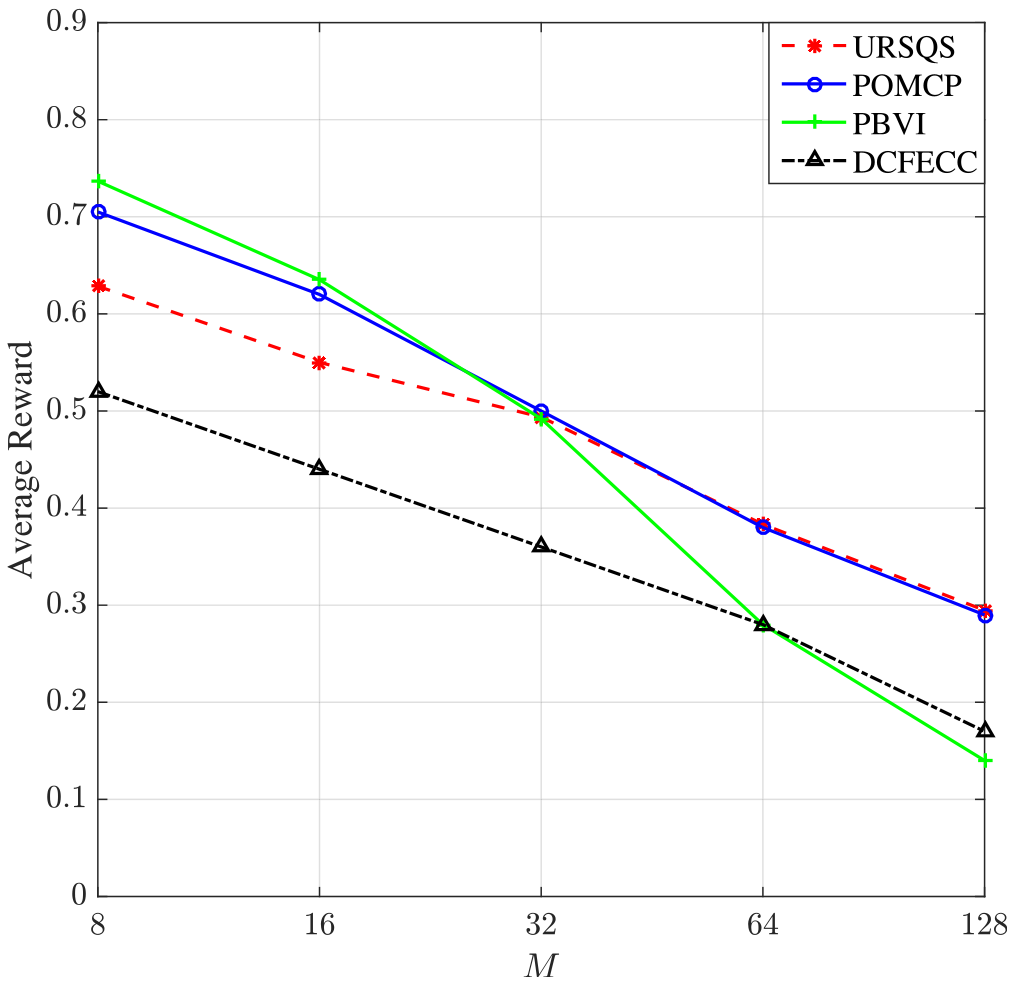
The researchers tested their approach against DCFECC (the non-sequential SOTA) and standard POMDP solvers (PBVI, POMCP) across various scenarios.
Key Findings:
- Superiority in Complexity: As the number of classes grew (from 8 to 128), the URSQS method maintained high rewards while the non-sequential DCFECC plummeted.
- Efficiency: While the POMCP solver effectively "found" good answers, it took hundreds of seconds to process. URSQS achieved similar accuracy in under 20 milliseconds.
- Budget Sensitivity: The model is smart enough to know when to stop. Unlike static methods that use the whole budget regardless of confidence, this system knows when the "information gain" of the next question isn't worth the monetary cost.
Critical Insight & Future Outlook
The beauty of this work lies in its Inductive Bias. By assuming the structure of the problem follows a coding-theoretic game, the authors bypass the "black box" complexity of general POMDPs.
Limitations: Currently, the model assumes worker responses are independent. In reality, workers might have shared biases (e.g., everyone confuses a Wolf with a Malamute). Future Work: The authors suggest integrating "gold questions" (questions with known answers) into this sequential flow to estimate a worker's reliability in real-time, further refining the questioning tree.
Takeaway
If you're building a system to categorize millions of images or text snippets using human-in-the-loop AI, stop asking static questions. Adaptive, game-theoretic questioning isn't just more accurate; it's the only way to scale without breaking the bank.