
Sequential Seeding: Optimizing Influence Diffusion Through Temporal Strategy
Sequential seeding to optimize influence diffusion in a social network
This paper introduces a sequential seeding strategy to minimize the Complete Influence Time in social networks using an Incremental Chance Model. It proposes an online algorithm that embeds a modified greedy search into a Markov Decision Process (MDP) framework to optimize node selection over multiple stages.
TL;DR
This research addresses the challenge of minimizing the time it takes for an idea or product to reach an entire social network. Unlike traditional "one-shot" seeding, this paper proposes a Sequential Seeding framework guided by a Markov Decision Process (MDP). By making decisions in stages and using an online greedy algorithm, it achieves faster total coverage even when resources are distributed over time.
Problem & Motivation: The Limitation of Static Seeding
In the classic Influence Maximization (IM) paradigm, a decision-maker chooses a set of initial adopters (seeds) at to trigger a cascade. However, this "all-in" approach ignores two real-world realities:
- Budget Constraints: Capital is often available in installments rather than a lump sum.
- Uncertainty: Influence diffusion is stochastic. A node that looked promising at might become redundant if its neighbors are already influenced by .
The author argues that a sequential strategy—where we observe who has been influenced before choosing the next set of seeds—is inherently more robust and efficient.
Methodology: MDP and the Online Greedy Framework
The core of the paper lies in modeling the diffusion as a progressive process where once a node is influenced, it stays influenced (the Incremental Chance Model).
The MDP Formulation
The problem is mapped to an MDP tuple :
- State (): A binary vector representing the current influenced/uninfluenced status of every node.
- Action (): Selecting uninfluenced nodes to seed at every time steps.
- Reward (): Designed to penalize time, such that maximizing reward is equivalent to minimizing the complete influence time.
Breaking the Curse of Dimensionality
Since a network of nodes has states, traditional Value Iteration is impossible. The author proposes an Online Algorithm that focuses only on the current reachable states.
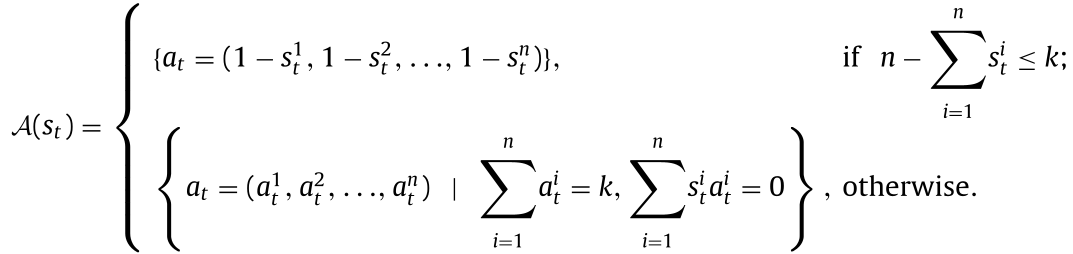
The algorithm uses a Heuristic Function () to pre-screen nodes. Instead of simulating every possible node (which is ), it only simulates the top candidates identified by heuristics like:
- SPL (Shortest Path Length): Seeding nodes furthest from the current influenced set.
- MPLR (Maximin Path Length Reduction): Seeding nodes that most significantly reduce the maximum distance in the network.
Experiments & Results
The author tested the algorithm on random networks with 1,000 nodes. Key findings include:
- The Trade-off: Increasing the search range improves the influence time but exponentially increases computation. A value of was found to be a "sweet spot" for performance vs. efficiency.
- Frequency Matters: Seeding 4 nodes every 5 steps () is generally more effective than seeding 8 nodes every 10 steps (), even though the total node-per-step ratio is identical. This proves the value of frequent observation.
- Superiority Over Baselines: The MDP-based online algorithm consistently beat "High-Degree" (seeding popular nodes) and "High-Weight" heuristics.
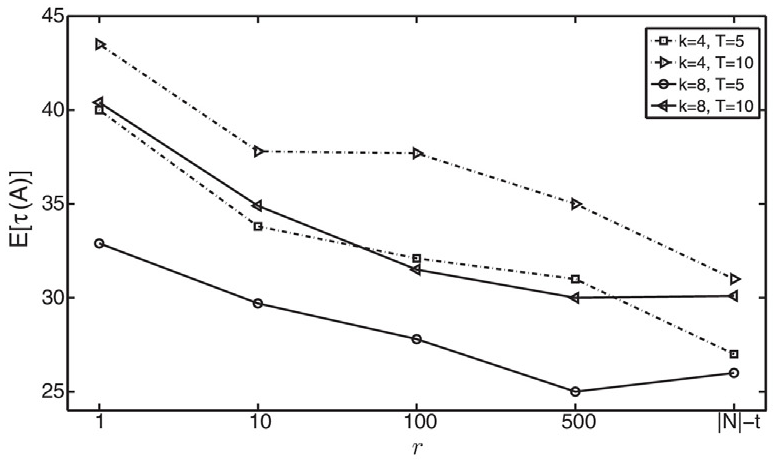 Fig: Influence time comparison across different seeding frequencies and budgets.
Critical Analysis & Conclusion
Takeaway
The shift from static to sequential seeding marks a transition from pre-planned optimization to adaptive control. This paper provides a rigorous mathematical bridge between social network analysis and control theory.
Limitations
- Full Observability: The model assumes we know the exact state of every node in the network at each decision step, which is rarely true for massive platforms like X (Twitter) or Facebook.
- Computational Cost: Even with the -greedy optimization, the simulation-based estimation of remains heavy for very large graphs ( nodes).
Future Outlook
Future work likely involves moving toward Deep Q-Learning (DQN) or Graph Neural Networks (GNNs) to learn the cumulative reward function, potentially eliminating the need for time-consuming simulations entirely.