
Serendipity by Design: Does Cross-Domain Mapping Work for LLMs?
Serendipity by Design: Evaluating the Impact of Cross-domain Mappings on Human and LLM Creativity
This paper investigates "Serendipity by Design," a study evaluating how "cross-domain mapping"—forcing analogies from remote source domains—impacts creativity in humans and Large Language Models (LLMs). Using models like GPT-4o and Claude 3.5 Sonnet, the researchers found that while humans significantly benefit from this intervention to overcome cognitive fixation, LLMs inherently generate more original ideas than humans on average and do not show a statistically significant boost from the same mapping prompts.
TL;DR
Is creativity a "game of chance" or a structured process? This study from Princeton and the Santa Fe Institute explores whether cross-domain mapping—the act of forcing an analogy between unrelated fields (like a "velcro" inspired by burrs)—can boost creativity. The verdict: it works wonders for humans stuck in a rut, but high-performing LLMs are already so "weird" and expansive that the intervention barely moves the needle for them.
Background: The Architecture of an Idea
Creativity researchers have long argued that the best ideas come from remote associations. Humans, however, suffer from steeper associative hierarchies—we tend to grab the most obvious, conventional link first. To break this habit, we use "interventions" to force our brains to look further afield.
The authors ask a provocative question: If LLMs are trained on the entire internet and can link a "refrigerator" to a "symphony orchestra" in milliseconds, do they even need these creative exercises? Or is their cognitive architecture fundamentally different?
Methodology: Engineering Serendipity
The researchers tested 140 humans and 7 top-tier LLMs (including GPT-4o, Claude 3.5, and o3) on 10 everyday products. Participants were split into two groups:
- User-Need (Control): "Improve this backpack based on what users need."
- Cross-Domain Mapping (Intervention): "Improve this backpack by mapping a property from an octopus onto it."
To ensure a fair fight, all ideas were rephrased by a neutral LLM to remove "fancy" language, then rated by 1,000 human judges on Originality, Feasibility, Usefulness, and Investment Worthiness.
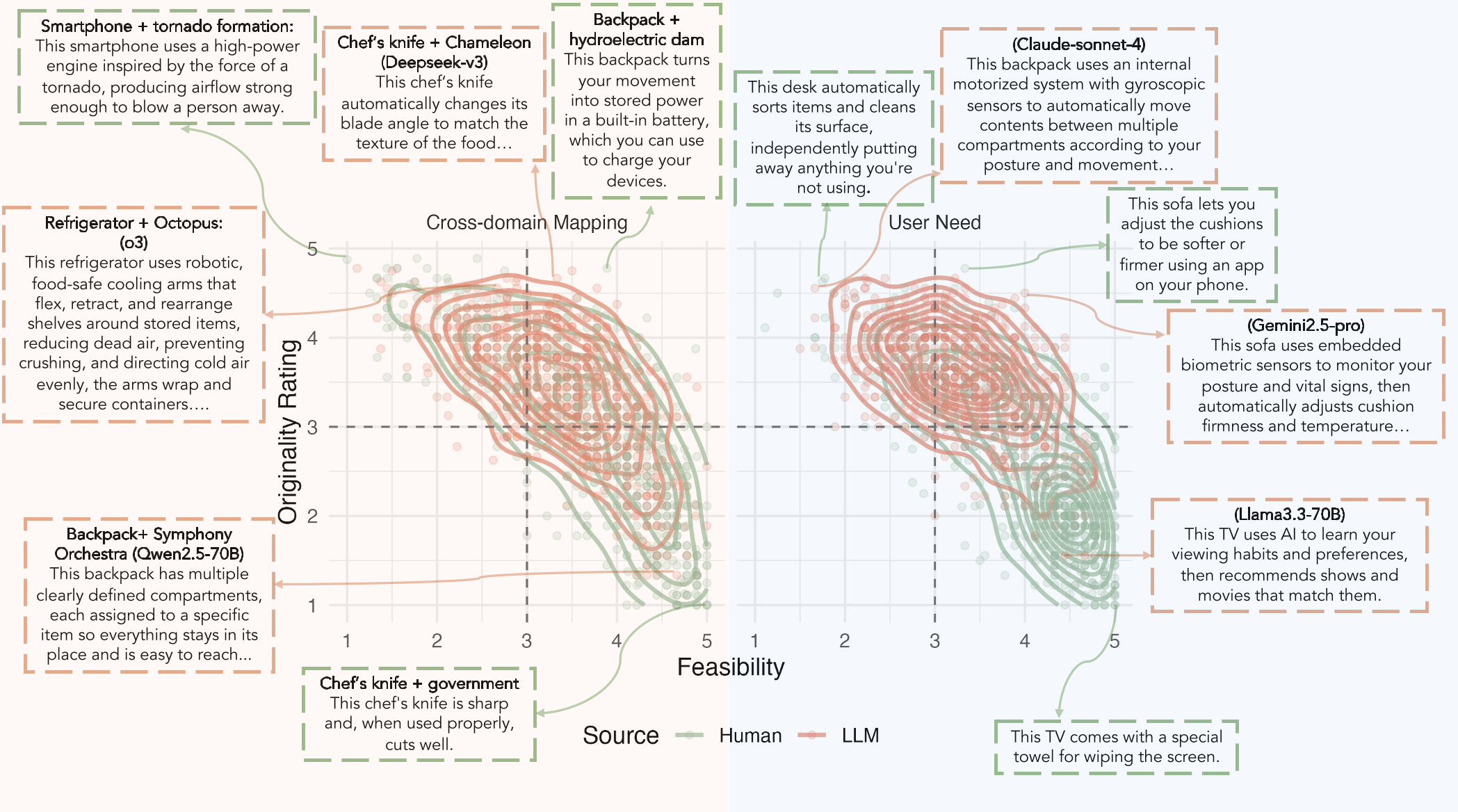 Figure 1: The "Creativity Frontier." Note how cross-domain mapping (left) shifts the human distribution (green) towards higher originality compared to the user-need prompt (right).
Key Insights: The Human-AI Asymmetry
1. The "Default" Creativity Gap
LLMs (specifically o3 and Claude-Sonnet-4) produced ideas that were significantly more original than humans by default. While humans struggle to escape "functional fixation," LLMs seem to live in a world of flat associations where everything is potentially related to everything else.
2. The Power of Distance
Not all analogies are created equal. The researchers used Wikipedia-based embeddings to calculate the semantic distance between the product and the inspiration.
- Low Distance: Sneaker + Sofa = "A very soft sneaker" (Boring).
- High Distance: Car + Octopus = "A car with tentacle-appendages for climbing walls" (Original).
Interestingly, for both humans and LLMs, the more "remote" the source, the more original the resulting idea.
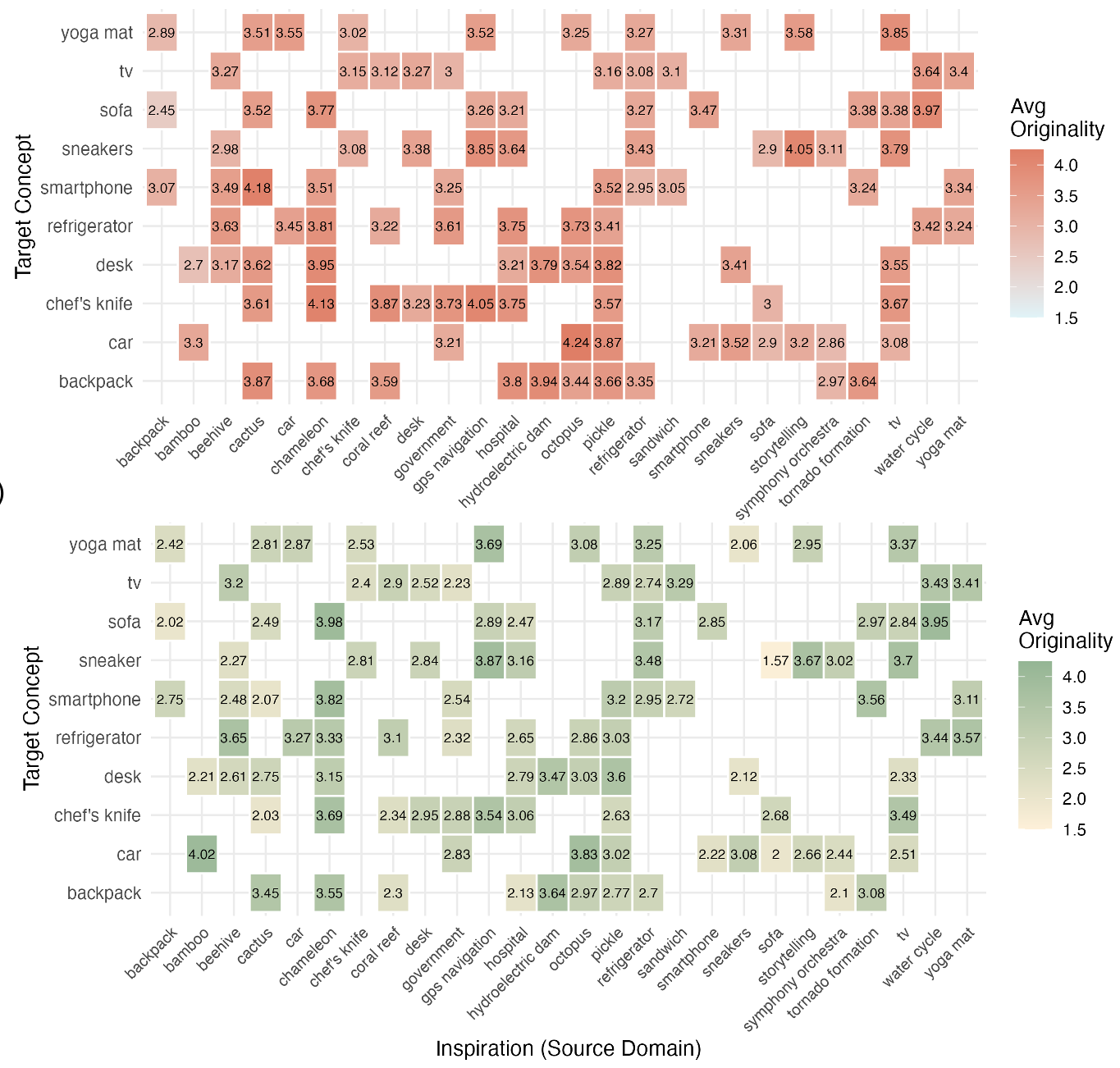 Figure 2: The correlation between semantic distance and originality. As the source domain moves further away, the "spark" of originality grows stronger in both systems.
3. Qualitative Differences: Form vs. Function
There’s a fascinating nuance in how they create. Humans tend to map perceptual features (a "pickle-green car with bumps"). LLMs tend to map mechanisms (a "pickle-inspired car with self-healing brine capsules"). LLMs are "functional analogizers," whereas humans are "visual analogizers."
The "Originality vs. Feasibility" Trade-off
The study confirmed a harsh reality: high originality usually comes at the cost of feasibility (r = -0.74). The most original human idea—a phone that generates a cyclone to blow people away—is fantastic but impossible. However, the authors argue that "unfeasible" ideas often look that way simply because the technology to realize them hasn't been "thinkable" yet.
Conclusion and Value
For AI practitioners, this paper is a reminder that "prompt engineering" for creativity might be different than for humans. We don't necessarily need to tell an LLM to "think outside the box"—its training data is the box, and it's already massive.
Takeaway: If you want truly wild ideas from an AI, don't just ask for "novelty." Instead, provide the most semantically distant reference point possible. The "serendipity" that fuels human genius can be intentionally manufactured for AI by reaching into the farthest corners of its latent space.
Limitations
- One-Shot: Creativity is usually iterative, not a single prompt.
- Subjectivity: "Originality" was rated by humans, who might be biased toward the mechanistic style of LLMs.
This research highlights that while we can "fix" human fixation with clever prompts, the real frontier for AI creativity lies in exploring the vast, distant mappings we haven't even thought to ask for yet.