
SG4Edu: Bridging the Employability Gap with Serious Games and Competence-Based Learning
14371_Serious Games for the Development of Employment Oriented Competences.
The paper introduces SG4Edu, a multi-platform serious game developed by the University of Deusto to foster and assess generic employability skills—specifically entrepreneurship and problem-solving—among higher education students through an immersive graphic adventure.
TL;DR
Researchers at the University of Deusto have developed SG4Edu, an innovative serious game designed to tackle a critical challenge in higher education: developing "generic competences" like entrepreneurship and problem-solving. By moving beyond static knowledge transmission into a digital, interactive "graphic adventure," this project provides a framework for assessing student readiness for the labor market through active, situated gameplay.
Background Positioning
In the academic landscape, this work is a methodological bridge. It takes the established theoretical frameworks of Competence-Based Learning (CBL) and translates them into a modern, multi-platform technical implementation. It moves the needle from "games for fun" toward "games as a rigorous assessment tool."
The Core Challenge: Knowledge vs. Competence
The modern economy doesn't just care about what you know; it cares about what you can do in problematic situations. The paper identifies a persistent gap:
- Passive Learning: Traditional methods struggle to cultivate attitudes and procedures.
- Assessment Difficulty: How do you measure "initiative" or "complex problem-solving" in a standard exam?
- Technical Fragmentation: Educational tools often fail because they don't work across the devices students actually use (mobile, tablets, PCs).
Methodology: Mapping Mechanics to Mastery
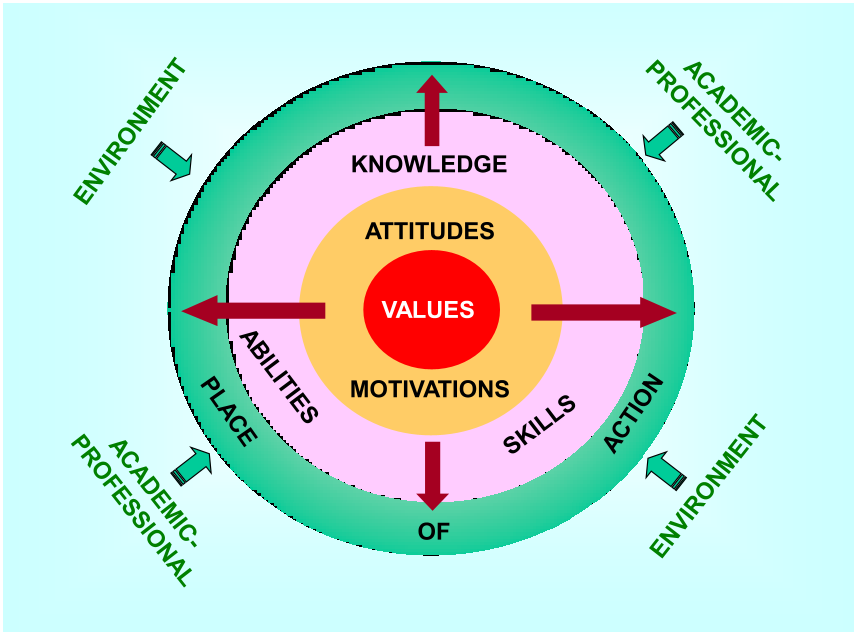
The genius of the SG4Edu project lies in its Competence Mapping. Rather than just creating a generic puzzle, the authors linked every game interaction to the University of Deusto's Three Levels of Mastery.
1. Architectural Blueprint
The team avoided heavy, restrictive game engines like Unity3D in favor of a lean, custom-built HTML5 and Javascript engine. This choice ensured "interoperability"—meaning a student can start a scenario on a campus PC and finish it on their tablet at home.
2. Behavioral Indicators
In the game, a student might have to manage an emergency evacuation or solve a plumbing puzzle to disable an alarm. These aren't just "minigames"—they are data points.
- Level 1 Mastery: Taking initiative in daily situations.
- Level 2 Mastery: Analyzing causes and constructing efficient solutions.
Experimental Structure & Results
The project followed a three-phase lifecycle:
- Phase I: Analysis of the digital leisure habits of youth (noting that 98% of young Basques use the internet for entertainment).
- Phase II: Prototype design focusing on "Entrepreneurship" and "Problem Solving."
- Phase III: Technical deployment and testing.
Performance Evidence
The research utilized "activity tables" to track how specific game scenarios triggered measurable pedagogical outcomes.
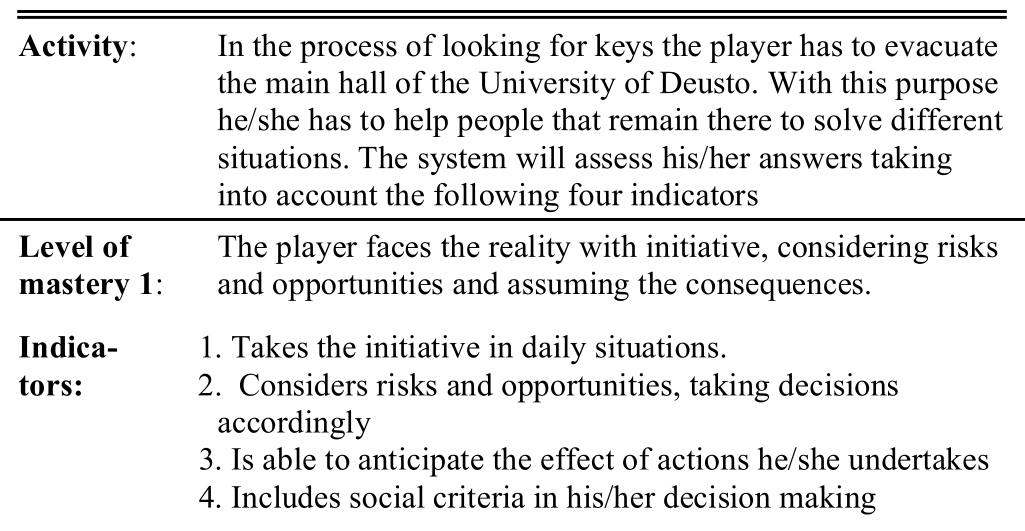
The results confirmed that serious games could successfully simulate real-world professional constraints—such as time and social consequence—which are difficult to replicate in a classroom.
Critical Insight & Perspective
The most striking takeaway from this paper isn't the technology, but the interdisciplinary friction. The authors openly admit that the "pedagogical team's plan was sometimes considered unaffordable by the technological team."
This highlights a universal truth in EdTech: Alignment is harder than coding. The success of a serious game depends less on graphical fidelity and more on how tightly the "game rules" mirror the "real-world competence rules."
Limitations & Future Work
- Visual Fidelity: The 2D HTML5 approach, while portable, lacks the high-end immersion of modern 3D titles.
- Scalability: Training faculty to integrate these games into existing curricula remains a significant hurdle.
- Next Steps: The team plans to expand the game to cover other soft skills like verbal communication and team leadership.
Conclusion
SG4Edu proves that serious games are no longer a "leisurely add-on" but a robust vehicle for high-stakes higher education. By grounding game design in a rigorous 12nd-year competence model, the University of Deusto has provided a blueprint for the future of employability-oriented education.