
Beyond MTurk: A Robust Framework for Server-Assigned Spatial Crowdsourcing
A Server-Assigned Spatial Crowdsourcing Framework
The paper introduces a formal framework for Server-Assigned (SAT) spatial crowdsourcing, defining the Maximum Task Assignment (MTA) and its extension, the Maximum Score Assignment (MSA). It proposes three core heuristics—Basic, Least Location Entropy Priority (LLEP), and Close Distance Priority (CDP)—to optimize task allocation in dynamic, spatiotemporal environments while significantly outperforming traditional online bipartite matching algorithms like Ranking.
TL;DR
This research shifts crowdsourcing from the digital screen to the physical world. By introducing the Maximum Task Assignment (MTA) and Maximum Score Assignment (MSA) problems, the authors provide a scalable server-side framework that intelligently matches mobile workers to location-specific tasks. Key innovations include using Location Entropy to predict worker availability and minimizing human travel costs, resulting in up to 90% efficiency gains in logistics and 35% better task completion rates.
The "Moving" Challenge: Why Spatial is Special
In traditional crowdsourcing, a worker in New York can label an image from a requester in Tokyo instantly. In spatial crowdsourcing, the worker must physically travel to a location (e.g., to take a photo of a disaster site or rate a restaurant).
Existing systems suffered from two major flaws:
- Worker-Selection Chaos: When workers pick tasks themselves (WST), they often cluster around easy tasks, leaving remote ones to expire.
- Static Assumptions: Most participatory sensing research assumes worker sets are fixed, ignoring the reality that mobile users appear and disappear sporadically.
Methodology: The Core Engine
The authors propose a Server-Assigned Tasks (SAT) mode. The server acts as an omniscient broker, receiving "Task Inquiries" from workers (containing their location, working region, and expertise) and "SC-queries" from requesters.
1. The Mathematical Foundation
The problem is modeled as a sequence of time-instance optimizations.
- MTA (Maximum Task Assignment): Reducible to a Maximum Flow Problem, ensuring the highest volume of work is completed within worker constraints.
- MSA (Maximum Score Assignment): Reducible to Maximum Weighted Bipartite Matching, where weights represent the "quality" or "expertise match" between a worker’s skills and a task type.
2. Strategic Heuristics: LLEP and CDP
The breakthrough lies in how the server prioritizes tasks when multiple options exist:
- Least Location Entropy Priority (LLEP): Inspired by information theory, this heuristic calculates how "popular" a location is. If a task is in a low-entropy area (rarely visited), the server prioritizes it, knowing that tasks in high-entropy areas (dense with workers) are more likely to be picked up later.
- Close Distance Priority (CDP): This focuses on the human element. By prioritizing tasks with the lowest Euclidean distance to the worker, the system dramatically reduces travel fatigue and operational costs.
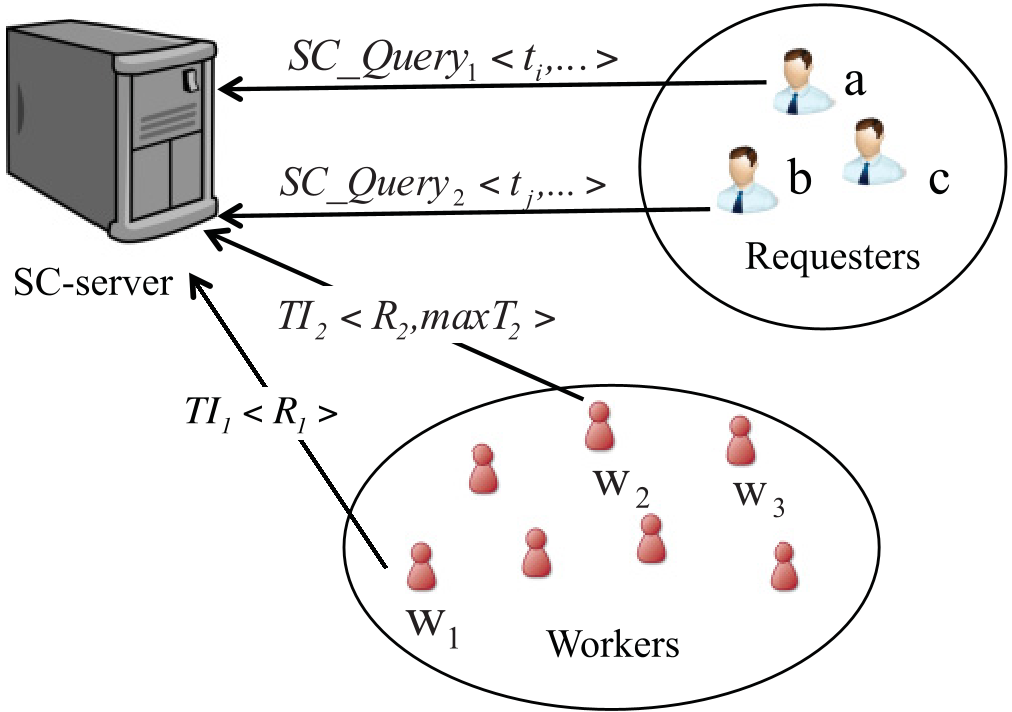 Figure: The SAT Framework showing the flow from Task Inquiry to Server Assignment.
Experimental Insights: Real-World Performance
The authors validated their framework using synthetic data and real-world traces from Gowalla and Yelp.
- Expertise Wins: The MSA model proved that by valuing expertise scores (e.g., assigning a photographer to a photo task), the system could maximize high-quality matches without sacrificing total volume, provided the expertise score is at least double a standard match score.
- Spatial Awareness vs. Ranking: They compared their methods against the Ranking Algorithm (a standard for online bipartite matching). In high-density scenarios (like the Yelp dataset), their LLEP method outperformed Ranking by 46%, proving that "Blind" online matching cannot compete with spatial-aware heuristics.
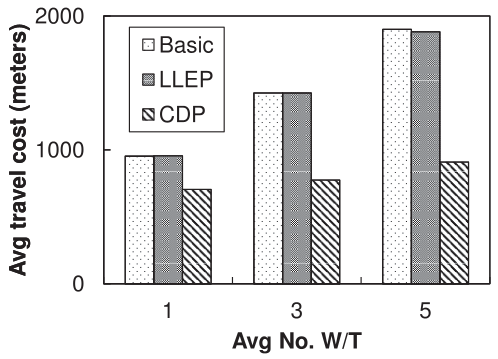 Figure: Comparison of Total Score and Expertise Matches across different worker densities.
Critical Analysis & Conclusion
This work provides the "operating system" for modern gig-economy apps like Uber or Field Agent. The transition from MTA to MSA is mathematically elegant, allowing the framework to generalize across diverse industries, from journalism to urban planning.
Limitations: The current model assumes workers are truthful and always perform tasks correctly once assigned. In the wild, "trust" and "reliability" are variables that need integration into the scoring matrix.
Future Outlook: As we move toward autonomous agents and more sophisticated gig platforms, integrating Differential Privacy (to protect worker locations) and Dynamic Incentive Models will be the next frontier for this spatial framework.