
Square Pigeon: Reclaiming Privacy via Server-less P2P Social Networking
The 9th International Conference on Future Networks and Communications (FNC-2014) "Server-less" Social Network for Enhanced Privacy
This paper introduces "Square Pigeon," a server-less mobile social network designed to enhance user privacy by bypassing central servers for data storage. It utilizes a Peer-to-Peer (P2P) architecture where the server only handles administrative coordination, while media content is transferred directly between mobile devices.
TL;DR
Square Pigeon is a research prototype that reimagines social media as a decentralized P2P network. By keeping media files on user devices and only using a server for "administrative coordination," it ensures that service providers never actually "see" or "own" your photos and videos. Despite the shift to P2P, the system maintains high efficiency with negligible battery drain.
The Invasion of the "Third Person"
In the current social media paradigm, when you send a photo to a friend, you aren't actually sending it to them. You are sending it to a corporate server, which then mirrors it to your friend. This "third person" in the middle represents a massive privacy loophole.
The authors of Square Pigeon identify that while smartphones have become powerful enough to act as servers, the primary hurdles for a P2P social network remain Resource Management (battery/data quotas) and Reliability (maintaining QoS when users go offline).
Methodology: Hybrid P2P Architecture
Square Pigeon doesn't go 100% decentralized—which would be too heavy for mobile signal processing. Instead, it uses a Hybrid Architecture:
- Administrative Server: Handles registration, contact discovery via phone numbers, and notification routing. Crucially, it only stores Links (pointers), never the media itself.
- P2P Data Layer: When a user clicks "Download" on a notification, the server uses a load-balancing algorithm to find an online peer who has the file. The data then moves directly from device A to device B.
- Link Formation: The system uses "Primary Links" (local directories on the sender's phone) and "Secondary Links" (standardized paths on the receivers' phones), allowing the server to coordinate transfers without understanding the content.
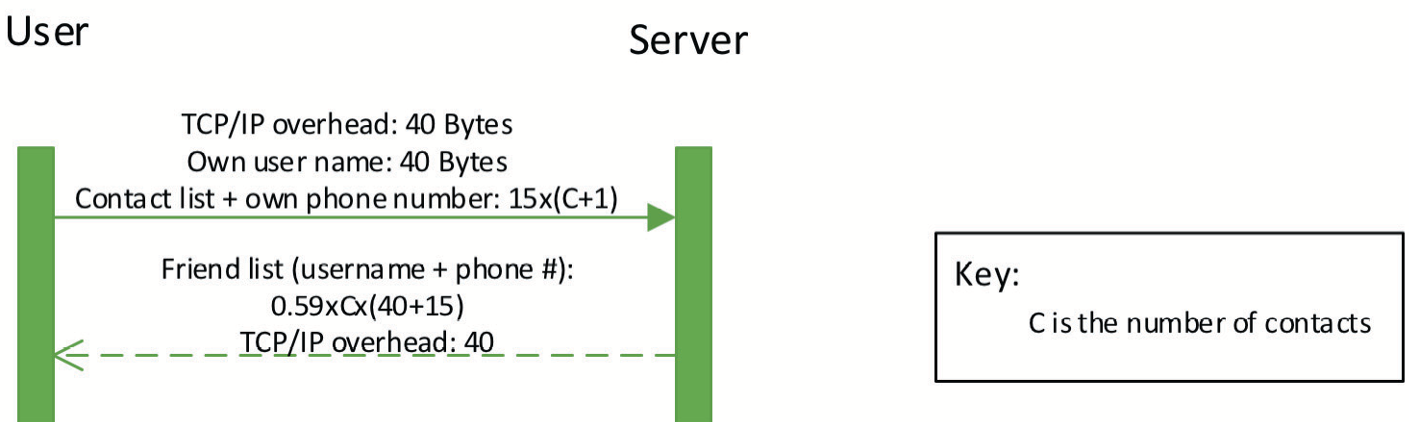 The protocol flow highlights how the server manages handshakes without touching the raw data.
Fairness through Load Balancing
A common failure point in P2P networks is "Free Riding"—where users download but never upload. Square Pigeon addresses this with a Fairness Load Balancing Algorithm.
The server tracks an "increment" value for every user, representing their total uploads. When a file is requested, the server selects the seeder with the lowest increment. This ensures that the original sender isn't drained of battery, as the burden of "seeding" is distributed across all recipients of the media.
Experimental Results: Performance & Battery
The study conducted a rigorous analysis of the overhead introduced by the signaling protocol.
- Data Overhead: For a standard group of 35 members, the communication overhead is only ~8.5KB. Given that average media (images/video) ranges from 2.8MB to 8.4MB, the "privacy tax" is less than 0.3%.
- Battery Impact: Using Nexus handset metrics, the energy cost was measured at approximately 0.005 J/KB. The authors conclude that the application is "lightweight" and does not significantly impact the handset's daily battery life.
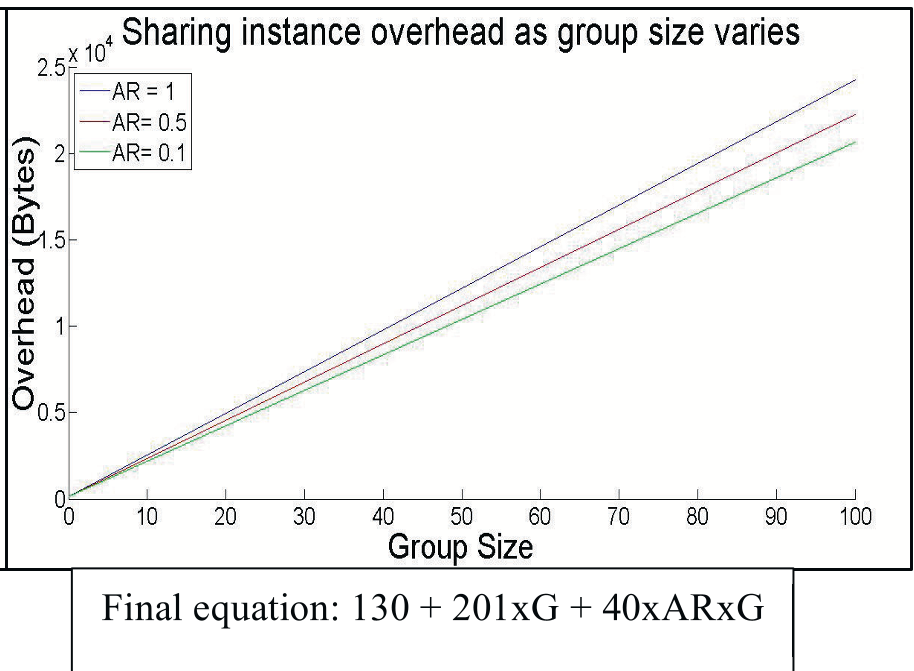 Comparison of signaling overhead versus group size and contact lists.
Critical Insight: The Future of P2P Socializing
Square Pigeon proves that a server-less architecture is technically feasible for mobile devices. However, its main limitation is Data Availability: if the original sender and all recipients are offline, the content becomes inaccessible.
The authors suggest Data Replication (automatically mirroring data to high-availability peers) as a future solution. In the modern context, this work laid the groundwork for contemporary "Local-First" software and decentralized protocols like IPFS or Scuttlebutt, emphasizing that user-owned data is not just a philosophical goal, but a practical engineering possibility.
Takeaway: True privacy in the mobile age requires moving the data storage to the edge. By using a "thin" server for coordination and a "fat" P2P layer for data, we can build social networks that respect boundaries without sacrificing the convenience of modern communication.