
Breaking the Integration Barrier: A Low-Code Framework for Mobile Social Messaging in PaaS
A Service-Based Framework for Mobile Social Messaging in PaaS Systems
This paper introduces a service-based framework for integrating Mobile Social Messaging (MSM) into Platform-as-a-Service (PaaS) systems like IBM Bluemix. It enables enterprise applications to communicate with users via popular SNS providers (WeChat, WhatsApp) using a coding-free, procedural knowledge-based approach.
TL;DR
In the era of cloud-native applications, industry giants still struggle to connect their legacy backend services with trendy social messaging apps like WeChat or WhatsApp. This paper presents a pioneering Mobile Social Messaging (MSM) framework for PaaS (IBM Bluemix) that replaces hard-coded API integrations with a coding-free conversation management system. By treating business logic as "procedural knowledge," it allows domain experts—not just coders—to build and maintain complex mobile interactions through a simple drag-and-drop interface.
Problem & Motivation: The "Integration Tax"
Enterprises face a dual-headed monster when moving to mobile SNS (Social Networking Services):
- API Fragmentation: Every provider (WeChat, WhatsApp, KakaoTalk) uses unique, frequently changing APIs. Keeping an app updated against these moving targets is a maintenance nightmare.
- The Knowledge Gap: Financial or insurance experts understand the business flow (e.g., how to reset a password), but they can't code. Developers can code, but they lack the domain expertise. This necessitates endless, expensive training sessions and documentation loops.
The authors identified that current PaaS offerings lacked a native service to bridge this gap, leaving companies to "reinvent the wheel" for every social platform they wanted to support.
Methodology: Decoupling Logic from Code
The core insight of the paper is the abstraction of social interactions into Actionable Procedure Knowledge. Instead of writing if/else statements in Java or Python, logic is defined as a sequence of standardized steps.
The Four-Layer Architecture
The framework is hosted on IBM Bluemix and consists of:
- UI Services: Includes a Conversation Authoring Service for drag-and-drop logic building.
- MSM Services: The "translator" layer. It listens to specific SNS APIs (like WeChat's Message APIs) and converts them into a standardized format the backend can understand.
- Backend Services: The "brain," featuring the iPASS Engine (to execute procedures) and IBM Watson (to handle "open questions" that don't fit a set procedure).
- Storage Services: Persistent data via NoSQL (Cloudant) and SQL databases.
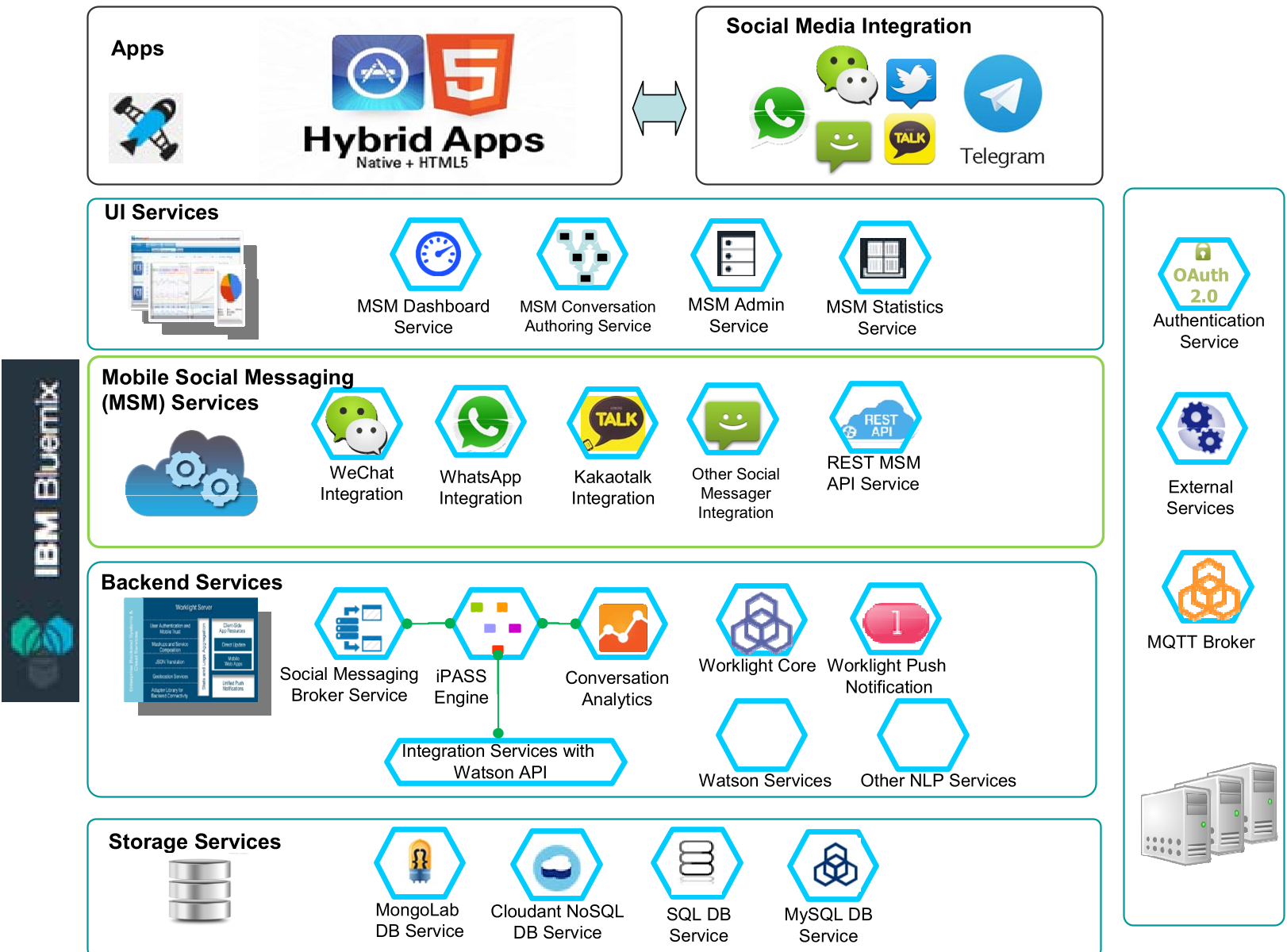 Figure 1: The layered MSM framework architecture decoupling the SNS APIs from business logic.
Experiments & Results: Coding-Free Agility
The paper illustrates the framework's power using a banking scenario. Traditionally, if a bank wanted to offer a service via WeChat, developers had to study WeChat’s public platform APIs (User Management, Customized Menus, etc.) and manually map them to financial backends.
With the proposed framework:
- Standardization: The Social Messaging Broker handles requests across different SNS providers uniformly.
- Efficiency: Changes to a business process (e.g., an updated insurance claim flow) are handled by domain experts in the Dashboard, requiring zero line of code changes and no redeployment of the application infrastructure.
- Intelligence: By integrating Watson NLP, the system doesn't break when a user deviates from the script; it uses semantic understanding to guide them back to the defined procedure.
Critical Analysis & Conclusion
Takeaways
This work is a significant milestone in PaaS evolution. It moves the platform beyond providing simple compute/storage icons to providing high-level, business-ready functional blocks. The use of procedural knowledge as a "bridge" between experts and IT is a robust strategy for reducing development workload.
Limitations & Future Work
While the framework excels at structured routine tasks (banking, customer service), it may still face challenges with highly creative or unstructured human interactions. The authors plan to extend this framework to other PaaS systems beyond Bluemix, potentially opening the door for cross-cloud social messaging services.
In a world where "The API is the Product," this framework suggests that the next step is "The Conversation is the Service."