
Reimagining the Kitchen God: Activating Cultural Heritage Through Service Design and Big Data
Service Design in the Preservation of Intangible Cultural Heritage: A Case Study in the Legend of the Kitchen God
This paper presents a service design framework for the preservation of Intangible Cultural Heritage (ICH), specifically focusing on the "Legend of the Kitchen God" in China. By integrating Big Data analysis, social media interaction, and digital touchpoints through a WeChat mini-program, the authors demonstrate how traditional folklore can be transformed into a sustainable modern lifestyle.
TL;DR
This study bridges the gap between ancient Chinese folklore and modern digital life. By transforming the "Legend of the Kitchen God" into a mobile service platform, the researchers have moved beyond static museum preservation to create a dynamic, data-driven ecosystem where the tradition of "performing good deeds" becomes a social, sustainable modern habit.
Academic Positioning: This work moves the field of Intangible Cultural Heritage (ICH) from "Digital Archiving" toward "Service Activation," positioning itself at the intersection of HCI (Human-Computer Interaction), Sociology, and Service Design.
Problem & Motivation: The "Glass Case" Trap
Intangible Cultural Heritage is fundamentally "living"—it requires human bearers. However, modern urbanization has physically displaced many traditions. For example, the Kitchen God was traditionally worshipped at a wood-burning hearth; modern granite-topped induction kitchens leave no room for such rites.
The authors identify three critical pain points:
- Cultural Standardization: Globalisation is erasing local nuances.
- Shortage of Inheritors: Fast-paced modern life discourages young people from learning complex, traditional rituals.
- Hollow Preservation: Current efforts often copy the form (the image of the god) but lose the spirit (the ethical motivation to do good).
Methodology: The "Welcome Kitchen God" Framework
The core insight of the paper is that the "Kitchen God" is essentially an ancient data-tracker. Traditionally, he recorded a family's deeds to report to the Jade Emperor. The authors' methodology replicates this logic using modern Service Design principles.
1. Architecture of the Digital Touchpoint
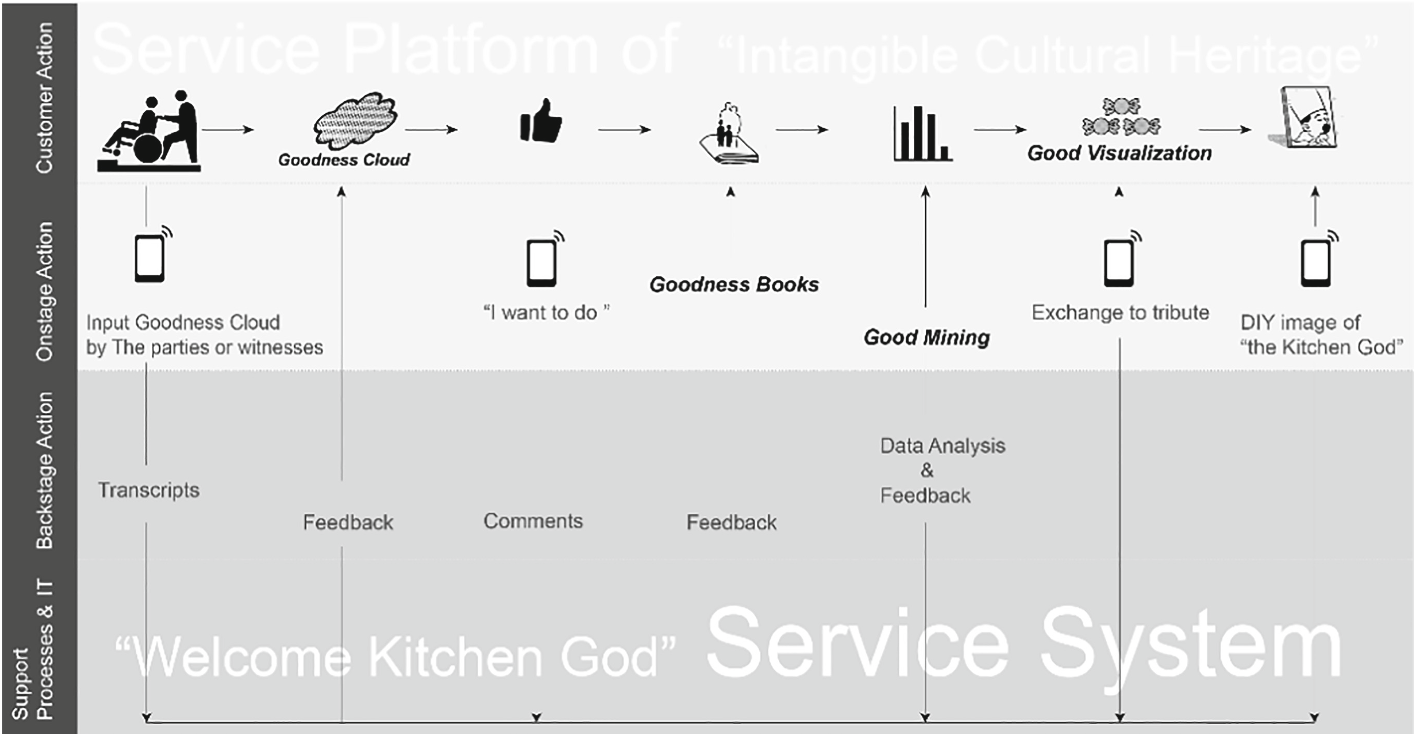
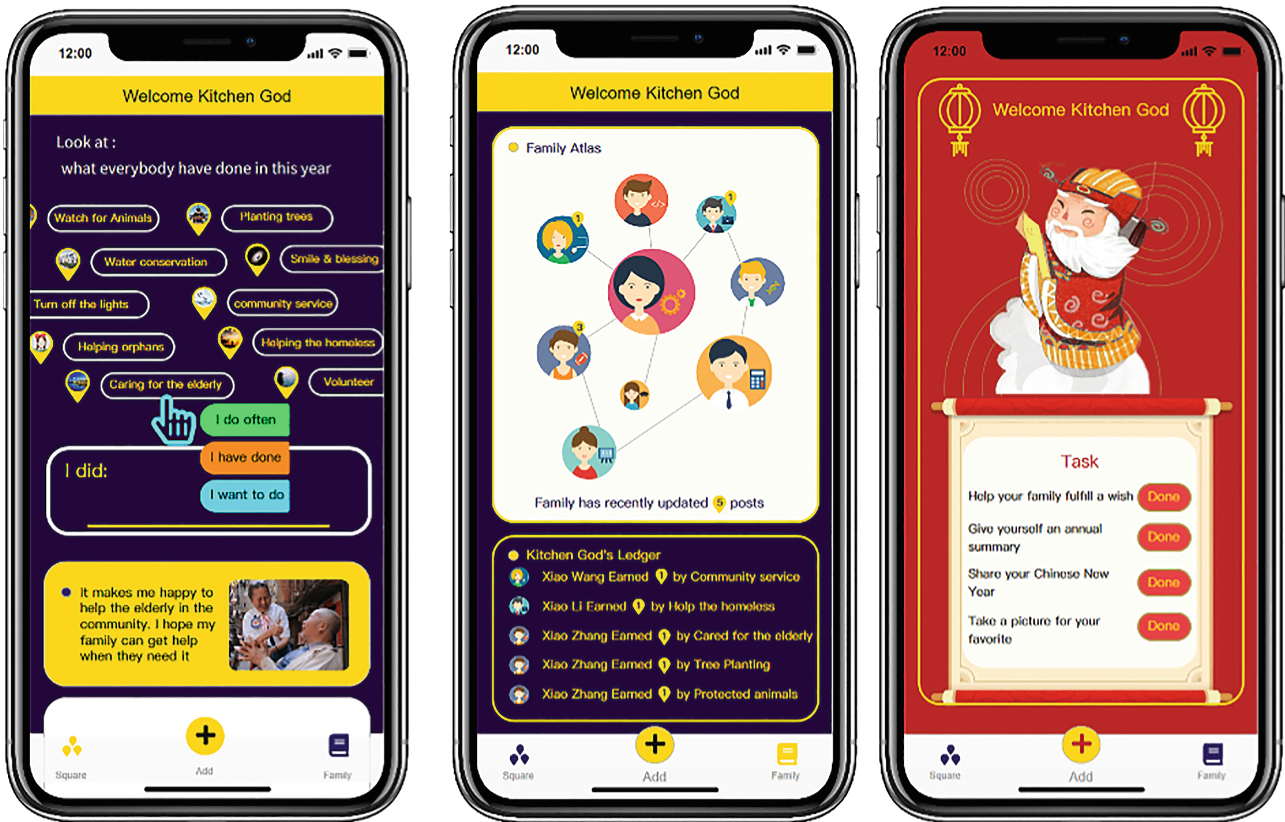
The researchers designed a WeChat mini-program consisting of seven functional modules designed to foster altruism and community connection.
2. Key Mechanisms:
- Goodness Cloud & Books: Users post small acts of kindness (e.g., "turning off lights," "complimenting a colleague").
- Household Teams: Gamifying the social unit. Families compete or collaborate to accumulate "Goodness points."
- Virtual Sacrifices: Instead of burning physical paper, users exchange their "good deed points" for digital offerings like kitchen candies or virtual blessings.
3. Big Data Integration (Social Mining)
Beyond the UI, the system leverages Data Mining. By analyzing which "good deeds" are most popular or difficult across different demographics, the platform provides actionable insights for NGOs and governments to design better social initiatives.
Experiments & Results: Quantitative Culture
The paper highlights the shift from qualitative observation to quantitative data. By using sensors and online behavioral data tracking, the study demonstrates:
- Increased Engagement: The low cost of "liking" a good deed encourages frequent interaction compared to traditional once-a-year festivals.
- Brand Value: In Shunyi District, related cultural creative products ("Zaowang" brand) generated 1.5 million yuan annually, proving that service design can also drive local economies.
Critical Analysis & Conclusion
Takeaway
The preservation of heritage is not about keeping things the same; it is about ensuring they still work in a new environment. This paper successfully reinterprets the Kitchen God as a "Social Credit for Goodness" platform, making it relevant to a digital-native generation.
Limitations
While the digital model is innovative, there is a risk of "Over-commercialization" and "Superficiality." If cultural heritage becomes purely about digital points and "likes," the deep spiritual and religious gravity of the original tradition might be further diluted. Additionally, the reliance on a single platform (WeChat) creates a centralized vulnerability.
Future Work
The authors suggest that this service model can be expanded to other ICH items. The next frontier involves using Artificial Intelligence to further personalize the "Goodness" recommendations and exploring how AR (Augmented Reality) can bring the physical kitchen deity back into modern homes in a non-intrusive way.