
Economic Agents: Transforming Wireless Mesh Service Negotiation via Rationality
Service negotiation over wireless mesh networks : an approach based on economic agents
This paper proposes an autonomous service negotiation framework for wireless mesh networks (WMNs) using Economic Agents. By integrating simple machine learning (Widrow-Hoff rule) with multi-criteria decision-making (TOPSIS-inspired), the system enables self-interested network nodes to negotiate resource allocation (like data transportation) rationally, balancing Quality of Service (QoS) with energy constraints.
TL;DR
In the evolving landscape of ubiquitous wireless coverage, the core challenge is no longer just connectivity—it is negotiation. This paper introduces a framework where network elements act as "Economic Agents." By treating data routing and resource sharing as a market transaction, the system achieves an 18% boost in network lifetime and a dramatic reduction in packet loss (from 15% to 1.6%) compared to traditional indiscriminate methods.
Context: The Hidden Cost of Cooperation
In Wireless Mesh Networks (WMNs), nodes are often required to relay traffic for others. However, in energy-limited scenarios like Wireless Sensor Networks (WSNs), every relayed packet consumes a portion of a finite battery life. This creates a conflict: global network health vs. individual node survival.
The authors argue that "Economic Rationality"—where every node manages its own interests—can lead to a superior global order. If a node has no incentive to cooperate, it shouldn't. The challenge is creating a mechanism where high-quality service provision is rewarded and waste is minimized.
Methodology: Satisfactory Solutions over Absolute Optima
Calculating a mathematically "optimal" solution in a dynamic, multi-hop environment is computationally expensive for simple sensors. Instead, the authors propose a mechanism based on Bounded Rationality.
1. The Multi-Criteria Decision Model
Instead of a single metric, agents evaluate an "array of incentives" (e.g., throughput, residual energy, delay). The paper employs a logic similar to the TOPSIS method:
- The Ideal Solution (): The best possible performance across all criteria (e.g., max bandwidth + min energy cost).
- The Non-Desirable Solution (): The worst performance.
- The Satisfactory Selection: The agent selects the alternative that is geometrically closest to and furthest from .
2. Adaptive Learning with Widrow-Hoff
To stay relevant in a shifting environment, agents don't keep fixed utility values. They use an adaptation mechanism based on the Widrow-Hoff rule (a precursor to modern neural network backpropagation). If a bid or offer is accepted, the agent adjusts its "internal price" (the variation) to remain competitive in future auctions.
(Note: The adaptation algorithm monitors "shouts" and "bids" in the network market to increment or decrement utility measures.)
Experimental Results: Tangible Gains
The researchers conducted 33 simulations comparing two scenarios:
- Indiscriminate Negotiation: Nodes accept service requests randomly.
- Economic Negotiation: Nodes use the proposed Economic Agents to decide whether to consume/provide services.
| Metric | Indiscriminate (Scenario 1) | Economic Agent (Scenario 2) | Improvement |
|---|---|---|---|
| Packet Loss | 15.0% | 1.6% | ~90% Reduction |
| Network Lifetime | 35,974s | 48,197s | +33.9% |
| Message Delay | High | Low | ~79% Reduction |
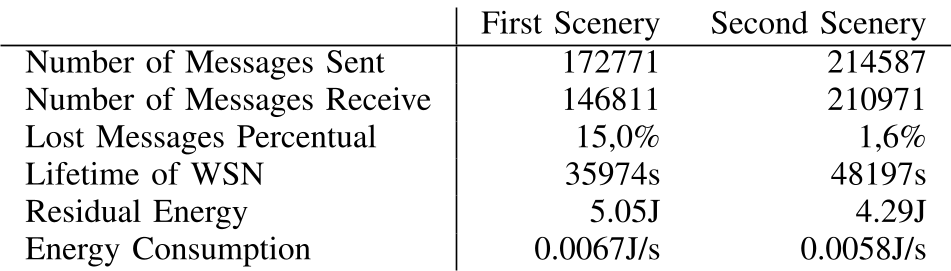
The data proves that when agents act "selfishly" but rationally, they prevent the "Tragedy of the Commons." Networks last longer because nodes only take on relaying tasks when the "price" (utility balance) is right, and the overall system throughput increases because higher-quality routes are prioritized.
Critical Insight: The Power of Local Decision Making
The true value of this work lies in complexity reduction. As stated in the paper, it is easier to maximize the resources of a unique element than to solve the optimization problem for the entire network. This decentralized approach aligns with the current industry shift toward Edge Computing and autonomous IoT systems.
Limitations & Future Work
While the results are impressive, the study focuses on a relatively static node distribution. The authors acknowledge that node mobility—where the market landscape changes every second—is the next frontier. Furthermore, applying modern Reinforcement Learning (RL) could potentially replace the Widrow-Hoff rule for even more nuanced bidding strategies.
Conclusion
By treating a wireless network as a micro-market, the authors provide a blueprint for ubiquitous urban coverage that is both efficient and sustainable. Service negotiation is no longer a technical handshake; it is a rational economic exchange.