
MS2A: Building a Resilient Social Network for the "Digital Dark Age" of Disasters
A Service-Oriented Mobile Social Networking Platform for Disaster Situations
This paper introduces MS2A, a Service-oriented Mobile Social Networking (MSN) platform designed for communication and collaboration in disaster scenarios where infrastructure is damaged. It leverages a lightweight REST-based Service-Oriented Architecture (SOA) and the Aframe multi-agent framework to enable off-grid, ad-hoc networking on Android devices.
TL;DR
When disasters strike, the "cloud" disappears. MS2A (Mobile Service-oriented Social Networking) is a decentralized platform that turns ordinary smartphones into sovereign service providers. By hosting a lightweight REST-based SOA engine directly on the device, it allows victims and rescuers to share GPS data, messages, and resources through ad-hoc WiFi and Bluetooth networks without a single bar of cell service.
Background: The Infrastructure Paradox
Modern emergency response relies heavily on digital coordination. However, the very events that necessitate this coordination—earthquakes, hurricanes, tsunamis—often destroy the cell towers and power grids they depend on. Current Service-Oriented Architecture (SOA) solutions for disasters are paradoxically "server-heavy," requiring mobile clients to connect to remote data centers. When the link breaks, the system dies. MS2A was born from a simple insight: The mobile device must be the server.
Methodology: Decentralized SOA on Android
The researchers developed a two-layer system that transforms a standard Android device into a self-sufficient node within an opportunistic network.
1. The Service Layer (The Engine Room)
Instead of the heavy SOAP protocol traditionally used in enterprise SOA, MS2A uses RESTful web services.
- Efficiency: REST uses 56% less power than SOAP, a critical factor when charging stations are non-existent.
- Aframe Framework: An agent-based framework that hides the complexity of ad-hoc connectivity. It utilizes "resident agents" to manage data fetching, migration, and network status.
- Local SOA Engine: By using I-Jetty (a lightweight web container), each phone runs its own web server, allowing it to provide services (like Map or Social Context) to any peer in its vicinity.
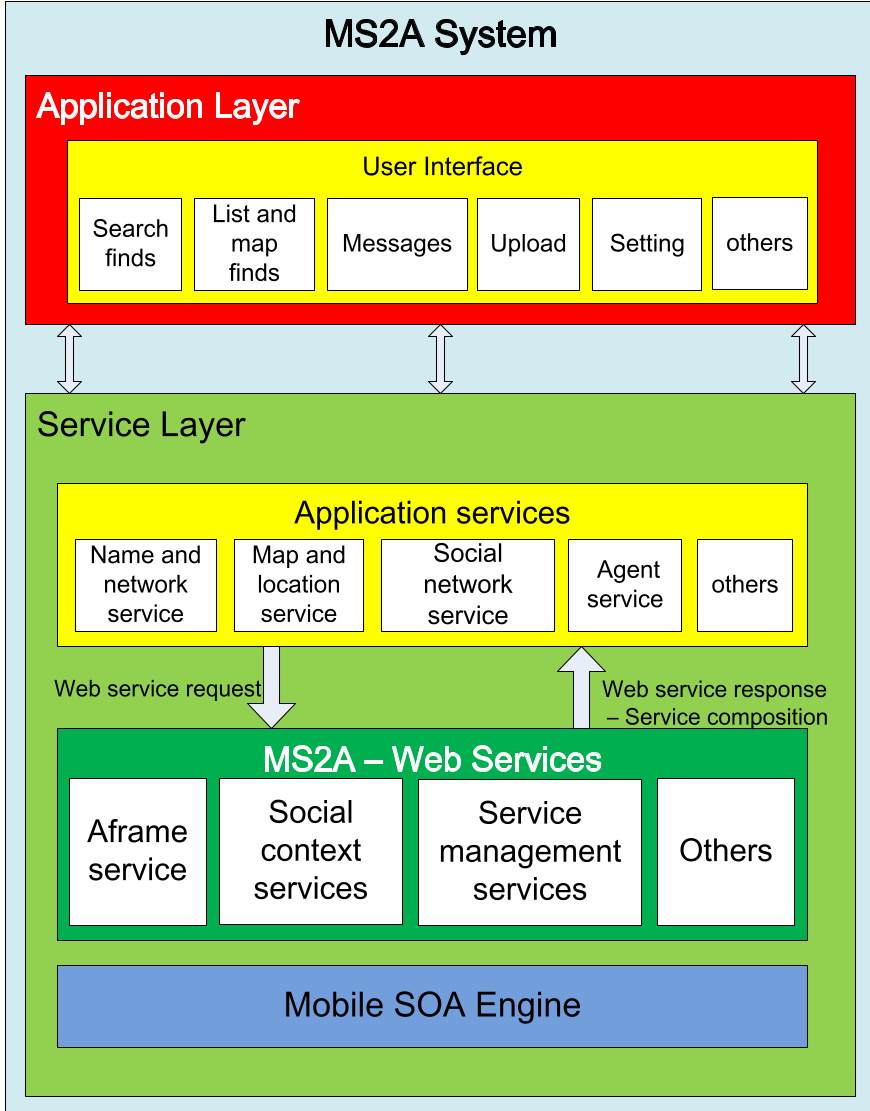
2. The Application Layer (The Rescuer's Interface)
This layer presents familiar social networking features—search, map views, and messaging—but powers them entirely through local peer-to-peer collaborations.
Implementation: Turning Theory into Rescue
The "magic" of MS2A lies in its resource-oriented mapping. Every device capability (GPS, battery, data storage) is mapped to a URL (e.g., /rest/GPS).
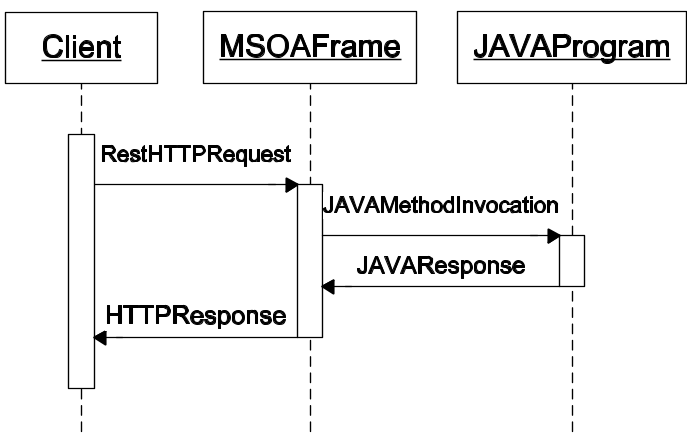
The workflow follows a clean Request-Response cycle locally:
- A Mobile Agent requests a service via a local URL.
- The SOA Engine maps the URL to a Java class.
- The Resident Agent executes the logic and returns the data via HTTP.
Experiments & Results: Collaboration is Key
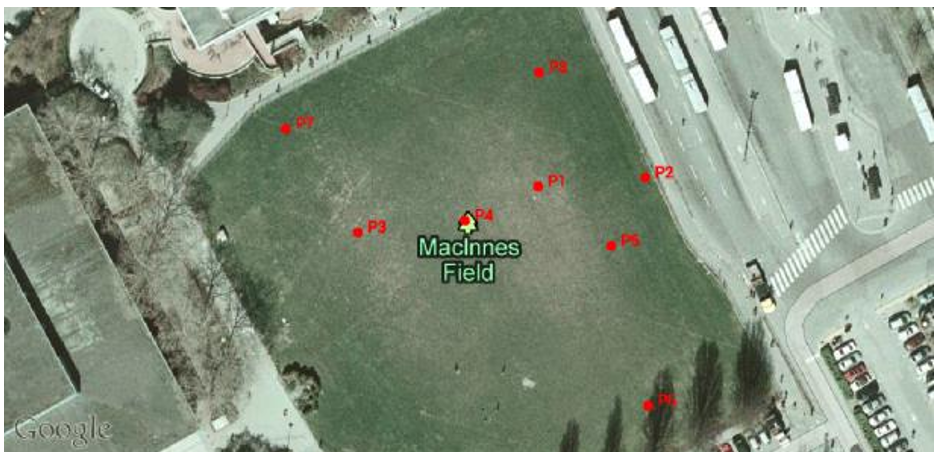
The team validated MS2A through a real-world deployment of four Android devices in a 400m x 400m zone.
- Messaging Stability: Every MSN message sent between nodes during a 15-minute walking test was successfully delivered, proving that WiFi ad-hoc clusters are sufficient for low-latency emergency comms.
- Service Composition (The "GPS Sharing" Case): In a standout demonstration, a tablet without GPS was able to "borrow" location services from a nearby smartphone. By connecting via Bluetooth, the tablet invoked the phone's RESTful GPS service, achieving 40m precision—enough to guide a rescuer to a victim.
Critical Insight & Future Outlook
MS2A proves that Service Composition is the future of edge computing. By abstracting hardware capabilities into web services, we create a "collaborative redundant" environment where the collective network is smarter than its individual nodes.
Limitations:
- Scalability: While 8 devices can connect to an Android hotspot, true large-scale mesh networking requires more sophisticated routing than classic WiFi hotspots.
- Interoperability: The current version is Android-centric; porting the I-Jetty-based SOA engine to iOS remains a challenge due to OS-level background service restrictions.
As we look toward 6G and ubiquitous IoT, the principles of MS2A—decentralized services and autonomous agents—will likely be the blueprint for the next generation of "zero-infrastructure" communication.