
SCSN: Beyond Keywords—Injecting Social Intelligence into Service Discovery
Service Search based on Service Composition Social Network
The paper introduces the Service Composition Social Network (SCSN), a tripartite model integrating User, Provider, and Service networks. It leverages social relationships and trust metrics extracted from web pages to improve the relevance of service discovery compared to traditional keyword-based repositories.
TL;DR
Modern software complexity requires composing multiple services, yet current search engines treat services as isolated tools. This paper proposes SCSN (Service Composition Social Network), a model that treats service discovery as a social process. By mapping the relationships between users, providers, and services, the authors create a "Trust-Aware" search space that significantly outperforms traditional repositories like SourceForge in ranking relevance.
The Missing Link: Human Centricity in SOA
Service-Oriented Architecture (SOA) has long mastered functional matching (e.g., "Does this API accept JSON?"). However, it often ignores the social context:
- Can we trust this provider?
- What do my peers with similar backgrounds use?
- Is this service frequently used in parallel with other reliable tools?
The authors argue that service composition is fundamentally a social transaction. By ignoring the human element, existing systems suffer from "low-trust" results and poor ranking quality.
Methodology: Building the SCSN
The core innovation lies in the tripartite graph structure and the automated extraction of relationships from the web.
1. The Tripartite Model
The SCSN is defined by three interconnected networks:
- User Social Network (USN): Connections between consumers (e.g., classmates, colleagues).
- Provider Social Network (PSN): Alliances or rivalries between service developers.
- Service Social Network (SSN): Logical links between services that are frequently composed together.
2. Relationship Extraction
Instead of manual tagging, the authors utilize a classification approach to extract five key relations: Friend, Classmate, Working, UsingSameServ, and ProvidingSameServ. By scraping personal and corporate web pages for attributes like Affiliation, SameMajor, and AgeGap, the system dynamically builds a graph where nodes are enriched with trust metadata.
(Note: The SCSN architecture integrates User, Provider, and Service profiles to create a multidimensional search space.)
Experimental Validation: SCSN vs. SourceForge
To test the feasibility, the authors extracted 800 services and 2,353 provider pages from SourceForge. They compared the SCSN search efficacy against the standard SourceForge search engine using Human Ground Truth (10 experts performing majority voting).
Key Findings
The experiment utilized 20 different keywords. The results, as seen in the similarity comparison, show a consistent gap: SCSN results align much more closely with human preferences than the raw keyword-based results from SourceForge.
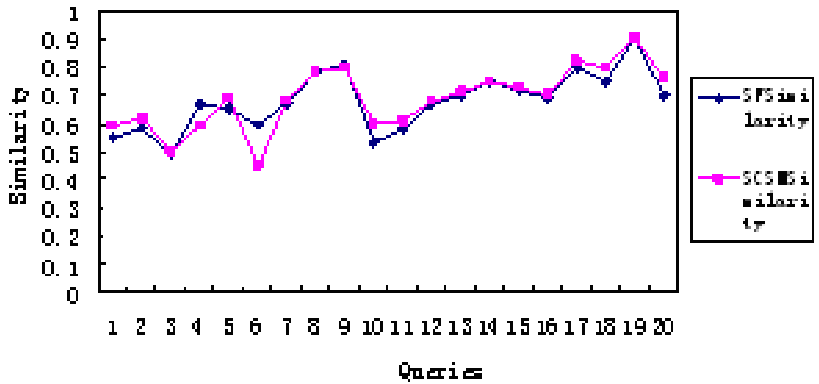 Fig 1: The similarity between SCSN rankings and standard human rankings is significantly higher than that of the SourceForge baseline.
Critical Insight & Future Outlook
The primary strength of this work is the Inductive Bias that social proximity correlates with service reliability. If my colleague trust a service, I am likely to find it useful—a simple yet powerful intuition often missing from "pure" semantic web research.
Limitations
- Dynamic Complexity: Building a social network from web pages is computationally expensive and prone to noise in web data.
- Cold Start: New services or providers without a social footprint may be unfairly penalized in a trust-based ranking.
Conclusion
SCSN represents a shift from Service Search to Service Recommendation. By treating the web as a living social ecosystem rather than a static database, the authors provide a blueprint for more resilient and human-centric service-oriented systems.