
SEWA DB: Stepping Out of the Lab for Real-World Affective AI
SEWA DB: A Rich Database for Audio-Visual Emotion and Sentiment Research in the Wild
The SEWA database (SEWA DB) is a massive, multilingual audio-visual corpus featuring over 2000 minutes of data from 398 participants across six distinct cultures. It introduces a comprehensive benchmark for affect recognition "in-the-wild," achieving professional baseline results across Facial Action Unit (FAU) detection, valence, arousal, and sentiment estimation.
TL;DR
The SEWA database is a groundbreaking effort to bridge the gap between laboratory-controlled emotion recognition and "in-the-wild" reality. By capturing 398 individuals from 6 cultures in their homes via webcams, the researchers have provided a rich, multi-modal benchmark for spontaneous facial, vocal, and social behavior analysis.
Context: Why "In-the-Wild" Matters
For years, Affective Computing has been "cheating." Most models were trained on professional actors portraying six basic emotions in front of HD cameras and studio lights. While these models reach 90%+ accuracy, they crumble when faced with a grainy webcam feed of a person in a dark room, or a subtle cross-cultural reaction to an advertisement.
The authors identify five specific failures in prior work:
- Controlled Settings: Lab data doesn't generalize to noisy, real-world environments.
- Posed vs. Spontaneous: Induced expressions have different ballistic and timing characteristics than authentic ones.
- Dyadic Neglect: Most datasets focus on individuals, ignoring how we mimic or react to an interlocutor.
- Cultural Homogeneity: Previous SOTA datasets (like VAM or RECOLA) are largely mono-lingual and mono-cultural.
- Sparse Annotation: Lack of overlap between Action Units (AUs), landmarks, and continuous affect scores.
Methodology: The SEWA Approach
The SEWA (Sentiment Analysis in the Wild) DB collection used a custom WebRTC platform to record pairs of subjects who already knew each other. The experiment was split into two parts:
- Part 1 (Watching): Subjects watched four highly specific advertisements designed to elicit disgust, witty pleasure, confusion, and interest/boredom.
- Part 2 (Discussing): The pair engaged in a 3-minute video chat to discuss the products, naturally eliciting agreement, disagreement, and mimicry.
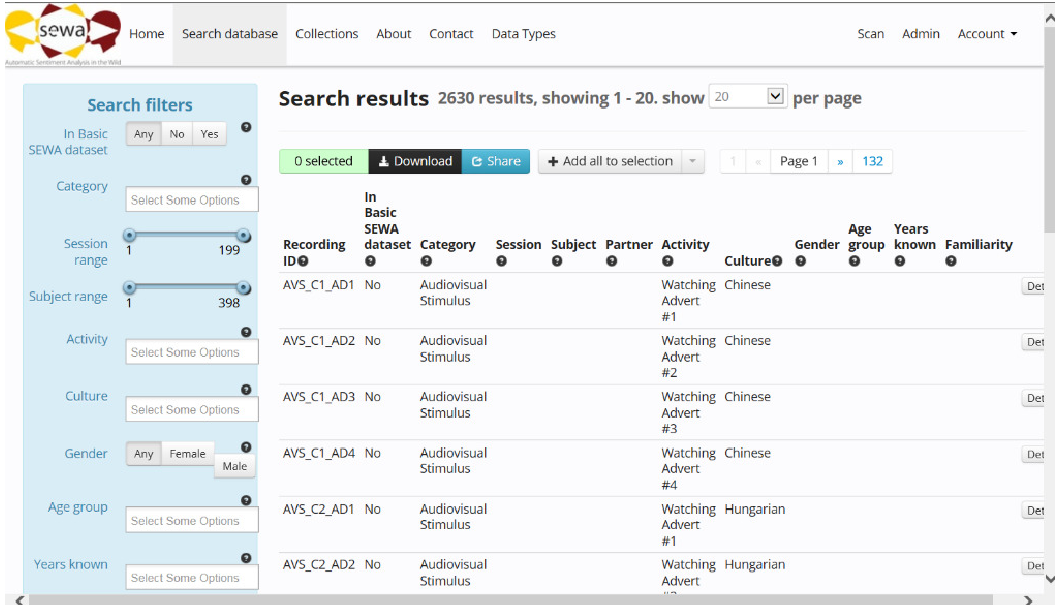
The diversity is impressive: British, German, Hungarian, Greek, Serbian, and Chinese participants across five age groups. Annotations were performed by native speakers to capture cultural nuances in expression.
Technical Deep Dive: Feature Extraction & Baselines
The paper doesn't just release data; it establishes rigorous baselines.
1. Multi-modal Feature Pipeline
- Visual: 49-point landmarks were tracked via a semi-automatic process using the Chehra tracker. Appearance was modeled using Dense SIFT descriptors around these landmarks, projected onto a 300-D PCA subspace.
- Audio: Low-Level Descriptors (LLDs) were extracted using
openSMILE, focusing on the ComParE and GeMAPS sets (spectral, prosodic, and voice quality features).
2. Modeling Results
The researchers tested traditional regressors (SVR, Random Forests), sequence models (LSTM-RNN), and End-to-End Deep Learning (ResNet-18).
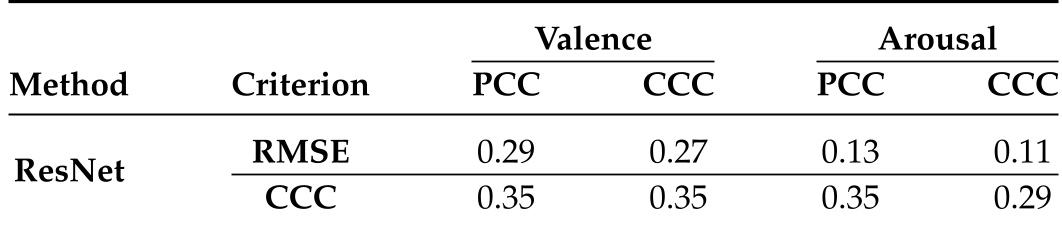
Key Insight: Valence vs. Arousal Dominance. Consistent with psychological theory, the experiments showed that video is a much stronger predictor for Valence (pleasure/displeasure), while audio is superior for Arousal (excitement/calm). When using ResNet-18 and optimizing for the Concordance Correlation Coefficient (CCC), the model was able to capture significantly more nuance in "in-the-wild" arousal than previous hand-crafted feature methods.
Critical Analysis & Takeaways
The SEWA DB highlights a massive "accuracy drop" when moving from lab data to real-world data. For example, FAU detection for AU12 (smiling) is significantly harder here than in lab datasets.
The Value of Culture: The dataset reveals that certain cultures (like Hungarian in this study) may show more "predictable" facial patterns for valence than others, suggesting that global AI models must be fine-tuned per-culture to be truly effective.
Limitations: While "in-the-wild," the data is still task-specific (advertisement watching). The "wildness" is also subject to the limitations of 2017-era webcams. Future work could benefit from extending this to mobile-first environments or fully unscripted social interactions.
Conclusion
The SEWA database isn't just a collection of videos; it's a call to action for the AI community to embrace the complexity, messiness, and cultural richness of human emotion. By providing a unified ground-truth across landmarks, AUs, and continuous sentiment, it provides the "Rosetta Stone" needed for the next generation of human-affect-aware interfaces.