
To Post or Not to Post? The Social Logic of Adolescent "Sexy" Self-Presentation
Sexual self-presentation on social network sites: Who does it and how is it perceived?
This study investigates the predictors and peer perceptions of sexual self-presentation among adolescents on social network sites (SNS). Utilizing a survey of 238 high school students and experimental mock Facebook profiles, the research identifies "Need for Popularity" and "Peer Norms" as primary drivers for posting sexualized content, while revealing significant gender-based double standards in how such content is evaluated by peers.
TL;DR
Is posting a "sexy" photo on social media a smart move for an adolescent's social status? This study reveals a complex social trade-off: while driven by a Need for Popularity, the results are mixed. Girls gain points with boys but lose them with girls, while boys seem to benefit from sexualized self-presentation (often interpreted as muscularity) without significant social costs.
Problem & Motivation: The Digital Stage for Sexual Development
Adolescence is a critical period for forming a sexual identity. With the move to Social Network Sites (SNS), this exploration has gone public. Previous scholarship could tell us how many teens were posting semi-nude or suggestive photos, but they couldn't explain why or how it actually affected their standing in the "peer economy."
The authors hypothesized that adolescents use these photos as strategic self-presentation tools to fit perceived peer norms and satisfy an internal drive for status.
Methodology: Testing the "Sexy" Signal
The researchers combined a psychological survey with a clever experimental setup. They created mock Facebook profiles where only the profile picture varied:
- Non-Sexual: A standard facial close-up.
- Sexual: The same person in swimwear or a suggestive pose.
Participants (aged 12-18) were assigned to evaluate these "strangers" on dimensions like likeability, attractiveness, and popularity.
Why They Do It: Popularity and Peer Pressure
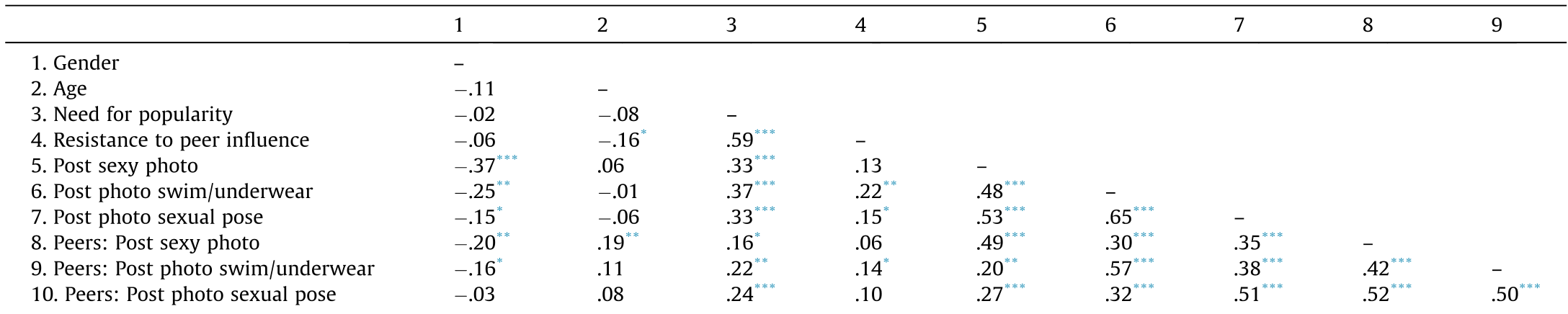
The study found two dominant predictors for why a teen would post a sexualized photo:
- Perceived Peer Norms: If a teen thinks their friends are doing it, they are far more likely to do it themselves.
- Need for Popularity: Those who actively seek social validation view "sexiness" as a currency to buy influence. Interestingly, "Resistance to Peer Influence" (the ability to say no to the crowd) was not a significant predictor, suggesting that the drive for popularity overrides general self-regulation in this domain.
Results: The Evolutionary Double Standard
The most striking findings emerged in the evaluation phase, which the authors interpreted through the lens of Evolutionary Psychology.
The Girl's Dilemma
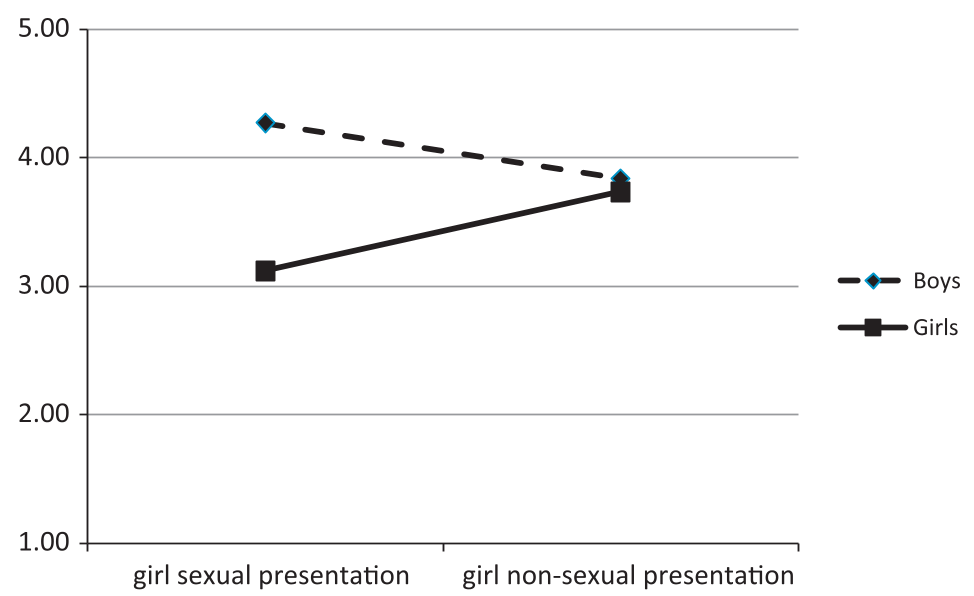
As shown in Figure 1, girls who presented themselves sexually were caught in a crossfire. They were rated significantly higher by boys but suffered a "derogatory" penalty from other girls. This aligns with the theory of intrasexual competition: females may socially penalize peers who make sexuality "too easily available" as it threatens the "mating market" stability.
The Boy's Advantage
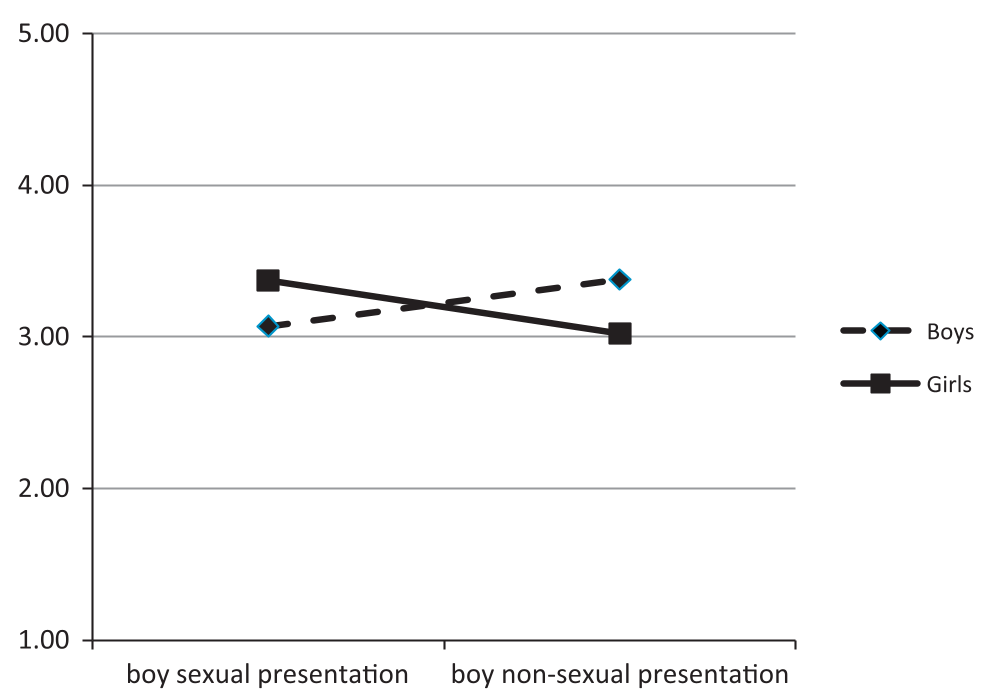
Conversely, as seen in Figure 2, boys who posted "sexy" (often muscular) photos were actually rated more positively by girls and saw no statistical decline in approval from other boys. The authors suggest that for boys, showing skin is often interpreted as a sign of physical fitness and resources rather than purely "sexual availability."
Critical Insight: A Maladaptive Strategy?
The study highlights a tragic irony: adolescents who most crave popularity (and thus post sexy photos) may end up alienating the very peers whose social support they need most—their same-sex friends.
Limitations & Future Work
- The "Attraction" Bias: This study used only attractive models. Would the social penalty be even harsher for "less attractive" teens engaging in sexual self-presentation?
- Modern Platforms: Conducted in the era of Facebook, the dynamics might be even more intensified on Instagram and TikTok, where "sexiness" is often algorithmically rewarded with "Likes" and "Views," potentially masking the negative social evaluations from immediate peers.
Conclusion
Sexual self-presentation on SNS is not just "teens being teens"—it is a calculated, though often misunderstood, attempt to navigate the social hierarchy. While boys may find success with this strategy, girls face a precarious balancing act between attracting opposite-sex attention and maintaining same-sex social capital.