
SFIM: Unmasking Encrypted User Behavior via Stable Feature Fingerprinting
SFIM: Identify user behavior based on stable features
The paper introduces the Stable Features Identification Method (SFIM) for identifying fine-grained user behaviors (e.g., posting, browsing, liking) within encrypted social network traffic, specifically targeting the Instagram application. By leveraging the RESTful architecture's reliance on stable JSON-based control data versus fluctuating multimedia content, the method achieves a SOTA accuracy of 99.8%.
TL;DR
Despite the prevalence of end-to-end encryption, user privacy remains vulnerable to sophisticated side-channel attacks. This paper presents SFIM (Stable Features Identification Method), a framework that ignores "noisy" multimedia traffic to focus on stable JSON control data. By mapping these stable EADU features into a high-dimensional vector space, the authors can identify specific Instagram behaviors (like 'Posting' or 'Exiting') with an incredible 99.8% accuracy, even when network conditions fluctuate.
The Stability Trap: Why Previous Methods Fail
Most researchers attempting to classify encrypted traffic rely on "Statistical Features"—the average packet size, the variance of timing, or the total count of segments. While these work in a lab, they fall apart in the real world.
Think of it like this: if you are on a shaky 4G connection, your app might retransmit packets or compress images differently than it would on a stable home Wi-Fi. Prior SOTA methods often saw their accuracy plummet when the transmission environment changed because their "fingerprints" were based on these volatile transmission artifacts.
The Core Insight: RESTful Stability
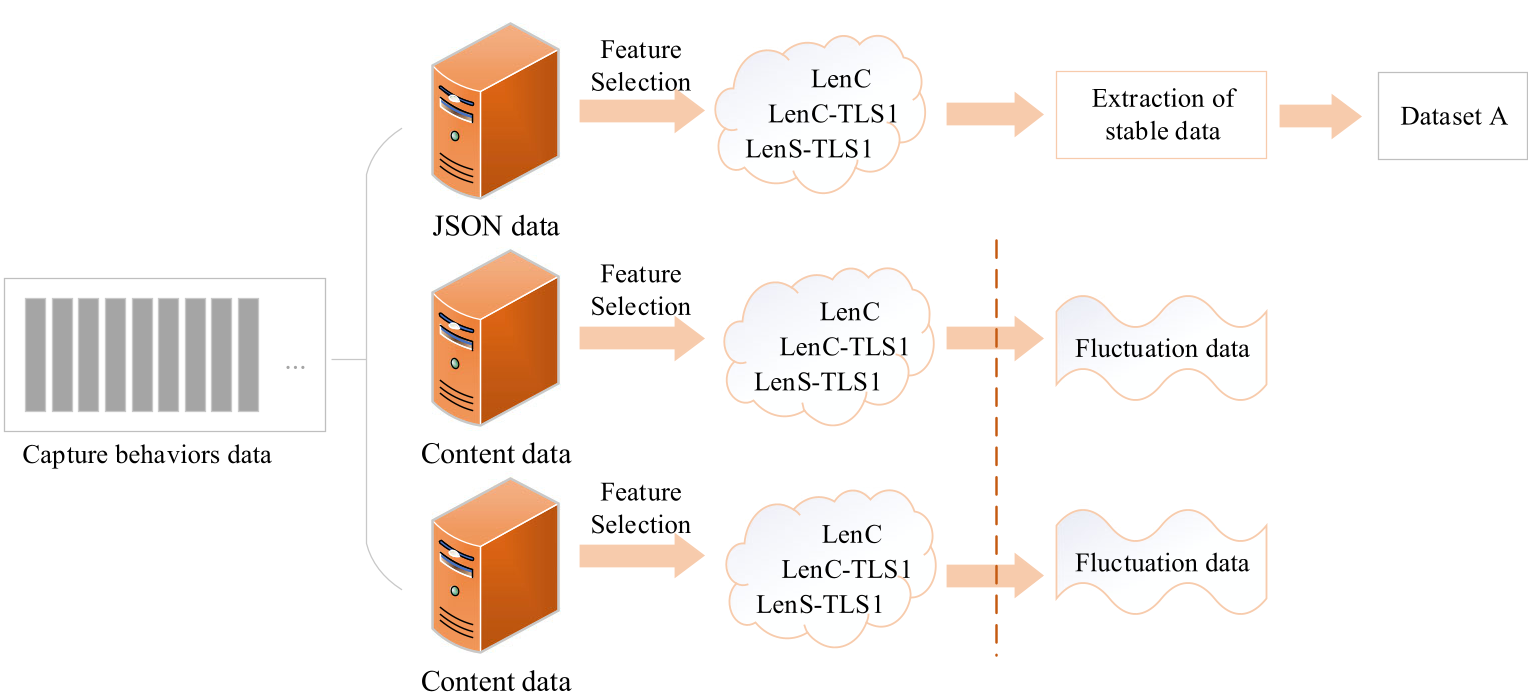
The authors of SFIM realized that modern social apps like Instagram use RESTful architectures. In this setup, there is a clear distinction between:
- Fluctuating Content: JPEG images and MP4 videos (affected by network quality/compression).
- Stable Control Data: JSON or XML files used to tell the app what to do (e.g., "User clicked LIKE").
By filtering specifically for these JSON-based Encrypted Application Data Units (EADU), SFIM extracts a signature that remains identical whether you are in a basement or a high-speed data center.
Methodology: From Entropy to High-Dimensional Vectors
The SFIM workflow follows a rigorous pipeline:
- EADU Restoration: Since a single EADU might be split across multiple TCP packets, the authors developed a custom algorithm to reconstruct the original unit length using TCP sequence and acknowledgment numbers.
- Feature Selection: Using Random Forest "feature importance" rankings, they identified three critical anchors: Request Length (LenC), and the lengths of the first TLS fragments for both request and response.
- Maximum Entropy Mapping: To avoid data imbalance, they used the principle of Maximum Entropy to divide the data distribution into ranges. This ensures the vector space is uniformly populated, reducing prediction risk.

Experimental Validation: Near-Perfect Accuracy
The authors tested SFIM against 9 distinct user behaviors on four different smartphone models (Samsung, Xiaomi, Huawei).
Key Performance Metrics:
- Accuracy: 99.8% (Average)
- Precision/Recall: 99.3%
- Best Performing Categories: 'Return' and 'Set up' (100% accuracy)
In a head-to-head comparison with models designed for WeChat (Hou et al.), SFIM provided significantly more stable results across categories. While other models fluctuated between 60% and 90% accuracy depending on the behavior, SFIM remained rock-solid near the 100% mark.
Deep Insight & Future Outlook
The "Magic" of SFIM lies in its Inductive Bias: it correctly assumes that the logic of an application (the JSON requests) is more characteristic of user behavior than the payload (the images).
Critical Analysis:
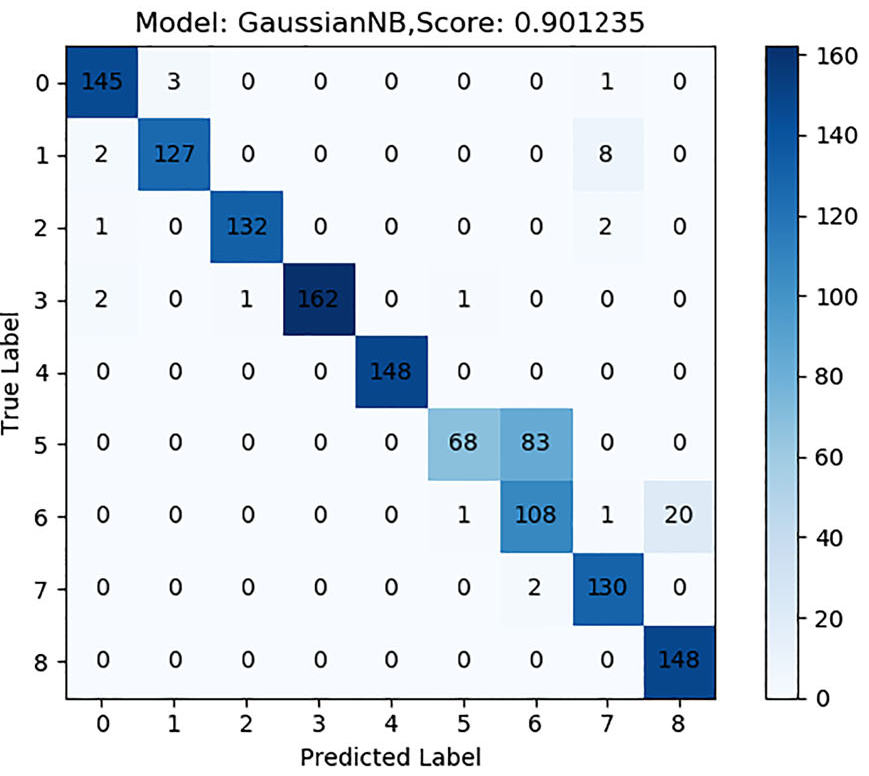
- The Sparse Advantage: The authors found that SVM (Support Vector Machines) outperformed other algorithms like Naive Bayes. This is likely because the high-dimensional mapping (450-D) creates a very sparse feature space where SVM's kernel-based separation is naturally superior.
- Limitations: The method currently requires manual labeling of behaviors during the training phase. If an application undergoes a major architectural update (changing its JSON structure), the model would likely need retraining.
Future Impact: This research serves as a wake-up call for application developers. Simply "encrypting" data isn't enough; the metadata—specifically the lengths and sequences of control packets—can be just as revealing as the plaintext itself. Future "Privacy by Design" might require adding dummy padding to JSON units to mask these distinctive stable signatures.
Summary Statement: SFIM proves that in the battle of privacy vs. traffic analysis, stability is the most dangerous weapon in a researcher's arsenal.