
SFPM: Solving the Fine-Grained Privacy Dilemma in Mobile Social Networks
SFPM: A Secure and Fine-Grained Privacy-Preserving Matching Protocol for Mobile Social Networking
The paper introduces SFPM, a Secure and Fine-grained Privacy-preserving Matching protocol for Proximity-based Mobile Social Networking (MSN). It utilizes a two-phase architecture—combining Cosine Similarity and Weighted -norm—to identify compatible users without exposing their private profile attributes, achieving significantly higher computational efficiency than Paillier-based methods.
TL;DR
Social discovery apps like WeChat or Twitter "People Nearby" often require users to share profiles to find similar friends. SFPM is a breakthrough protocol that allows for "ice-breaking" matches based on deep similarity (Weighted -norm) without the smartphone ever revealing the user's raw profile data to the cloud or the stranger. By replacing heavy public-key encryption with an efficient scalar-product method, it makes fine-grained matching practical for mobile hardware.
Background: Why "Fine-Grained" is Hard
Most "People Nearby" services use Private Set Intersection (PSI)—they simply check how many common tags (e.g., "Music," "Travel") you share with a neighbor. This is "coarse-grained."
If two people both like "Music," but one likes Classical (Level 10) and the other likes Heavy Metal (Level 1), a coarse-grained system treats them as a perfect match. Truly effective matching requires a "fine-grained" approach (vector distances), but calculating distances between encrypted vectors has historically required Paillier Encryption, which is so slow that it drains a smartphone's battery in minutes.
Methodology: The Two-Phase Filter
SFPM proposes a clever two-phase pipeline to balance accuracy and speed, managed by a semi-trusted Data Processing Center (DPC).
1. Vector Encryption & Offloading
Instead of standard RSA or ECC-based homomorphic encryption, SFPM uses a specialized symmetric encryption: This allows the DPC to compute dot products using simple modular multiplications while keep the values of (profile attributes) hidden behind random noise and secret keys.
2. The Architecture
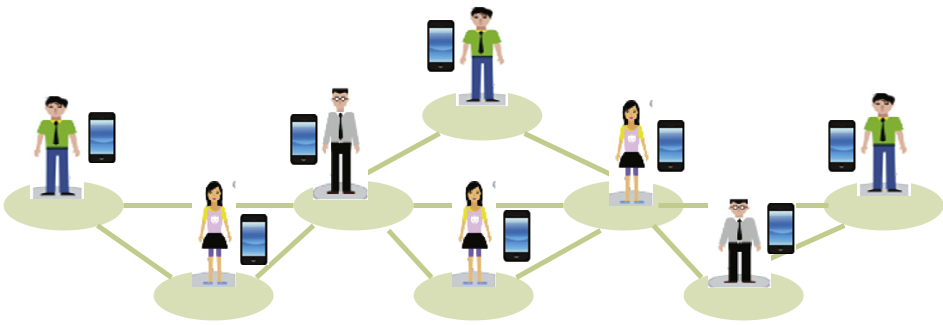
- Phase-I (Cosine Similarity): The DPC performs a broad sweep to filter out users with low correlation.
- Phase-II (Weighted -norm): For the top candidates, the system converts profile values into binary vectors to calculate precise, weighted distances. This accommodates the "User Self-Controllable" aspect, where you can decide that "Professional Background" is 5x more important than "Hobbies."
Performance: Goodbye, Exponentiation Latency
The technical brilliance of SFPM lies in its avoidance of modular exponentiation. In the Paillier-based protocols (like those by Zhang or He et al.), the user's phone must perform thousands of exponentiation operations.
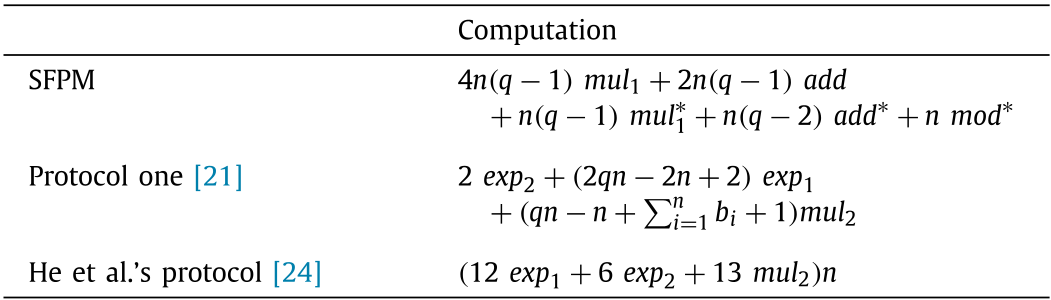
As shown in the performance evaluation, SFPM's computational complexity scales linearly with the number of attributes , but the operations are strictly multiplications and additions.
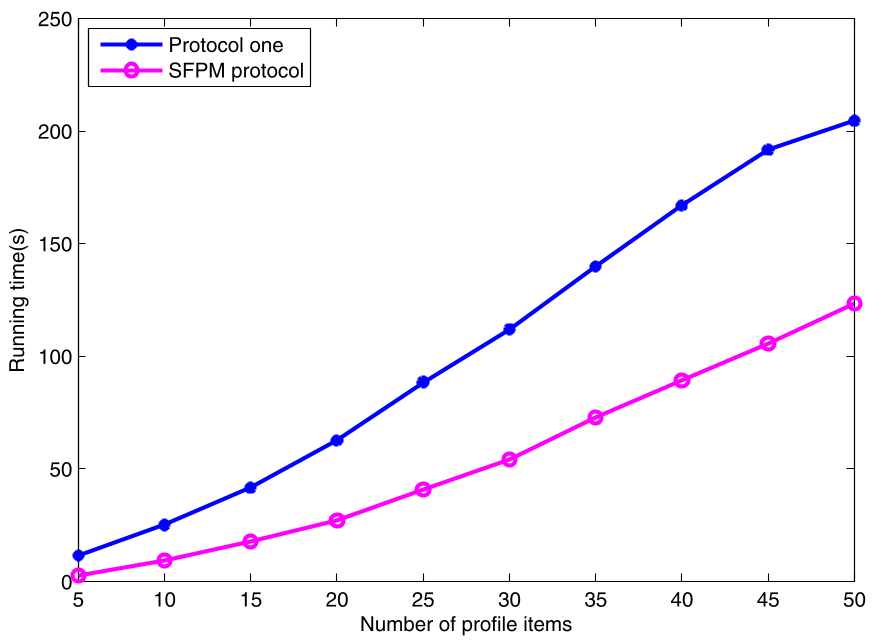
In real-world tests on Android 4.1 devices (the standard during the study), the gap in running time widened significantly as the profile size increased, proving that SFPM is far more scalable for "Big Data" social networking.
Security & Integrity
Unlike many theoretical protocols, SFPM accounts for Active Attacks. Using HMAC (Hash-based Message Authentication Code), the protocol ensures that even if a malicious actor (or the DPC itself) tries to tamper with the ciphertexts or inject "noise," the user can verify the integrity and source of the data.
Critical Analysis & Conclusion
Takeaway: SFPM successfully bridges the gap between high-security cryptographic theory and the practical constraints of mobile computing. It moves the burden of "Big Data" matching to the cloud (DPC) while keeping the keys and privacy in the hands of the user.
Limitations:
- Trust Model: It relies on a "honest-but-curious" DPC. If the DPC colluded with the Key Distribution Center (KDC), privacy could be compromised.
- Communication Overhead: Because it uses binary vector expansion for -norm calculations, the message size can grow if the range of attribute values () is very large (e.g., ).
Future iterations could replace the -norm with more computationally efficient metrics like -norm (Euclidean distance) directly in the encrypted domain to further optimize communication.