
SFPM: Redefining Fine-Grained Privacy in Mobile Social Discovery
SFPM: A Secure and Fine-Grained Privacy-Preserving Matching Protocol for Mobile Social Networking
The paper introduces SFPM, a Secure and Fine-grained Privacy-preserving Matching protocol for Proximity-based Mobile Social Networking (MSN). It utilizes a two-phase architecture—combining Cosine Similarity and Weighted -norm—to achieve high-precision friend recommendations while protecting user profile confidentiality via efficient scalar-product-preserving encryption.
1. Executive Summary
TL;DR: The SFPM (Secure and Fine-grained Privacy-preserving Matching) protocol solves the dilemma of "social discovery vs. data privacy" in mobile networks. It introduces a two-stage filter—Cosine Similarity followed by Weighted -norm—leveraging ultra-efficient encryption to allow users to find the best-matched friends without ever revealing their raw profile data to the cloud or strangers.
Positioning: This work represents a significant leap from coarse-grained Private Set Intersection (PSI) methods to fine-grained similarity scoring, prioritizing practical deployment on resource-constrained mobile devices.
2. Problem & Motivation: The Cost of Connection
In the era of Big Data, Mobile Social Networks (MSN) like WeChat or Twitter thrive on "Proximity-based Friend Recommendation" (PFR). However, matching profiles involves sharing sensitive interests, medical history, or lifestyle habits.
Prior Work Pitfalls:
- Coarse Grain: Older PSI-based methods only tell you if you share an attribute, not how much you care about it.
- Computation Bloat: Methods using Paillier homomorphic encryption are too slow for real-time mobile use, draining batteries and causing latency.
- Limited Security: Many existing protocols ignore message integrity, making them susceptible to tampering or noise injection.
3. Methodology: The Two-Phase Precision Filter
SFPM introduces a Data Processing Center (DPC) that acts as a semi-trusted mediator to handle the heavy lifting. The core "magic" lies in its two-phase approach:
Phase-I: The Broad Filter (Cosine Similarity)
Using an efficient scalar-product encryption, the DPC calculates the "angle" between user vectors. This determines general compatibility without unlocking individual attributes.
Phase-II: The Surgical Strike (Weighted -norm)
For the top candidates, the protocol shifts to a binary-expanded -norm calculation. This allows users to assign weights to specific attributes (e.g., "I care more about shared hobbies than professional background"), providing a truly personalized matching result.
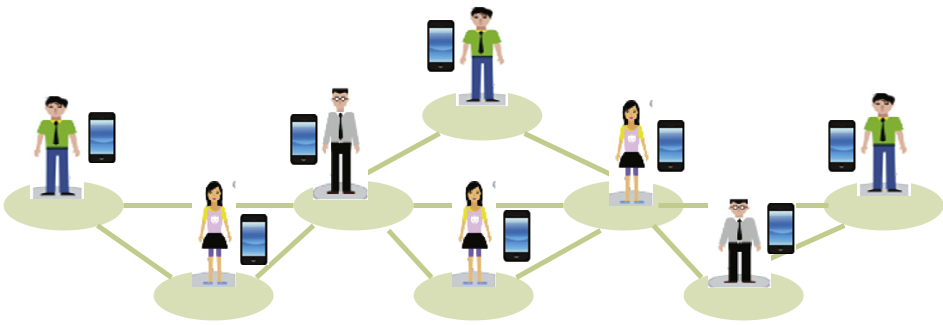 Figure 1: The SFPM system model involving the KDC, DPC, and mobile users.
4. Experiments & Results: Efficiency in Action
The authors didn't just stop at theory; they implemented SFPM on Meizu Android phones and an Intel i5 server.
Computational Superiority
By replacing expensive exponentiations with modular multiplications (), SFPM achieves a massive speedup. As shown in the benchmarking, while competing protocols' costs skyrocket with the number of profile items (), SFPM maintains a nearly linear and significantly lower growth curve.
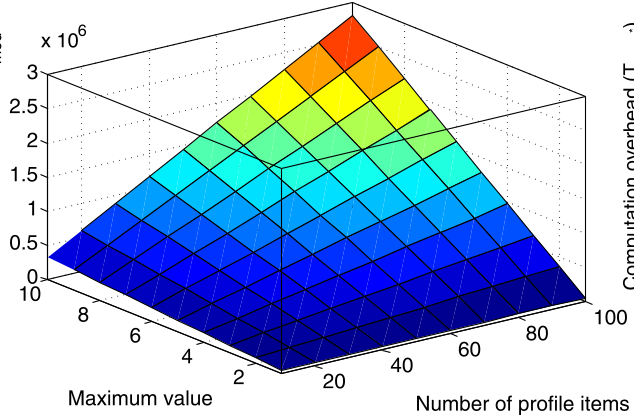 Figure 2: Computation complexity comparison demonstrating SFPM's efficiency over Zhang et al. and He et al.
Communication Trade-offs
SFPM introduces HMACs for security, which slightly increases packet size compared to non-authenticated protocols. However, in the age of 4G/5G, this extra overhead is negligible compared to the massive gains in security and speed.
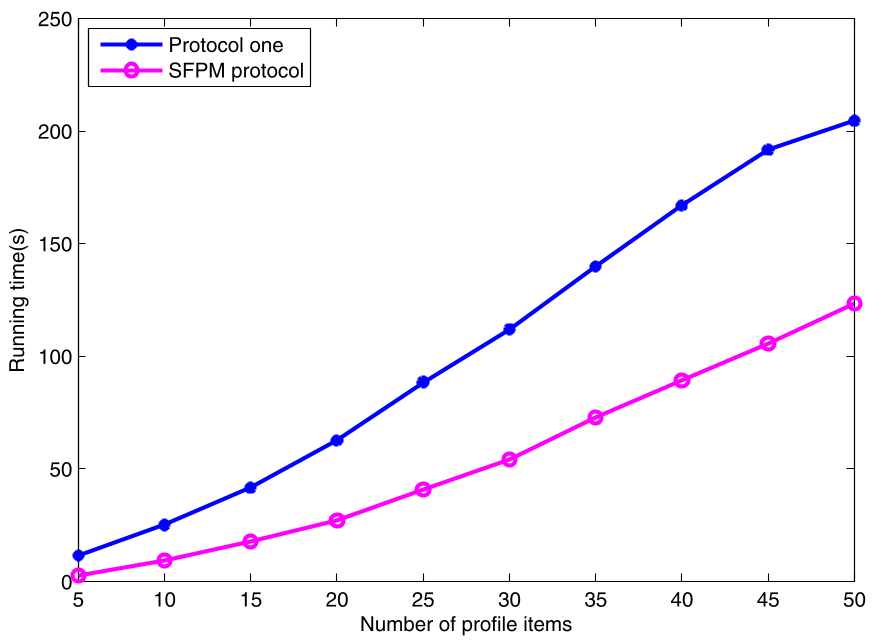 Figure 3: Average running time vs. number of profile items—SFPM remains efficient even as profile complexity grows.
5. Critical Analysis & Conclusion
Takeaway
SFPM successfully balances the "Privacy-Utility-Efficiency" triangle. Its primary contribution is the shift toward multi-stage matching, which allows for complex similarity metrics (like weighted ) without the typical performance tax.
Limitations
The protocol assumes a "semi-trusted" DPC. While the DPC cannot see the data, it still knows who is matching with whom. Future iterations could incorporate Anonymity Sets or Differential Privacy to hide social graph metadata.
Future Outlook
The authors suggest that while -norm is effective, the modular architecture of SFPM could potentially support -norm (Euclidean distance) or Jaccard similarity in the future, expanding its use cases for more complex Big Data mining tasks.