
SGT Framework: Beyond the Top-10 List for Recreational Web Search
SGT Framework: Social, Geographical and Temporal Relevance for Recreational Queries in Web Search
The paper introduces the SGT (Social, Geographical, and Temporal) framework, a system designed to rank and present Points of Interest (POIs) for recreational queries in web search. By leveraging large-scale Location-Based Social Network (LBSN) data from Foursquare and Facebook, it transitions from generic top-lists to intent-aware "result bundles" that categorize suggestions based on social context and time.
TL;DR
Most search engines treat "things to do in London" as a request for a generic list of tourist traps. This paper introduces the SGT Framework, which uses data from over 1 billion social check-ins and tips to understand the social, geographical, and temporal nuances of recreational queries. The core shift is from a linear list of results to intent-oriented bundles (e.g., "Best for Kids," "Nightlife," "Cheap Eats") that better match how humans actually plan leisure time.
The Motivation: Why Your Search Results Feel Generic
When a user searches for "cheap bars for a bachelor party in San Francisco," they aren't just looking for bars; they are looking for a specific atmosphere (Social), in a specific city (Geographical), and likely under specific constraints (Constraint).
The authors identify that current systems fail because:
- Lack of Personalization: Most web searchers are anonymous, making traditional collaborative filtering (like Netflix ratings) impossible.
- Missing Context: Static lists don't account for whether it is raining, whether the user has kids, or if it is a Saturday night versus a Monday morning.
- Information Overload: A list of 50 dots on a map is less helpful than 3 distinct groups of "what you might actually want."
Methodology: Mining the "Wisdom of the Crowd"
The SGT (Social, Geographical, Temporal) framework processes recreational queries through a multi-step pipeline:
1. The Recreational Taxonomy
The authors mapped queries into five dimensions:
- Geographical: City/State/Relative (e.g., "near me").
- Temporal: Seasons, time of day, or specific holidays.
- Activity Preference: Sightseeing, eating, relaxing.
- Activity Suitability: Romantic, kid-friendly, group-oriented.
- Activity Constraint: "Free," "lively," "quiet."
2. Solving Data Sparsity with Category Mapping
A major challenge in POI recommendation is that many local venues don't have enough "tips" (reviews) to be statistically significant. The SGT framework solves this by aggregating tips at the Category Level.
For example, if a specific park doesn't have a tip saying it's "good for kids," but the category Playground is strongly associated with the "kids" aspect across the entire dataset, that park gets a boost for "kids-related" queries.
 Equation: Category relevance scoring used to bridge the gap for long-tail POIs.
From Lists to Bundles (The UX Breakthrough)
The paper’s most impactful contribution is the move toward Bundling. Instead of a ranked list from 1–10, the UI presents clusters of results.
 Comparison: Linear lists (left) provide zero context, whereas bundles (right) categorize options based on intent like "with kids" or "at night".
Experimental Results
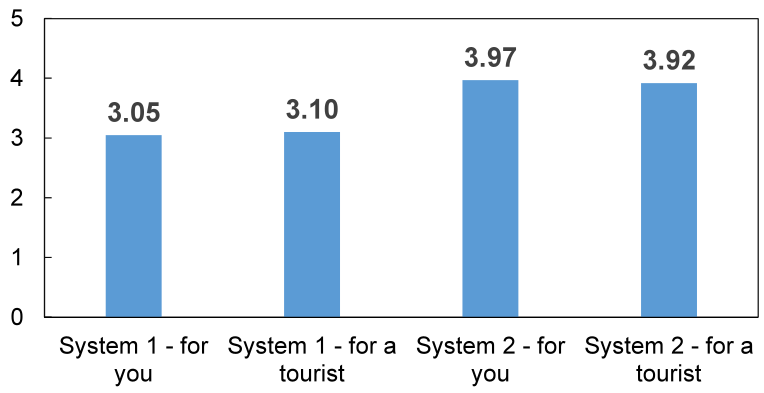
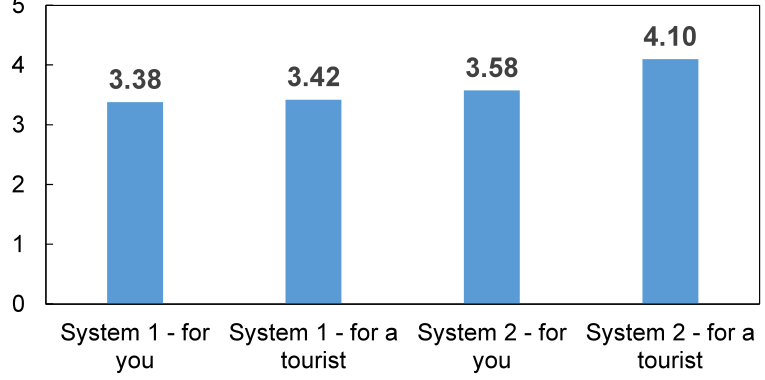
The researchers conducted a user study comparing linear lists to SGT bundles. The results showed a clear preference for the bundled approach.
- Discovery: Users found more "unusual" or "hidden gem" options in bundles.
- Utility: Even users who were residents of a city found the bundles useful for organizing their thoughts, suggesting the relevance model effectively captured the "local vibe" of different POI categories.
Critical Analysis & Future Outlook
While this 2016 work predates the LLM era, its core insight remains vital: intent is multi-dimensional. Today, we would use Transformer models to extract sentiment and intent from tips more accurately than the keyword-matching used here.
Limitations:
- The system doesn't yet account for "trendiness" (real-time spikes).
- The evaluation was small-scale (10 users).
Future Work: The next logic step is Personalization without History. Can we use the current query's linguistic nuances to predict a user's latent preferences without needing their past check-in data? The SGT framework provides the architectural foundation for that evolution.