
Shape Anisotropy: The Hidden Architect of Active Turbulence and Swarming
Shape anisotropy governs organization of active rods: Swarming, turbulence, flocking, and jamming.
The study presents a comprehensive experimental and simulation-based framework to explore the collective dynamics of light-driven, self-propelled colloidal rods. By systematically tuning shape anisotropy (aspect ratio) and area fraction, the authors identified a diverse state diagram including swarming, active turbulence, flocking, and jamming, achieving a synthetic model that mimics complex biological microswimmer behaviors.
TL;DR
Researchers have developed a tunable synthetic model using light-driven colloidal rods to decode the "alphabet" of collective motion. By simply changing the length-to-width ratio (aspect ratio) and the density of these rods, they can trigger a spectrum of behaviors: from the chaotic swirls of active turbulence to the coordinated march of flocking. The findings provide a physical blueprint for understanding how bacteria like E. coli move and offer new rules for designing "smart" self-propelling materials.
Background: Beyond Spheres
In the world of active matter, spherical particles have been the "hydrogen atom"—simple and well-studied. However, most biological swimmers, from bacteria to sperm, are elongated. This rod-like shape introduces a critical variable: Shape Anisotropy. Elongated particles don't just bump into each other; they align, create specific fluid flows (hydrodynamics), and experience unique steric (physical crowding) constraints.
The Core Problem: Decoupling Biology from Physics
Why do bacteria swarm? Is it "quorum sensing" (chemical communication), or is it just the physics of being a rod in a fluid? Previous "dry" experiments using granular rods lacked the fluid-mediated forces that make biological motion so complex. This study fills that gap by creating a minimal synthetic model—light-activated rods that mimic the hydrodynamic "pusher" behavior of real bacteria.
Methodology: Tuning the Micro-Swimmers
The authors synthesized rods with a TiO2 head and a SiO2 tail. Under green light, a chemical reaction at the head drives the rod forward.
Mapping the Flow
Using Particle Image Velocimetry (PIV), the team visualized how these rods "breathe" in the fluid. They discovered a pusher-type mechanism: fluid is pushed out from the head and drawn in at the tail, creating a dipole flow field that scales as .
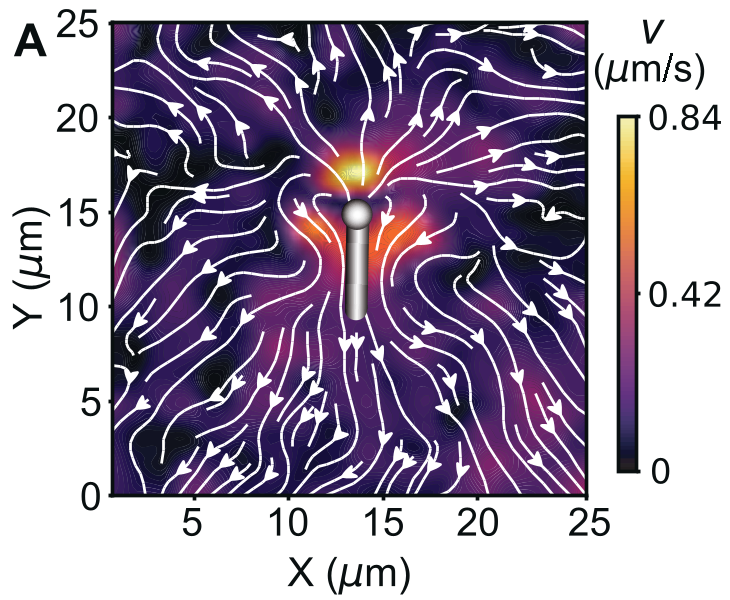 Figure 1: (A) Flow streamlines showing pusher-type behavior. (C-F) Evolution of states from isotropic to large clusters as density increases.
The State Diagram: A Universe of Motion
One of the paper's most significant contributions is the comprehensive State Diagram. By varying the aspect ratio () and area fraction (), they mapped out several "phases" of matter:
- Isotropic: Random Brownian motion at low densities.
- Swarming: Small, polar-aligned clusters that move together.
- Active Turbulence: Chaotic, swirling vortices observed primarily at intermediate aspect ratios ().
- Flocking: Large-scale coordinated motion, dominant in highly elongated rods ().
- Jamming: Complete immobilization due to extreme crowding.
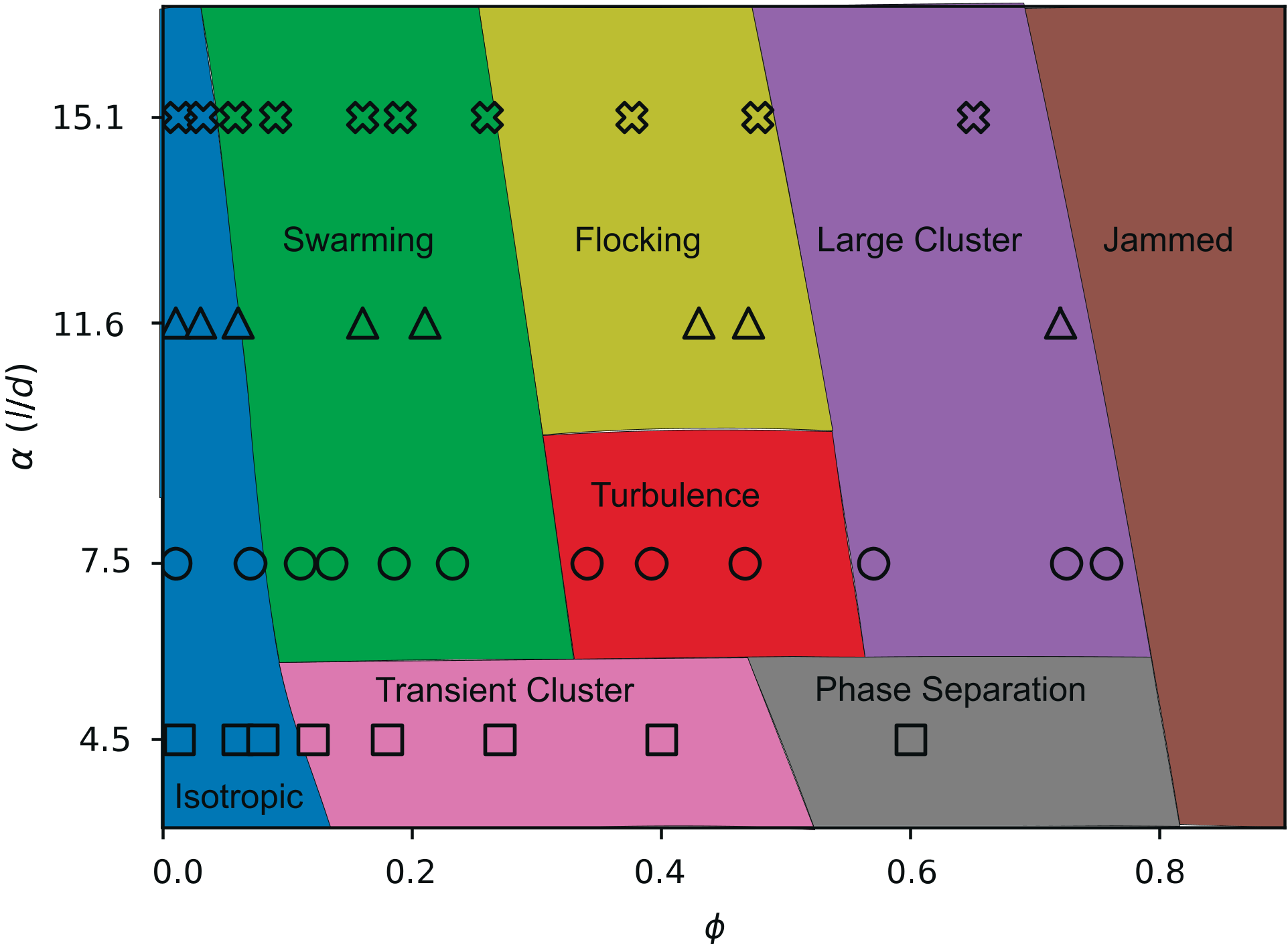 Figure 2: The experimental state diagram illustrating how aspect ratio and density govern collective behavior.
Deep Insight: Why Turbulence Disappears
A fascinating finding is that Active Turbulence is sensitive to length. While rods with exhibit chaotic vortices, extremely long rods () do not. In long rods, steric alignment (the physical need to stay parallel) is so strong that it overrides the hydrodynamic torques that would otherwise create swirls. This explains a long-standing biological mystery: why wild-type B. subtilis (intermediate length) are turbulent, while their elongated mutants are not.
Quantitative Evidence: Giant Number Fluctuations (GNF)
To prove these systems are truly "out-of-equilibrium," the authors measured density fluctuations. In a normal container of gas, the number of particles doesn't vary much. In these active swarms, however, the researchers found Giant Number Fluctuations, where density varies far more than predicted by standard statistics. The turbulent state showed the highest "anomalous" scaling, a hallmark of chaotic active systems.
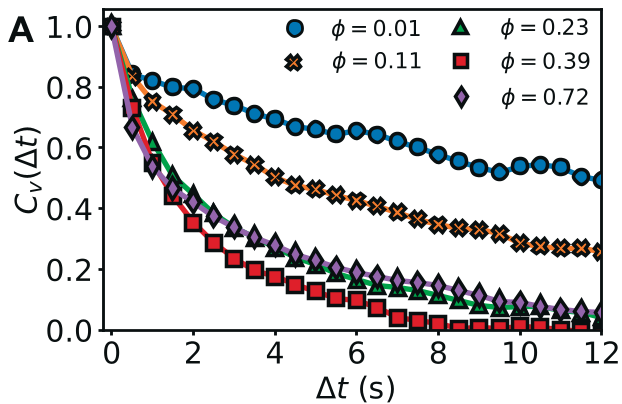 Figure 3: Velocity autocorrelation and Number Fluctuations across different states.
Conclusion & Future Outlook
This study proves that the self-organization of micro-swimmers is a delicate balance between how they are shaped and how they move the fluid around them.
- Takeaway: Hydrodynamic interactions are the "glue" for turbulence, but shape anisotropy is the "governor" that controls whether the system swirls or flocks.
- Implication: For engineers, this provides a "design manual" for programming synthetic swarms for targeted drug delivery or micro-fluidic mixing.
- Limitation: The current model is quasi-2D (sedimented at a wall); future work could explore how 3D boundaries change these phase boundaries.