
Deciphering the Geometry of Life: How Shape Anisotropy Dictates the Chaos and Order of Active Rods
Shape anisotropy governs organization of active rods: Swarming, turbulence, flocking, and jamming.
This study uses light-driven, TiO2-headed colloidal rods to investigate the self-organization of polar active matter. By systematically varying aspect ratio and area fraction, researchers identified a complete state diagram including swarming, active turbulence, flocking, and jamming, achieving a synthetic minimal model for biological swimmers like E. coli.
TL;DR
Researchers have uncovered a "universal state diagram" for active matter by studying synthetic light-powered colloidal rods. By simply tuning the length-to-width ratio (aspect ratio) and concentration, the system shifts from random motion to coordinated swarms, chaotic "active turbulence," and eventually solid-like jamming. This work provides a physical explanation for why bacteria evolved specific shapes to optimize their survival.
Background Positioning: The Missing Link in Active Matter
In the world of active soft matter, we have long understood how spheres (Active Brownian Particles) cluster. However, most biological swimmers—from E. coli to sperm—are rod-shaped. Previous "dry" models (like vibrating grains) missed the crucial fluid physics (hydrodynamics), while "wet" biological observations are often muddled by complex genetics. This paper acts as a SOTA Bridge, providing a minimal synthetic model that perfectly replicates biological phases through pure physics.
Problem & Motivation: Why Shape Matters
Why do some groups of swimmers move like an army (flocking) while others look like a stormy sea (turbulence)? The authors hypothesized that the answer lies in shape anisotropy.
- Short Rods: Suffer from high rotational diffusion; they get "kicked" off course by thermal noise too easily to form stable groups.
- Long Rods: Have intense steric alignment; they "lock" into parallel tracks, suppressing chaos.
- The "Goldilocks" Zone: There is a specific middle ground where rods are long enough to align but short enough to be reoriented by fluid torques, creating the mesmerizing vortices of active turbulence.
Methodology: Brewing "Pusher" Rods
The team synthesized rods with a catalytic TiO2 head and an inert SiO2 tail. Under green light, a chemical reaction at the head pushes fluid outward.
- The Mechanism: The rods are "pushers," meaning fluid is drawn in at the sides and ejected from the front and back.
- Experimental Precision: Using PIV (Particle Image Velocimetry), they tracked tracer particles to prove that the fluid velocity decays as , confirming a dipole-like hydrodynamic flow.
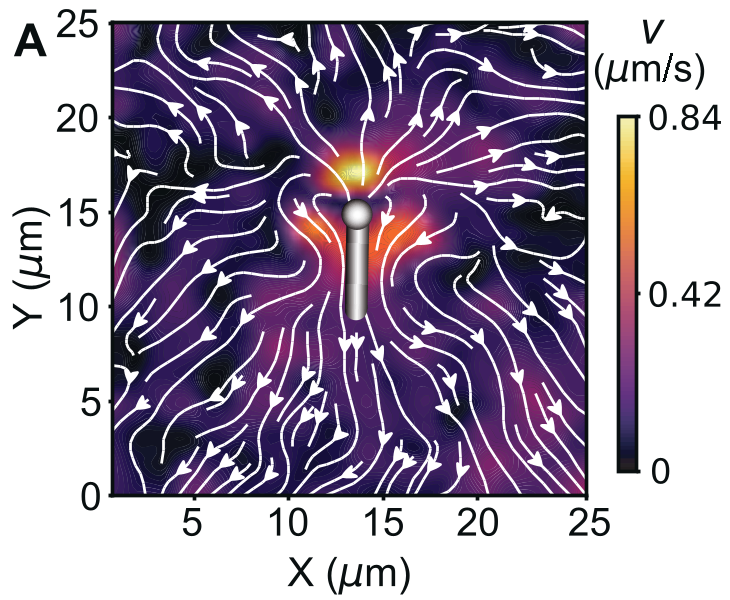 Figure 1: (A) Flow streamlines showing pusher-type behavior. (C-F) Transition from isotropic gas to swarming, turbulence, and large clusters.
Experiments & Results: The Rise of Active Turbulence
The most striking discovery occurred at an aspect ratio of . As the area fraction () reached ~0.4, the system didn't just align—it exploded into a chaotic state of counter-rotating vortices.
- Vortex Life: These vortices live for 2-3 seconds before dissolving and reforming.
- Energy Spectra: The energy distribution followed a specific power law (), a hallmark of "Active Turbulence" also seen in dense bacterial suspensions.
- Giant Number Fluctuations (GNF): The system broke standard equilibrium laws. In a normal system, density fluctuations follow a square-root law; here, the exponent reached 0.17, indicating massive, non-equilibrium clustering.
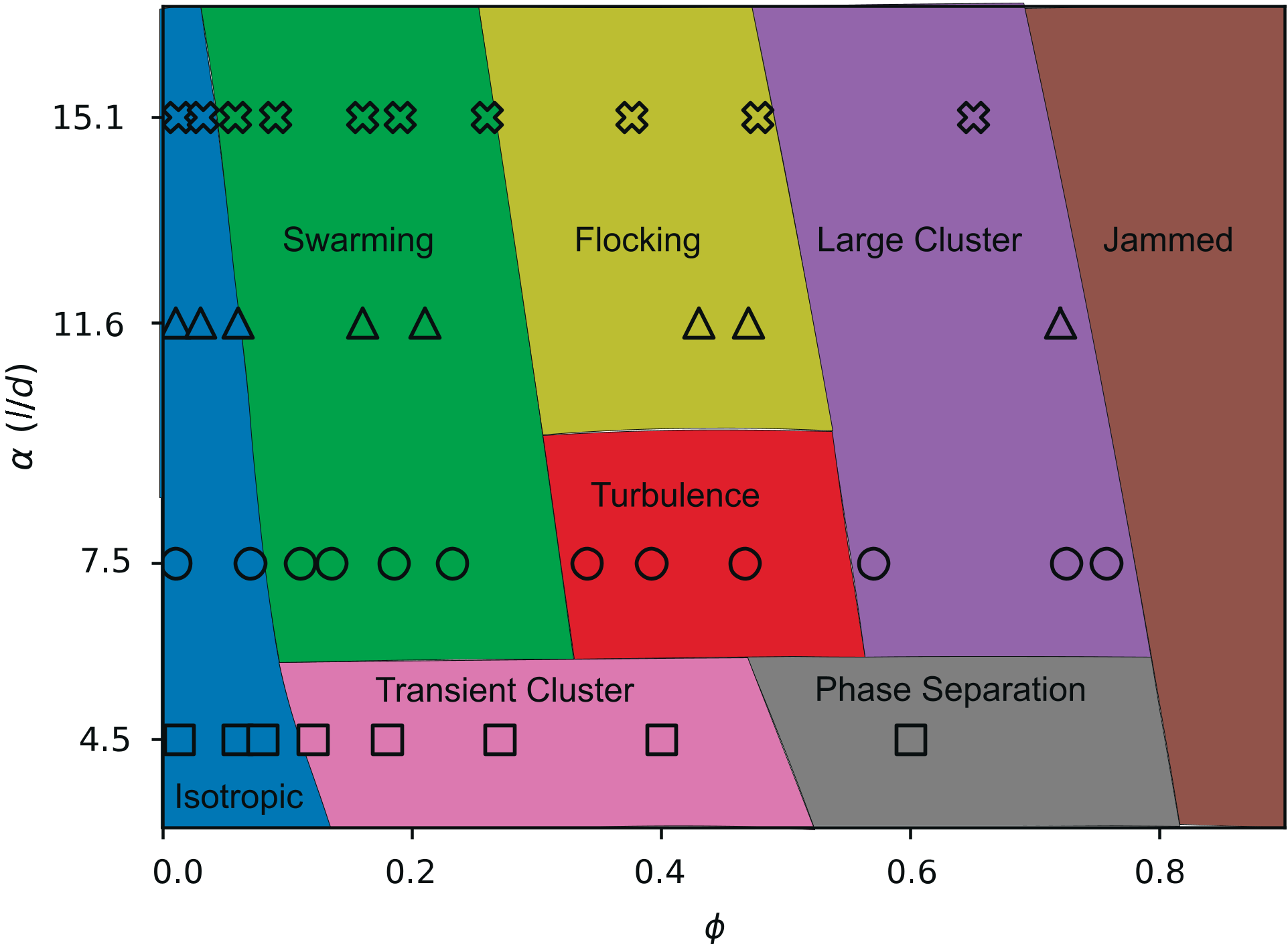 Figure 2: The Master State Diagram. Colors indicate the dominant collective behavior based on aspect ratio and concentration.
The Simulation Verification
To prove it was the fluid causing the chaos, the authors ran simulations without hydrodynamics. Result? They could replicate swarming and jamming, but turbulence vanished. This confirms that active turbulence is a purely hydrodynamic phenomenon—a "stress" between fluid flow and rod orientation.
Critical Analysis & Conclusion
The Evolution Connection
The authors conclude with a profound biological insight: E. coli and B. subtilis typically have aspect ratios between 5.6 and 6.3. This study shows that this specific range is the "sweet spot" for generating turbulence. By being turbulent, bacterial colonies can mix the surrounding fluid, bringing in fresh nutrients and flushing out waste much faster than simple diffusion would allow.
Takeaway for Future Tech
This framework allows us to "program" synthetic materials. If you want a micro-robot swarm to mix a fluid, use intermediate-length rods. If you want them to transport cargo in a straight line, use long, high-aspect-ratio rods.
Limitations: The study is quasi-2D (particles on a surface). Future work must explore whether 3D environments introduce new topological defects or different scaling laws for the turbulent regime.
Final Verdict: A masterclass in using synthetic "minimal models" to solve high-level biological mysteries.