
The Geometry of Chaos: How Rod Shape Directs the Collective Dance of Micro-Robots
Shape anisotropy governs organization of active rods: Swarming, turbulence, flocking, and jamming.
This study investigates the self-organization of light-driven TiO2-SiO2 micro-rods through combined experiments and Brownian dynamics simulations. By systematically tuning rod aspect ratio () and area fraction (), the researchers mapped a comprehensive state diagram transitioning from active Brownian motion to swarming, active turbulence, flocking, and jamming.
TL;DR
Researchers have uncovered that the "slimness" of a micro-rod (its aspect ratio) determines whether a group of them will move in a synchronized flock, a chaotic swirl, or a jammed crowd. By creating light-powered synthetic rods, the team mapped a "State Diagram" that explains why certain bacteria might have evolved specific shapes to maximize survival through efficient fluid mixing.
The Motivation: Nature's Design Rules
Why is E. coli shaped like a pill rather than a sphere? In the world of active matter, shape is not just an aesthetic choice; it’s a fundamental control knob. While we’ve understood "Motility-Induced Phase Separation" (MIPS) in spherical particles for years, the rules for elongated "rods" are far more complex. These particles don't just bump into each other; they align, create complex fluid flows, and influence their neighbors from a distance.
The authors set out to bridge the gap between "dry" granular models—which ignore the fluid—and real biological systems, by creating a "minimal model" of synthetic rods where the fluid environment is as important as the particles themselves.
Methodology: Brewing Light-Powered Rods
The researchers synthesized Janus-like rods with a Titania (TiO2) head and a Silica (SiO2) tail. When bathed in green light, a chemical reaction at the TiO2 head generates a gradient that pushes the rod forward.
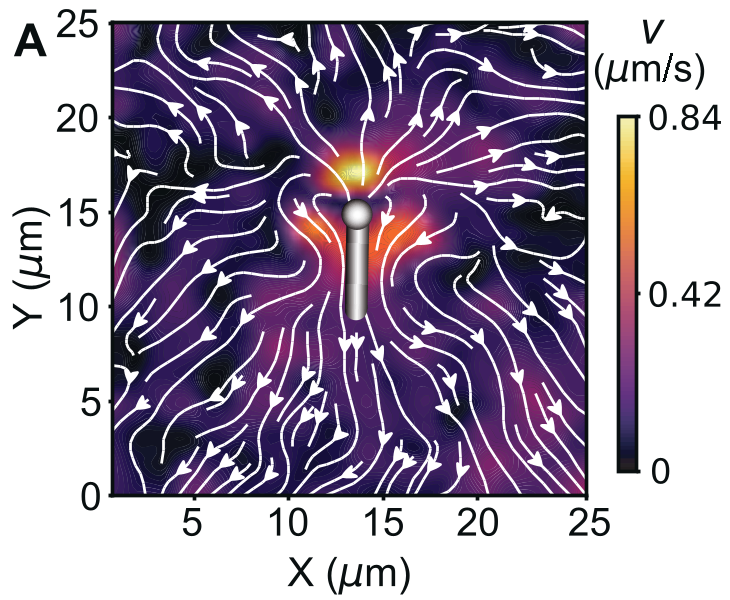 Fig 1: Micro-rod synthesis and the "pusher" hydrodynamic flow field, where fluid is ejected from the head and drawn back into the tail.
By tracking passive "tracer" particles around these rods, they confirmed the rods are "Pushers". They push fluid away at the front and pull it in at the rear, creating a dipole-like flow field that facilitates alignment and attraction—key ingredients for collective behavior.
Results: From Swarms to Turbulence
The team discovered that by changing the rod's length-to-width ratio () and their density (), the system enters wildly different physical states:
- Isotropic (, low ): Random, independent movement.
- Swarming (, medium ): Coordinated, small groups moving together.
- Active Turbulence (, ): A chaotic state of rotating vortices. This is the paper's "Goldilocks" zone—where hydrodynamics and steric collisions perfectly balance to create messy, high-energy mixing.
- Flocking (, medium ): Long, thin rods align so strongly that they suppress chaos, moving as stable, coherent "flocks."
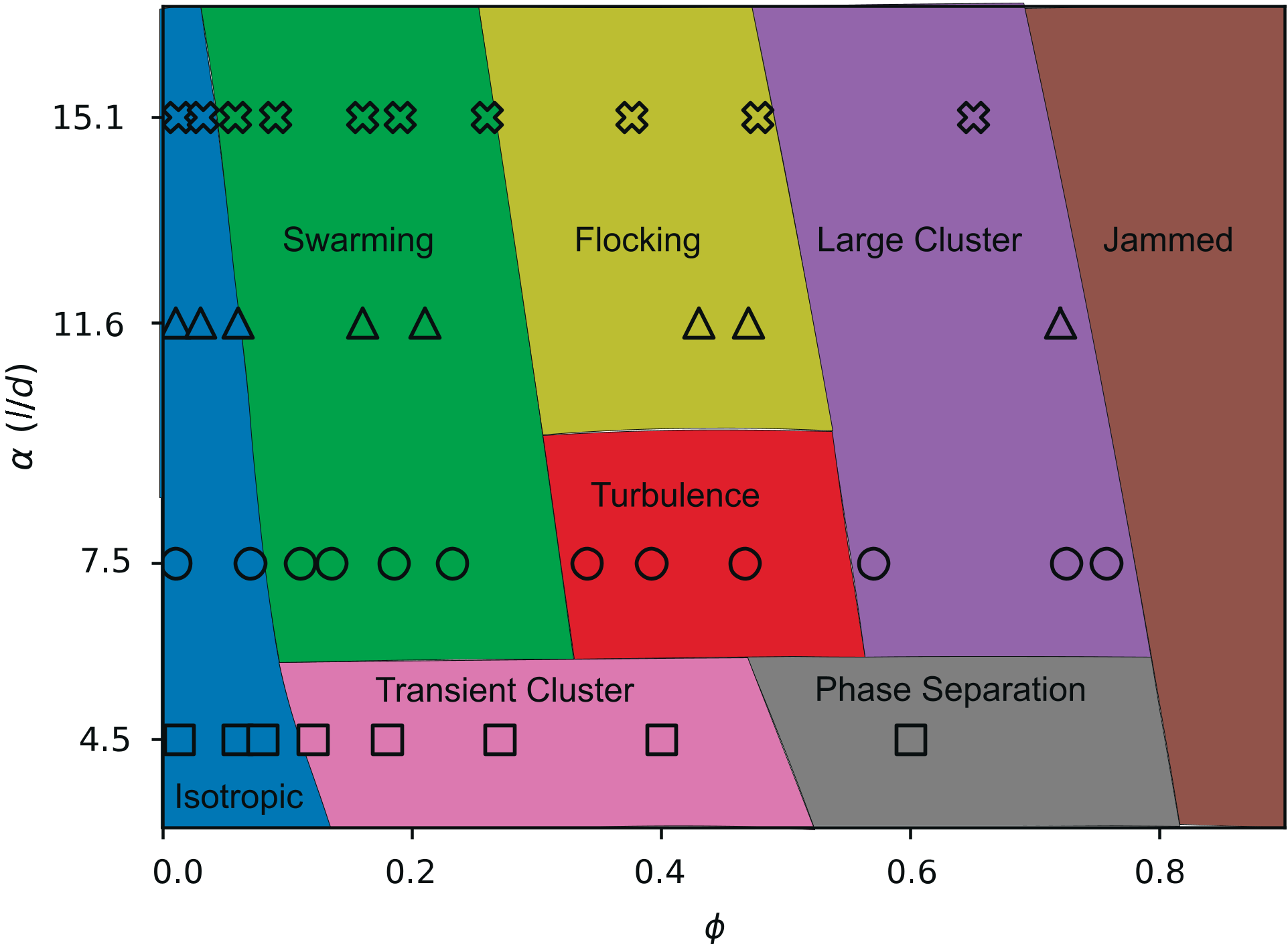 Fig 2: The master State Diagram showing how aspect ratio and area fraction govern the phase transitions.
The Secret Sauce: Hydrodynamic Torques
One of the most profound insights came from the comparison between experiments and "no-fluid" simulations. In simulations without hydrodynamics, the system could swarm and jam, but it never became turbulent. This proves that the chaotic swirling motion in active matter is a direct result of fluid "torques"—the invisible hands of the liquid turning the rods against each other.
Why Should We Care?
This research provides a physical rationale for a long-standing biological mystery. "Wild-type" bacteria often have intermediate aspect ratios (around 5-6), which this study shows is the ideal range for generating active turbulence. Elongated mutants, however, struggle to create this chaos. This suggests that bacteria may have evolved their shapes specifically to stir the fluids around them, ensuring they never run out of nutrients or get trapped in their own waste.
Conclusion and Future Outlook
This work builds a rigorous framework for "Shape Anisotropy" in active matter. It moves us closer to designing programmable synthetic materials—tiny robots that can switch from a stable transport mode (flocking) to a high-efficiency mixing mode (turbulence) simply by changing their environment or concentration.
Limitations: The current study is primarily 2D. Moving to 3D environments where hydrodynamic interactions are more complex remains the next great frontier for the "Active Soft Matter" community.