
Shape Anisotropy: The Hidden Controller of Active Swarms and Turbulence
Shape anisotropy governs organization of active rods: Swarming, turbulence, flocking, and jamming.
This study investigates the self-organization of light-driven, polar self-propelled colloidal rods, identifying how shape anisotropy (aspect ratio) and concentration dictate collective phases. The authors used TiO2-SiO2 Janus rods to map a comprehensive state diagram encompassing swarming, active turbulence, flocking, and jamming, showing that intermediate aspect ratios are critical for biological-like turbulence.
TL;DR
Why do bacteria like E. coli look the way they do? This study reveals that the "aspect ratio" (length-to-width) of a microswimmer is not just a biological coincidence but a fundamental physical lever. By creating synthetic light-driven rods, researchers have mapped a "state diagram" showing how simple changes in shape and density can flip a system from orderly swarming to chaotic "active turbulence," or even total jamming.
Background: Beyond the Sphere
Most models of "Active Brownian Particles" focus on spheres. While useful, spheres are boring—they don't have an orientation-dependent personality. Real biological swimmers are elongated. This elongation introduces Shape Anisotropy, which forces particles to align when they collide (steric interaction) and creates complex fluid wakes (hydrodynamic interaction).
The authors synthesized TiO2-headed silica rods that "swim" when exposed to green light. By growing these rods to different lengths, they could finally answer: How does shape alone change the collective fate of a swarm?
The Core Mechanism: Pushers and Phoretics
The rods function as "pushers." Chemical reactions at the Titania head push fluid away at the front and draw it in from the back.
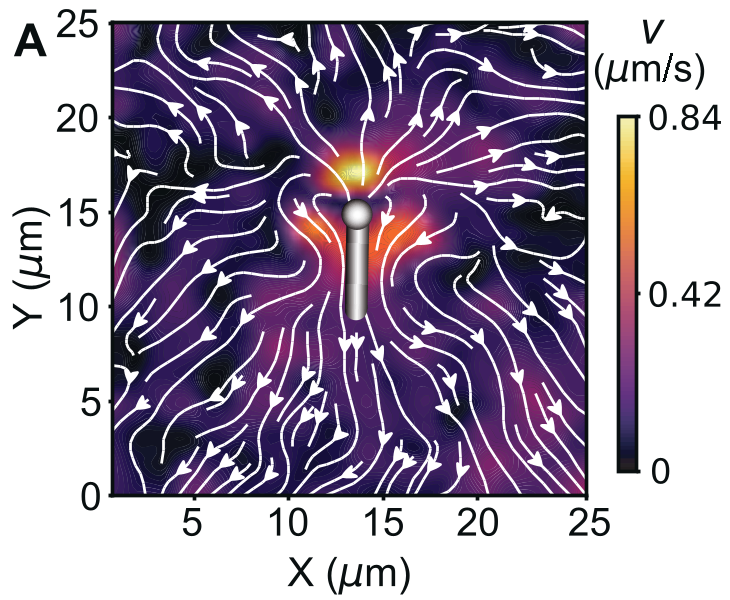 Figure 1: PIV analysis confirms the pusher-type mechanism, where streamlines reveal fluid being pushed forward and drawn in behind the head.
This flow field is the "secret sauce." When two rods approach, their wakes interact. If they are moving together at an acute angle, they attract. If they meet head-on, they repel. The researchers used pNIPAM-coated tracers to prove that these interactions are a mix of fluid dynamics (hydrodynamics) and chemical gradients (phoresis).
The State Diagram: A Universe of Behaviors
By sweeping through different aspect ratios () and area fractions (), the team discovered a rich landscape:
- Isotropic (Low ): Random, independent movement.
- Swarming: Small groups align and move coherently.
- Active Turbulence (The Sweet Spot): Only seen at . The system forms chaotic, rotating vortices.
- Flocking: Long rods () align so strongly that turbulence is suppressed; they move in massive, slow-moving "flocks."
- Phase Separation: Short rods () can't stay aligned; they just clump into dense, disorganized "islands."
- Jamming (High ): The system becomes a microscopic traffic jam.
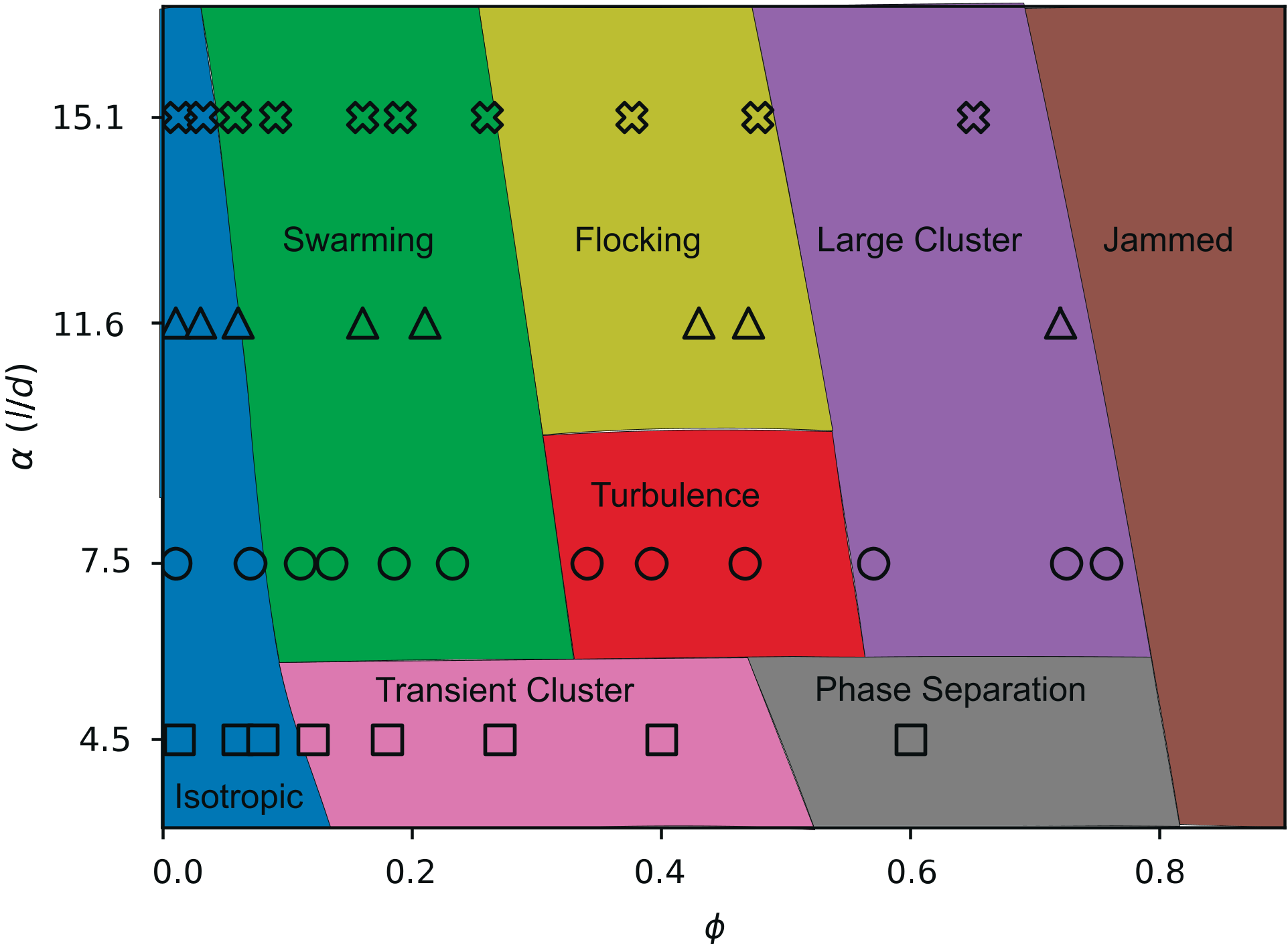 Figure 2: The master state diagram showing how shape () and density () define the collective phase.
Deep Insight: Why Turbulence Disappears
A fascinating finding is that Active Turbulence (the chaotic swirling often seen in dense bacterial cultures) requires a delicate balance.
- Short rods lose their orientation too fast (high rotational diffusion) to form vortices.
- Long rods align too perfectly (low rotational diffusion), creating stable flocks that resist the "tilting" needed for chaos.
- Intermediate rods () are just "floppy" enough to allow hydrodynamic torques to destabilize order, creating the beautiful, churning energy spectra characteristic of turbulence.
Critical Analysis & Takeaways
The study’s most profound impact is providing a physical rationale for biological evolution. Wild-type E. coli typically have aspect ratios around 5–6, putting them right in the "Turbulent Zone." This likely optimizes their ability to mix their environment and find nutrients.
Limitations: The study is conducted in a quasi-2D plane near a wall. While this captures many features of bacterial biofilms, 3D bulk behavior might introduce different hydrodynamic constraints.
Future Outlook: This work sets the stage for "Programmable Active Matter." Imagine synthetic micro-robots where we change their behavior not through complex coding, but by simply manufacturing them to be longer or shorter.