
Shape Anisotropy: The Hidden Architect of Collective Motion in Active Rods
Shape anisotropy governs organization of active rods: Swarming, turbulence, flocking, and jamming.
This study investigates the self-organization of light-driven, polar self-propelled colloidal rods using a combination of experiments and Brownian dynamics simulations. By systematically tuning shape anisotropy (aspect ratio) and area fraction, the researchers identified a diverse state diagram including swarming, active turbulence, flocking, and jamming, achieving a synthetic model that physically replicates complex biological collective behaviors.
TL;DR
Researchers have developed a tunable synthetic model of self-propelled colloidal rods to decode how particle shape and density dictate the transition from chaotic "active turbulence" to coordinated "flocking." By manipulating aspect ratios, the study proves that the physical geometry of a swimmer—independent of biological signaling—is enough to drive complex organizational states similar to those seen in bacterial colonies.
Perspective: Moving Beyond Spheres
In the realm of active matter, spherical particles have been the "standard candle." However, life is rarely spherical. From E. coli to microtubules, many biological swimmers are rod-like. This elongated geometry introduces a critical variable: Shape Anisotropy.
The central challenge has been decoupling "nature" from "nurture"—are bacteria swarming because of complex biological quorum sensing, or is it simply the physics of being a rod in a crowded fluid? By creating light-activated TiO2-SiO2 rods, this paper provides a "minimal model" to answer that question.
The "Pusher" Mechanism: Physics of the Flow
At the heart of the methodology is the photocatalytic reaction at the rod's head. When exposed to green light, the rods become "pushers." PIV (Particle Image Velocimetry) analysis revealed that fluid is pushed away from the head and drawn in at the tail.
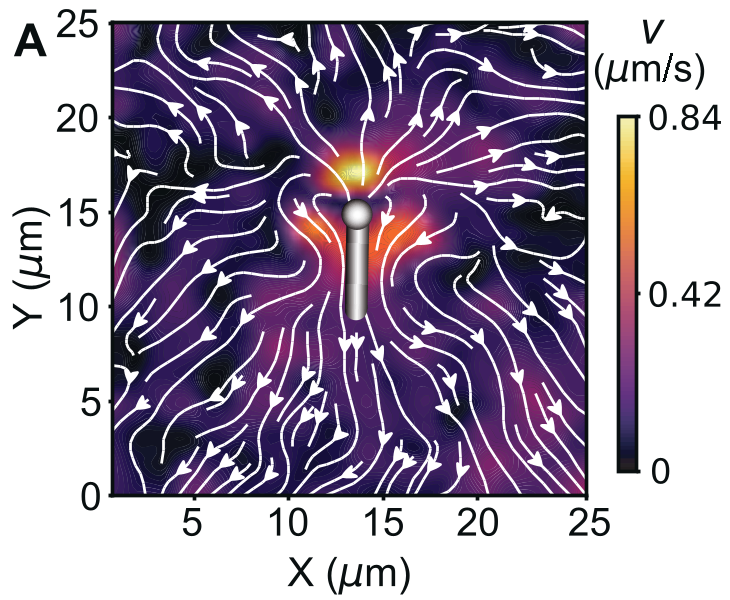 Figure 1: (A) Streamlines showing the pusher-type hydrodynamic flow. (C-F) Progression of collective states from isotropic to large clusters.
Interestingly, the authors used pNIPAM-coated tracers to "blind" the system to phoretic effects, proving that the flow is a complex cocktail of hydrodynamic and osmotic components. This distinction is vital for researchers attempting to build synthetic systems that truly mimic biological fluid environments.
The State Diagram: A Roadmap of Emergent Behavior
The most striking contribution of this work is the Experimental State Diagram. It maps the behavior of the rods across two axes: Aspect Ratio () and Area Fraction ().
- Intermediate Anisotropy (): This is the "sweet spot" for chaos. Here, hydrodynamic torques are strong enough to destabilize alignment, creating active turbulence. Think of it as a microscopic mosh pit of rotating vortices.
- High Anisotropy (): Longer rods act like disciplined soldiers. Steric hindrance (the sheer physical presence of the neighbor) overrides the chaotic fluid torques, leading to flocking—where large groups move with a unified, local polar order.
- Low Anisotropy (): Shorter rods lack the "leverage" for stable alignment, resulting in transient clusters that quickly dissolve due to high rotational diffusion.
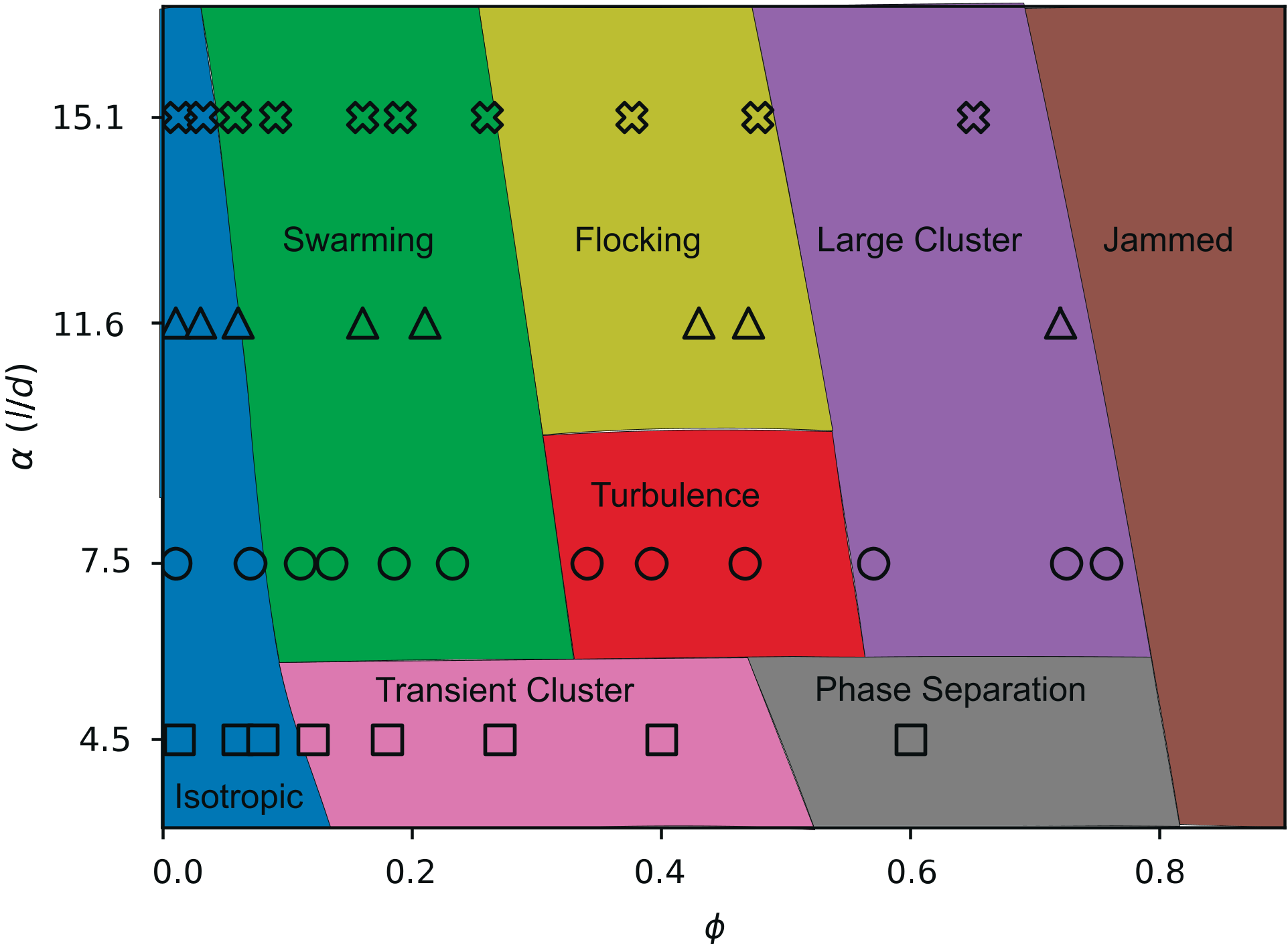 Figure 2: The universal state diagram showing how shape () and concentration () govern phases like turbulence and flocking.
Why Turbulence Disappears: The Steric vs. Hydrodynamic Tug-of-War
A key insight comes from comparing the experiments to Brownian Dynamics Simulations. The simulations—which accounted for steric repulsion but ignored hydrodynamics—successfully predicted swarming and jamming but failed to reproduce turbulence.
This confirms a fundamental theory: Active turbulence is not just about collisions; it is a fluid-mechanical phenomenon. The fluid torques are essential to reorienting the rods and generating the rotational stress needed for vortices. When rods get too long (), they physically block these rotations, effectively "freezing out" the turbulence into a more ordered flock.
Deep Insight: Evolution’s Design Rule?
The study concludes with a provocative biological observation. Wild-type E. coli typically have aspect ratios around 5-6—well within the turbulent regime. Mutants with much larger aspect ratios fail to produce turbulence.
The researchers suggest that nature may have selected these specific geometries to optimize mixing and transport. A colony that can generate active turbulence is better at distributing nutrients than one stuck in a jammed or purely aligned flock.
Conclusion & Future Outlook
This work provides a masterclass in using synthetic materials to probe biological mysteries. By proving that shape anisotropy governs organization, it opens the door to:
- Programmable Materials: Designing swarms that can switch from "transport mode" (flocking) to "mixing mode" (turbulence) via light intensity.
- Adaptive Microfluidics: Using active rods to power "active pumps" within lab-on-a-chip devices.
The limitation remains in the 2D nature of the study; the next frontier will be understanding how these transitions occur in 3D volumes where the degrees of freedom—and potential for chaos—are even higher.