
Shape Anisotropy: The Hidden Architect of Active Matter Organization
Shape anisotropy governs organization of active rods: Swarming, turbulence, flocking, and jamming.
This study investigates the self-organization of light-driven TiO2-SiO2 polar active rods through experiments and Brownian dynamics simulations. By systematically tuning shape anisotropy (aspect ratio to ) and density, the researchers identified a comprehensive state diagram encompassing swarming, active turbulence, flocking, and jamming.
Executive Summary
TL;DR: Researchers from the University of Twente have mapped the collective "social behavior" of light-powered microscopic rods. By varying just two parameters—how long the rods are (aspect ratio) and how crowded they are (area fraction)—the system spontaneously organizes into states ranging from chaotic active turbulence to synchronized flocking.
Background: This work serves as a vital bridge between synthetic active matter and biology. It provides a "minimal model" that mimics organisms like E. coli, allowing scientists to separate pure physics (collisions and fluid flow) from complex biological behaviors (like chemical signaling).
The "Why": Why Particle Shape Matters
In the world of active matter, spherical particles are well-understood—they cluster and phase-separate primarily based on speed. However, most things in nature are elongated. Bacteria, sperm, and microtubules are all rods.
The authors argue that shape anisotropy introduces two critical forces:
- Alignment: Long rods naturally want to line up when they bump into each other (Steric interaction).
- Hydrodynamic Torques: As a rod swims, it creates a "wake" in the fluid that can physically rotate its neighbors (Hydrodynamic interaction).
Methodology: Engineering the Micro-Swimmers
The team synthesized Janus rods with a Titania (TiO2) head and a Silica (SiO2) tail.
- Propulsion: Under green light, a redox reaction at the head creates a chemical gradient, pushing the rod forward.
- The Physics: Tracer particle experiments confirmed these are "pushers"—they push fluid out from the head and draw it in from the sides.
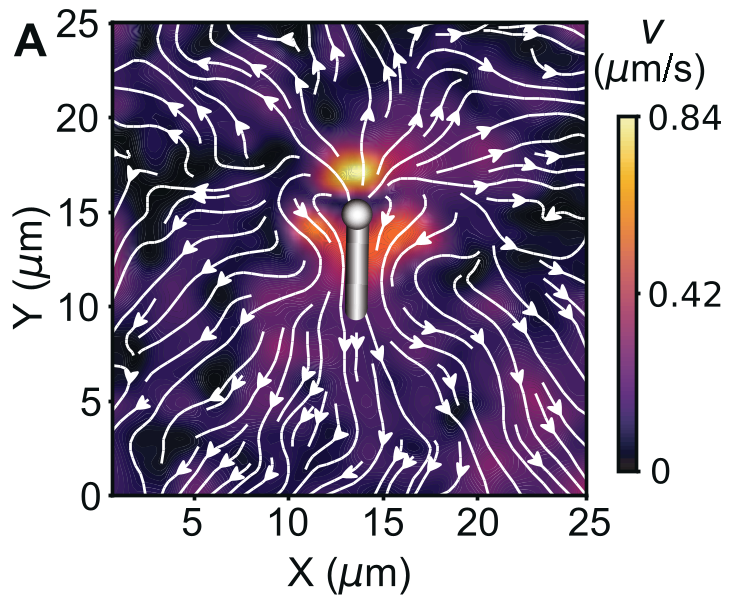 Fig 1: From left to right: (A) Fluid streamlines showing the "pusher" mechanism. (C-F) Transition from Isotropic motion to Swarming, Turbulence, and Large Clusters.
The Core Discovery: The State Diagram
The most significant contribution of this work is the State Diagram (Fig 4), which identifies how the "Physicality" of the rod dictates the "Sociology" of the group.
1. The Sweet Spot for Chaos: Active Turbulence ()
At intermediate lengths, the rods create chaotic, swirling vortices. This state is marked by Giant Number Fluctuations (GNF)—mathematical proof that the particles are moving in highly correlated, non-random groups. Interestingly, simulations without fluid dynamics could not replicate this, proving that active turbulence is a purely hydrodynamic phenomenon.
2. High Anisotropy: The Road to Flocking ()
As rods get longer, they become harder to rotate. This suppresses turbulence. Instead of swirling, the rods merge into large, stable, and persistent flocks that move together like schools of fish.
3. The Short Rod Limit: Transient Clusters ()
Short rods rotate too quickly due to thermal noise (Brownian motion). They never stay aligned long enough to form a swarm, resulting in only "flickering" transient groups.
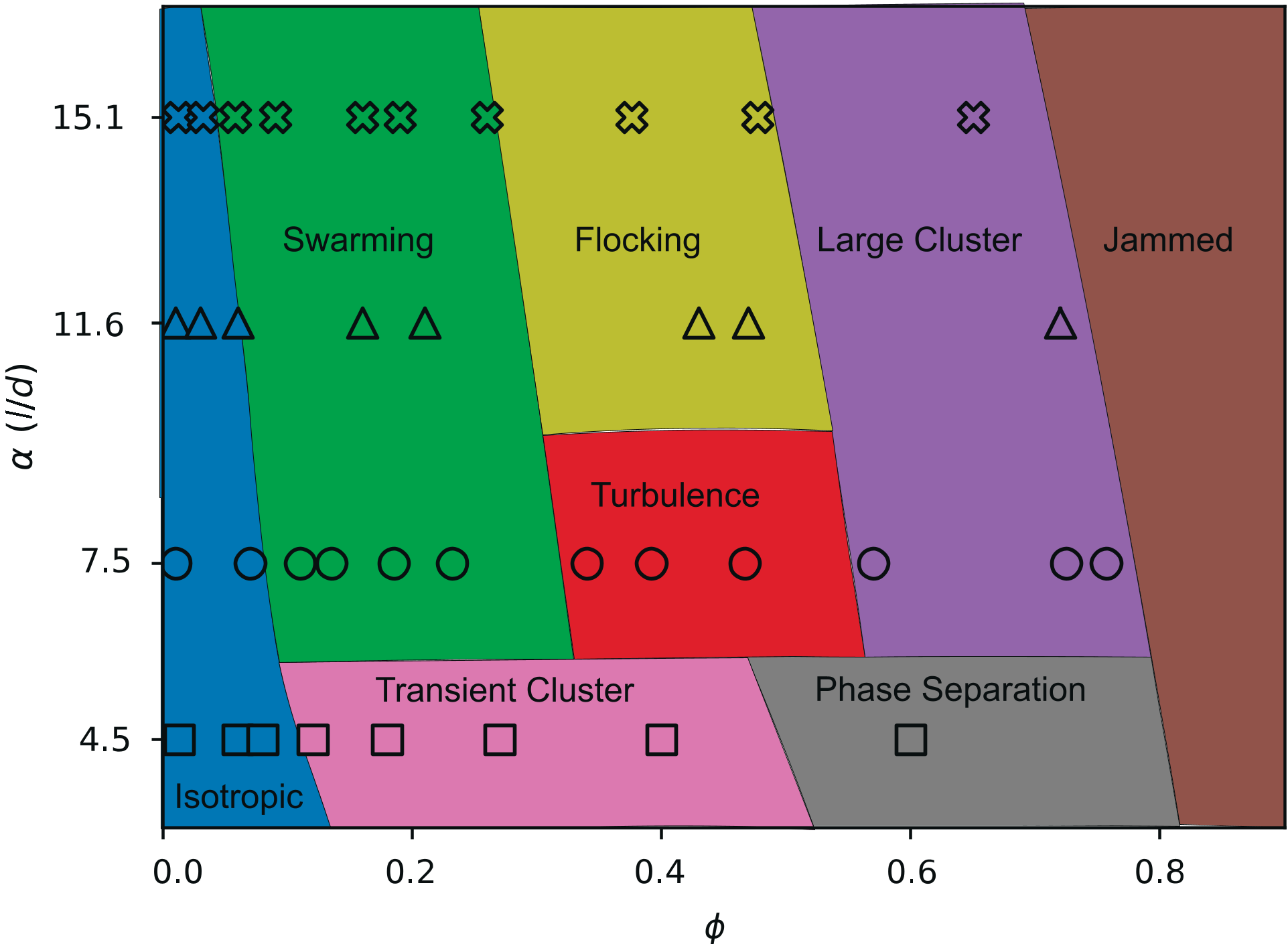 Fig 2: The universal map of active rod behavior across different aspect ratios () and densities ().
Experimental vs. Simulation Insights
By running "Dry" Simulations (Brownian dynamics without fluid flow), the authors made a profound observation:
- Steric interactions (collisions) are enough to create swarms and jamming.
- Hydrodynamic torques (fluid flow) are strictly required to create turbulence.
This explains a long-standing biological mystery: wild-type bacteria often have aspect ratios around 6 (near the turbulent regime), while elongated mutants do not. Nature may have optimized these shapes for specific tasks—turbulence for mixing nutrients, and flocking/swarming for rapid transport across surfaces.
Critical Analysis & Conclusion
This paper provides a masterclass in decoupling complex interactions. By carefully isolating the role of the length-to-width ratio, the authors have provided a blueprint for programmable active materials.
Future Outlook: The next frontier lies in adaptive transport. Imagine synthetic micro-rods that can switch from "transport mode" (flocking) to "mixing mode" (turbulence) simply by changing the light intensity or surrounding fluid viscosity. While this study is limited to 2D surfaces, it sets the stage for 3D "active fluids" that could revolutionize microfluidic drug delivery and biomimetic engineering.
Takeaway: Shape isn't just a geometry—it's a control algorithm for collective intelligence in the microscopic world.