
SPIN: Revolutionizing Influential Node Discovery via Game Theory
9172_A Shapley Value-Based Approach to Discover Influential Nodes in Social Networks.
The paper introduces SPIN (ShaPley value-based Influential Nodes), a game-theoretic framework for solving the Target Set Selection problem in social networks. By modeling information diffusion as a cooperative game, it utilizes the Shapley Value to identify nodes with the highest marginal contribution to the diffusion process, achieving SOTA performance in both top-k nodes and λ-coverage tasks.
TL;DR
Finding the most "influential" people in a social network—the Target Set Selection problem—is notoriously hard (NP-hard). This paper introduces SPIN, an algorithm that uses the Shapley Value from cooperative game theory to rank nodes. It is not only significantly faster (up to 700x speed-up) than traditional greedy approaches but also proves more effective in complex scenarios where influence doesn't simply "add up" (non-submodular settings).
The Problem: The High Cost of Greed
For years, the gold standard for influence maximization has been the Greedy Algorithm (KKT). It works by picking the one node that adds the most influence, repeating until the target set is full.
The catch? It’s painfully slow. To figure out which node is "best," it must simulate thousands of diffusion cascades for every candidate node at every step. If you want to find 100 influential nodes in a large network, the KKT algorithm might take days or even weeks. Furthermore, KKT relies on submodularity—the idea of "diminishing returns." If the network dynamics are more complex (e.g., specific combinations of people are needed to trigger a trend), greedy methods lose their theoretical edge.
The Insight: Influentials as Cooperative Players
The authors suggest a brilliant shift in perspective: Why not treat the network diffusion as a cooperative game?
- Players: The nodes in the network.
- Value Function: The total number of people influenced by a specific group (coalition).
- Shapley Value: A fair way to distribute the total "profit" (influence spread) based on each node's average marginal contribution across all possible group combinations.
By using approximate Shapley values through sampling, the authors decouple the expensive ranking process from the size of the target set . Once you have the rank list, choosing or takes mere seconds.
Methodology: The SPIN Framework
The SPIN algorithm consists of two core phases:
- RankList Construction: Instead of exhaustive search, SPIN uses a set of random permutations to estimate the "average marginal contribution" of each node.
- Sieving Heuristic: To avoid picking nodes that are all in the same "clique" (which would be redundant), SPIN uses a spatial constraint. If the next best node is already adjacent to one already chosen, it skips it initially to ensure the influence starts from diverse points in the network.
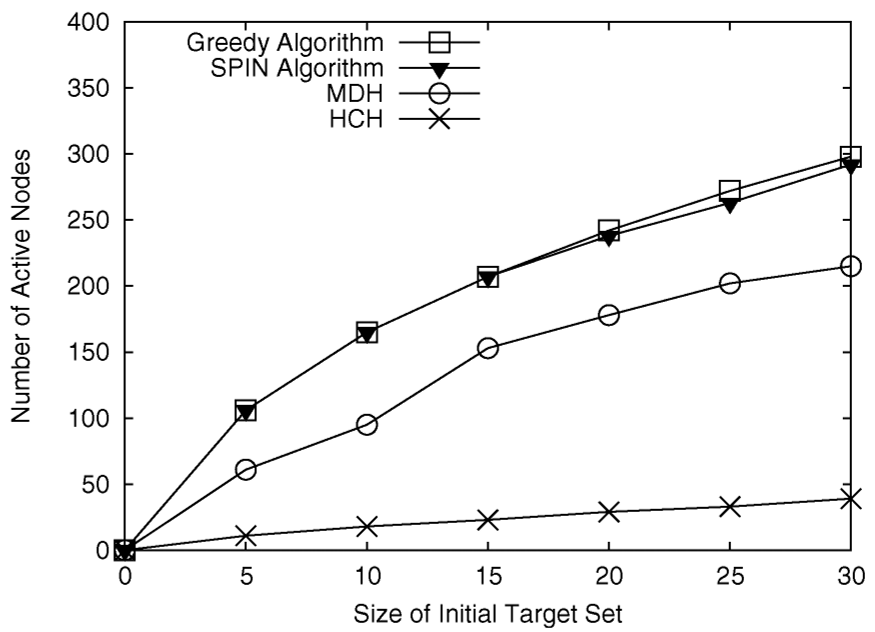 Figure: Performance of SPIN vs. Greedy (KKT) and Heuristics across different graph types.
Breaking the Submodularity Barrier
One of the most impressive parts of this research is where it tackles non-submodular models like the Multiplication Threshold Model. In these cases, the traditional Greedy algorithm loses its luster. SPIN, however, maintains high performance because the Shapley value captures the inherent "bargaining power" and collaborative value of a node, regardless of whether the returns are diminishing or increasing.
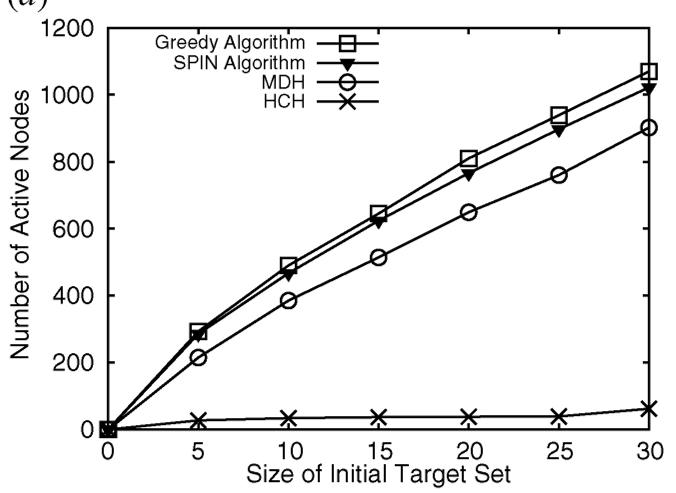 Figure: SPIN nearly matches Greedy performance but with a fraction of the computational overhead.
Results & Efficiency
The performance metrics are staggering:
- Speed-up: On the Netscience dataset, SPIN was 473x to 722x faster than KKT.
- Scalability: For the HEP (High-Energy Physics) dataset with over 10,000 nodes, SPIN successfully identified influencers where the standard Greedy algorithm was simply too slow to run.
- Quality: In almost all cases, the "spread" achieved by SPIN was within a tiny margin of the much more expensive Greedy method.
| Dataset | Nodes | SPIN Time (Min) | KKT Time (Min) | Speed-up |
|---|---|---|---|---|
| NIPS | 1,061 | 15.2 | 7,201.5 | 473x |
| Netscience | 1,589 | 28.2 | 8,539.4 | 302x |
Critical Insight & Future Outlook
While SPIN is a massive leap forward, it’s not perfect. Because it relies on sampling, its accuracy depends on the number of permutations. However, the authors found that influential nodes show a "power-law" distribution—the truly important nodes stand out even with relatively few samples.
The future of this work lies in integrating Mechanism Design (managing nodes that might lie about their influence) and Community Detection (ensuring every sub-community is targeted). SPIN has proven that the "physics" of social influence is best understood through the "mathematics" of cooperation.
Conclusion
SPIN shifts the paradigm of influence maximization from a brute-force search to a nuanced evaluation of collaborative value. For practitioners in viral marketing, sociology, or public health, this provides a tool that is finally fast enough for real-world, large-scale networks.