
Discovering Shared Interests: A Bipartite Graph Approach to Online Social Networks
Discovering Shared Interests in Online Social Networks
This paper introduces a graphical framework for discovering shared interests in Online Social Networks (OSNs) by modeling user-content interactions as bipartite graphs. By applying one-mode projections and agglomerative clustering, the authors successfully capture inherent clusters of users and information within the Digg social news platform.
TL;DR
Understanding "who likes what" is the cornerstone of the modern social web. This paper moves beyond simple follower-following counts by modeling users and news stories as a Bipartite Graph. By projecting this graph into one-mode "Similarity Networks," the authors identify clusters of users with highly consistent voting patterns, providing a robust framework for improving recommendation engines and filtering social spam.
The Motivation: Moving Beyond Topology
Most social network research focuses on the "Social Graph" (who follows whom). However, the "Interest Graph"—the latent connections formed by users interacting with the same content—is often more indicative of behavior.
The problem with prior work is its inability to effectively partition users based on interdependent interactions. In a social news site like Digg, a user’s identity is defined by the stories they promote. The authors recognized that existing community detection methods often miss these "content-mediated" relationships.
Methodology: The Power of Projections
The core innovation lies in the transition from a Bipartite Graph to One-Mode Projections.
1. The Bipartite Foundation
Users () and Stories () are disjoint sets. An edge only exists between a user and a story (representing a "digg" or vote).
2. One-Mode Projections
To find shared interests, the bipartite graph is projected into two unipartite graphs:
- User Projection (): Connects two users if they voted for the same story. The edge weight represents the volume of shared stories.
- Story Projection (): Connects two stories if they were voted on by the same user. The edge weight represents the commonality of their audience.
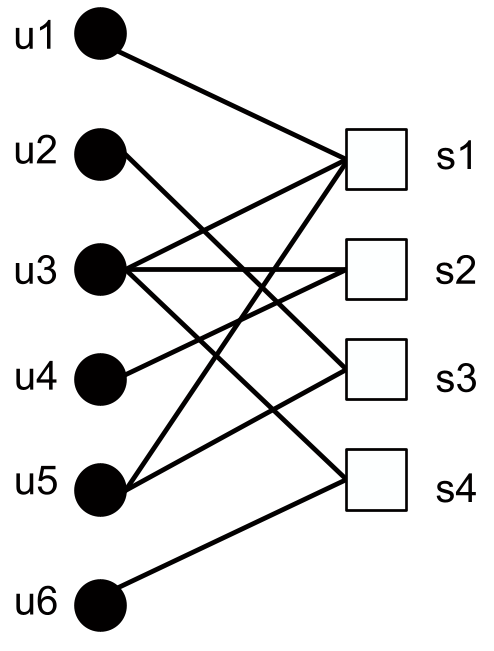 (a) Bipartite Graph; (b) User Projection; (c) Information Projection.
3. Clustering for Discovery
Using the CLUTO toolkit, the authors apply agglomerative clustering to the similarity matrix derived from these projections. This maximizes the internal similarity of clusters using a square-root optimization function to ensure tighter, more meaningful groups.
Experiments: Do the Clusters Actually Mean Anything?
The authors tested their method on a dataset of 3 million votes from Digg. They introduced a metric called Voting Consistency to validate their findings.
Key Finding: The Consistency Boost
In a random sample of the Digg population, it is rare for a large percentage of people to vote for the same thing (only 4.7% of stories get votes from 30% of users). However, within the discovered User Clusters, the consistency skyrockets.
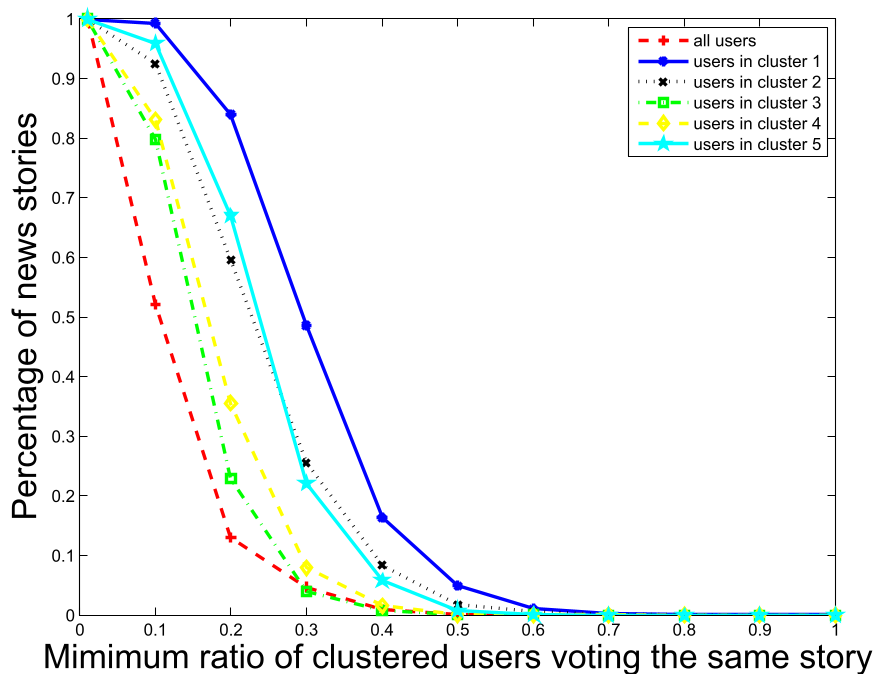 Figure 4: This graph demonstrates that users within a cluster are significantly more likely to vote for the same stories than a random set of users, proving that the algorithm successfully captured "Shared Interests."
The resulting clusters successfully divided 139,409 users into groups where their behaviors were highly predictable, effectively "denoising" the social signal of the entire platform.
Critical Analysis & Conclusion
Takeaway
The bipartite projection method is a computationally efficient way to transform raw interaction logs into a high-order map of preferences. It captures the Inductive Bias that users who share content preferences belong to the same functional community even if they don't "follow" each other.
Limitations & Future Work
- Temporal Dynamics: The study uses a static snapshot. Shared interests in news are often ephemeral (trending topics), which a static graph might struggle to track over time.
- Computational Scale: While simpler than some modern deep learning approaches, building similarity matrices for millions of users still poses a scaling challenge.
The authors suggest that these clusters can be used to detect anomalous voting behavior. If a user suddenly votes for something completely outside their cluster's fingerprint, it could indicate a compromised account or coordinated spam—a vital insight for modern platform integrity.
Senior Editor's Note: This work serves as a foundational bridge between classical graph theory and modern recommendation systems, highlighting that who you are in a digital space is best defined by what you consume.