
Beyond the Boss: How Shared Leadership and Functional Diversity Fuel Team Creativity
An analysis of shared leadership, diversity, and team creativity in an e-learning environment
2014-03-12
Summary
Problem
Method
Results
Takeaways
Abstract
This paper investigates the dynamics of team creativity within e-learning environments by proposing a model that integrates shared leadership (from a social network perspective), demographic diversity, and knowledge sharing. Utilizing data from 40 teams, the study demonstrates that shared leadership and role diversity are critical drivers of team creativity, with knowledge sharing acting as a significant mediator.
In the era of rapid digital transformation, the "lone genius" or the "heroic leader" models are becoming artifacts of the past. Today’s most innovative solutions emerge from teams. But what exactly makes a team creative? Is it just about having diverse backgrounds, or is it about how leadership is distributed?
The paper **"An analysis of shared leadership, diversity, and team creativity in an e-learning environment"** dives deep into these questions, providing a data-driven look at the mechanics of collaboration.
## TL;DR: The Recipe for Innovation
This study analyzes 40 teams in an e-learning context to discover that **Shared Leadership** (where everyone leads) and **Knowledge Sharing** are the engines of creativity. Perhaps most surprisingly, it finds that while traditional "demographic" diversity (like age) matters, **Role Diversity** is the direct catalyst for novel ideas.
---
## The Problem: The Failure of Vertical Hierarchies
In complex, ambiguous environments, a single formally appointed leader often lacks the cognitive bandwidth to handle every challenge. Prior research has struggled to clarify:
* Does diversity actually help or just cause conflict?
* Can leadership exist without a "boss"?
* What is the specific bridge between a team's composition and its creative output?
The authors argue that we must view leadership not as a person, but as a **social network property**.
---
## Methodology: Measuring the "Density" of Influence
Instead of asking "who is the leader," the researchers used a **Social Network Perspective**. They measured **Density**: the total amount of leadership influence circulating within a team.
### The Research Model
The study looked at how four types of diversity (Age, Gender, Major, and Role) and Shared Leadership impact Knowledge Sharing, which in turn drives Team Creativity.

---
## Key Insights: Why It Works
### 1. The Power of "Leading Together"
The data shows a massive positive correlation between shared leadership and the willingness of team members to share their internal knowledge. When employees feel they have "participative safety"—the sense that they can lead and be heard—they open up the "knowledge silos."
### 2. Role Diversity > Major Diversity
The study found that simply having different academic majors wasn't enough. However, **Role Diversity**—assigning and possessing different functional responsibilities—directly boosted the team's ability to generate "new and useful" ideas.
### 3. The Task Complexity Paradox
The researchers found a fascinating interaction: when tasks are perceived as complex or non-routine (high variety/low analyzability), the dependence on shared leadership becomes even more critical for successful knowledge exchange.
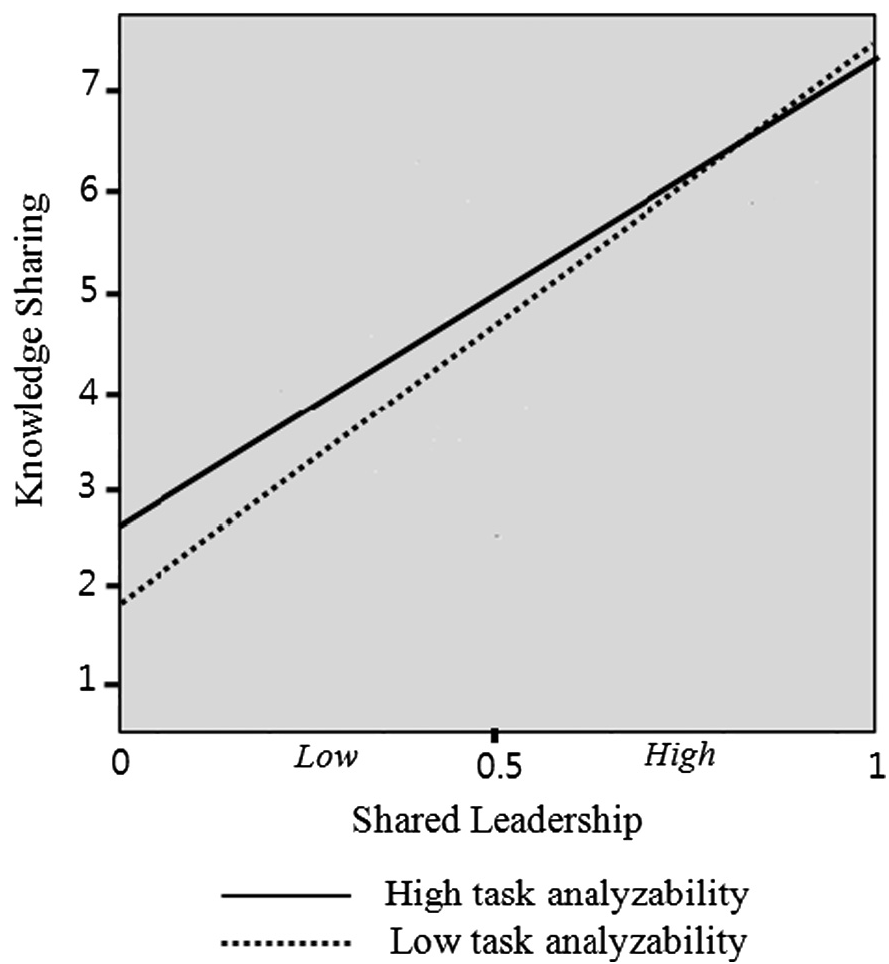
*Fig: The interaction effect showing that as task analyzability decreases, the impact of shared leadership on knowledge sharing becomes more pronounced.*
---
## Experimental Results
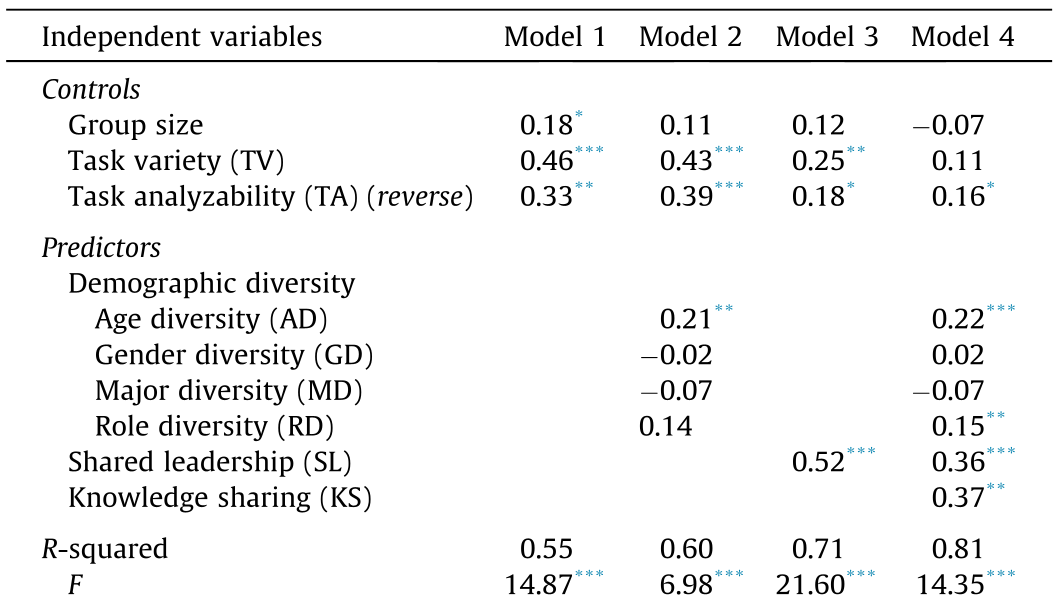
Through hierarchical regression, the authors validated that:
* **Shared Leadership** has a coefficient of **0.36** on team creativity.
* **Knowledge Sharing** maintains a strong **0.37** effect.
* **Age Diversity** unexpectedly contributed positively, likely because the environment was a college setting where age differences signify different levels of experience rather than social status.
---
## Critical Analysis & Takeaways
While the study is limited by its student sample (e-learning environment), the implications for the modern workplace are profound:
* **Redefine Leadership**: Managers should stop trying to "control" and start trying to "distribute." Shared leadership is a resource.
* **Functional Design**: When building teams, focus on **functions and roles**. Don't just look for diverse resumes; look for diverse *responsibilities*.
* **Knowledge as a Bridge**: Creativity isn't magic; it is the result of knowledge accumulation. If the environment doesn't feel "safe" for sharing, the creativity will never materialize.
**Conclusion**: The "Boss-less" team isn't a myth; it's a high-performance network. By maximizing the density of leadership and ensuring role variety, organizations can turn a group of individuals into a creative powerhouse.