
Identifying Shared Leadership: How Wikipedia Works Without a Traditional Boss
Identifying shared leadership in Wikipedia
This paper introduces an automated method to measure "shared leadership" in Wikipedia by classifying 4 million user-to-user messages into four leadership types using SVM and domain-specific features. The study demonstrates that leadership is highly distributed, with peripheral editors contributing a significant portion of leadership behaviors compared to formal administrators.
TL;DR
In the traditional corporate world, we know exactly who the leaders are—they have the titles. But in Wikipedia, leadership is a behavior, not a badge. This 2011 seminal study from Carnegie Mellon University uses machine learning to prove that leadership is "shared" across the entire community. By analyzing 4 million messages, the researchers found that "regular" editors do the bulk of the leading, debunking the myth that only administrators run the show.
Background: The Shift from Vertical to Shared Leadership
Most organizational theories are built on Vertical Leadership—a top-down hierarchy where a manager directs a subordinate. However, Wikipedia operates on Shared Leadership, a dynamic, interactive influence process among peers. The core mystery the authors aimed to solve was: Who is actually doing the leading in a system where everyone is a volunteer?
Methodology: Coding Leadership with Machine Learning
To quantify leadership, the researchers moved beyond manual coding (which is impossible at Wikipedia's scale) and developed an automated classification system.
1. The Four Leadership Behaviors
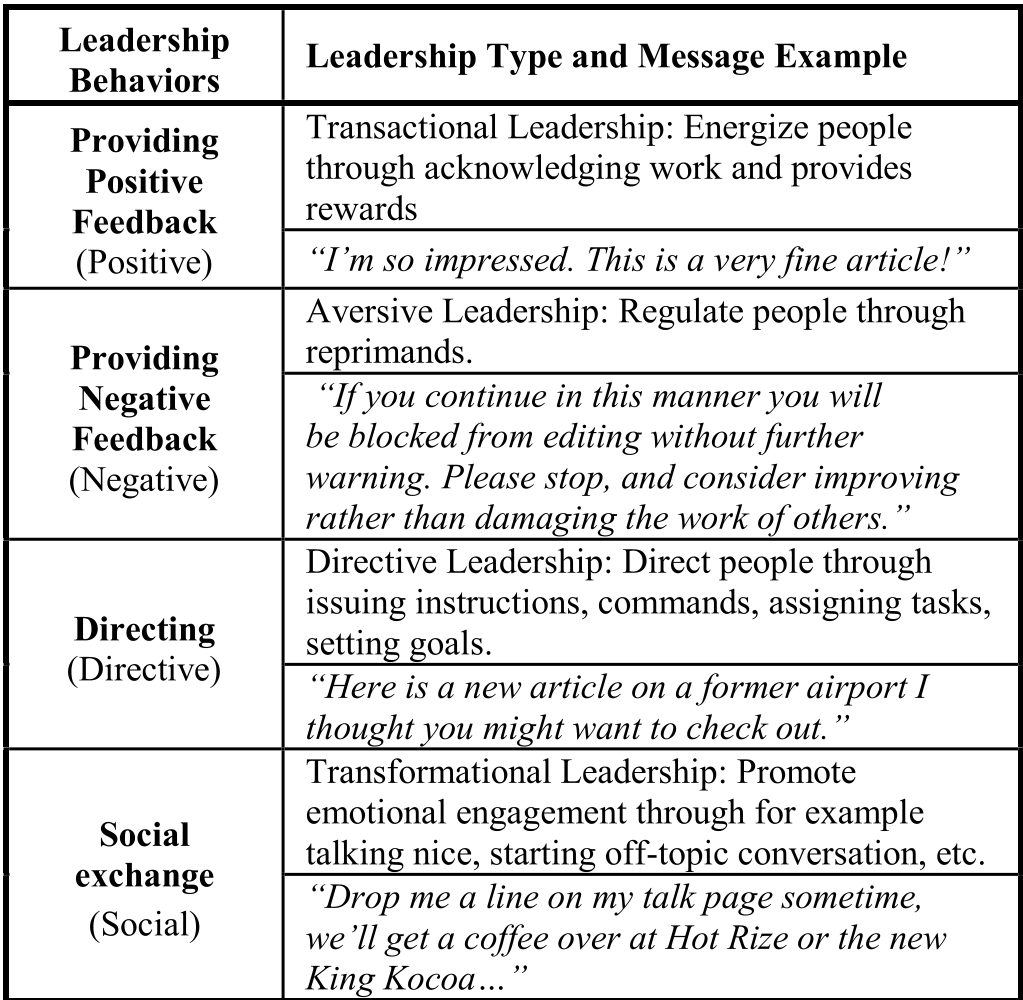
The study focused on four vital functions derived from organizational psychology:
- Positive Feedback: Energizing people through rewards (e.g., "Great article!").
- Negative Feedback: Regulating behavior through reprimands (e.g., "Stop vandalism").
- Directing: Issuing instructions or setting goals.
- Social Exchange: Building emotional engagement and "talk-story."
2. Feature Engineering with Domain Knowledge
Instead of relying solely on "bag-of-words" models, the authors injected Wikipedia-specific domain knowledge into their SVM (Support Vector Machine) classifier. They used features like:
- Barnstars: Specific tokens of appreciation in Wikipedia.
- Negative Jargon: Terms like "vandalism" or "blocked."
- Structural Patterns: Such as the
<You + modal>(e.g., "You should...") which is a strong indicator of directive leadership.
Key Insights: Who Leads the Leaderless?
The results from analyzing 4 million messages on the M45 Hadoop cluster were surprising.
Peripheral Power
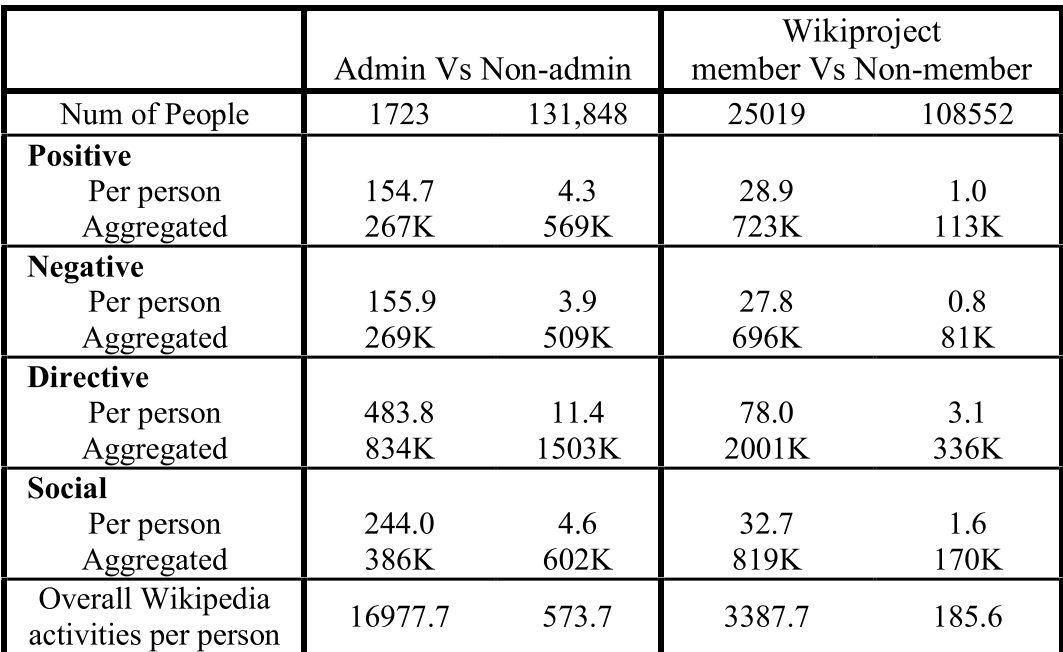
When looking at the total volume of leadership activity, non-administrators actually do more work than administrators. For instance, 64.3% of all directive messages (telling others what to do) were sent by people without formal administrative powers.
Leadership Styles: Core vs. Regular Members
The study also looked at WikiProjects (sub-groups dedicated to specific topics). They found a fascinating "Role Swap":
- Regular Members: More likely to focus on tasks (Directing and Feedback).
- Core Members/Founders: More likely to focus on social maintenance (Social Exchange). Insight: As you become a core leader, your role shifts from "telling people what to do" to "keeping the community together."
Impact and Future Directions
This research provided a technical framework for studying large-scale social behavior. It proved that:
- Scale Matters: We can't understand online communities by looking at 100 people; we need to look at millions.
- Leadership is Ubiquitous: If you want a healthy online community, you shouldn't just look for "great managers"—you should build tools that help everyone give feedback and direction.
Limitations: The study primarily focuses on text based on User Talk pages. Future research could integrate these findings with edit history to see if a "directive" message actually leads to better article quality.
Conclusion
Wikipedia's success isn't due to a small group of elite "bosses." It's successful because it enables a massive, distributed network of editors to lead each other. This "Shared Leadership" model remains a blueprint for how modern decentralized organizations—from DAO's to open-source projects—can thrive in the 21st century.