
Beyond the Spark: Why "Spreaders" are the True Oracles of Viral Videos
Incorporating the Position of Sharing Action in Predicting Popular Videos in Online Social Networks
2014-01-01
Summary
Problem
Method
Results
Takeaways
Abstract
This paper proposes a novel expert selection framework for predicting video popularity in Online Social Networks (OSNs) by categorizing users based on their structural positions in the diffusion graph. By distinguishing between "Initiator," "Spreader," and "Follower" actions, the authors demonstrate that focusing on "Spreader Experts" significantly improves the accuracy of early-stage popularity forecasting in platforms like Renren.
## TL;DR
Predicting which video will go viral is a billion-dollar question for CDNs and marketers. While most research hunts for "Influencers" or "Initiators," this paper reveals a surprising truth: the **Spreaders**—users who sit in the middle of a sharing chain—are actually the most accurate predictors of a video’s ultimate success. By isolating these "Spreader Experts," we can predict video popularity with high precision using data from only a tiny fraction of the network.
## Background: The Pareto Peak of OSNs
In Online Social Networks (OSNs) like Facebook or Renren, video popularity is extremely skewed. The authors found that the top **3.2% of videos account for 90% of all sharing actions**. To manage network traffic and optimize caching, we must identify these "Golden Videos" early. But monitoring millions of users is computationally "expensive." The solution? Find the right "Experts."
## The Problem: All Actions are Not Equal
Prior works treated every "share" the same. If User A shares a video, they are an influencer. However, information diffusion is a structural process. A user might share a video they found on YouTube (Initiator), or they might share something they saw from a friend (Spreader/Follower).
The authors argue that by ignoring where a share occurs in the **Propagation Graph**, existing models lose the signal in the noise.
## Methodology: Mapping the Propagation Graph
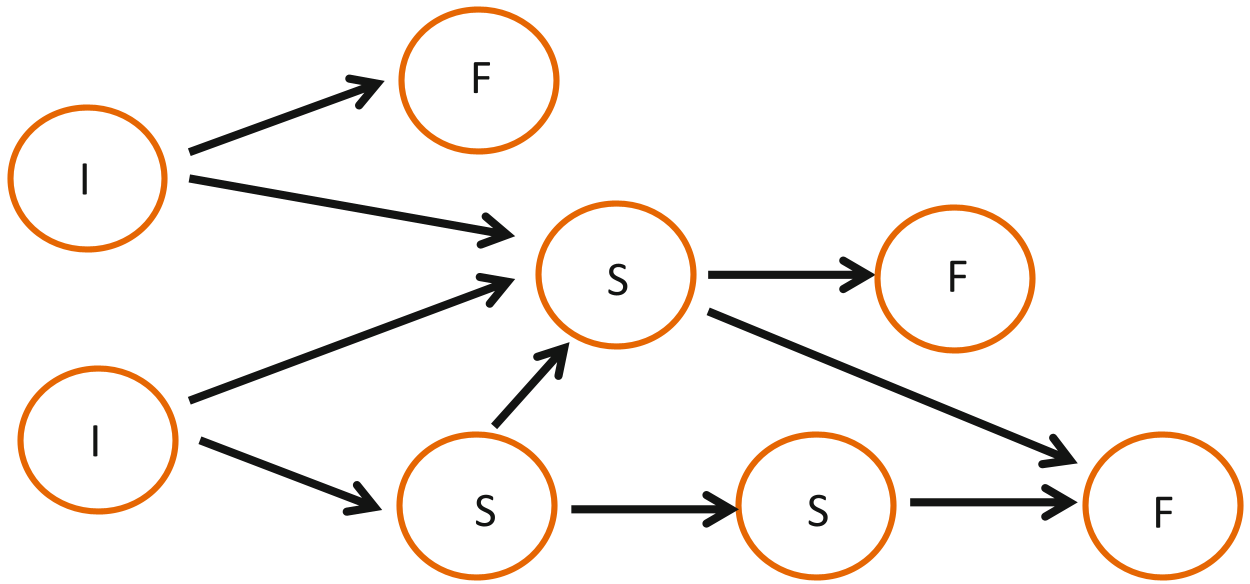
The researchers tracked 2.8 million users over three years to map how videos move across friendship links. They defined three distinct roles:
1. **Initiator (I):** The root. They share a video independently or import it from an external site.
2. **Spreader (S):** The bridge. They share a video from a friend and *successfully influence* others to share it further.
3. **Follower (F):** The dead-end. They share the video but no one follows their lead.
### Identifying the Experts
Using a "Competitive Influence" model, the authors looked for users who consistently shared future "Golden Videos" within a 7-day **Promptness Window**. To ensure they weren't just "lucky," they used the **Adjusted Wald Confidence Interval** to rank users, selecting only those with a high statistical lower bound of precision.
## The Big Reveal: Spreaders > Initiators
The most striking finding of the paper is visual. When looking at "All Videos" vs. "Top Videos," the architectural makeup changes. Common videos are driven by initiators, but **Popular Videos are driven by Spreaders.**
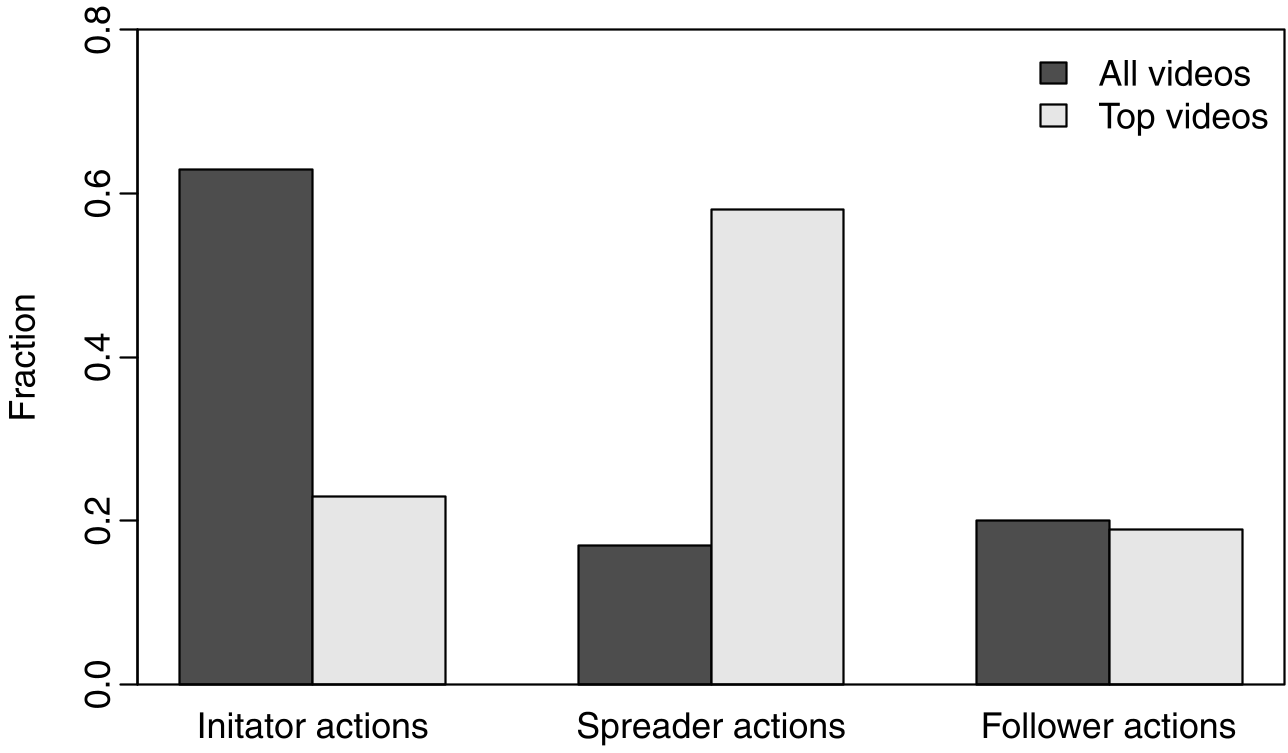
As the charts show, the proportion of Spreader actions (S) is significantly higher in top-tier content. This suggests that the "Spreader" position is a gatekeeper for virality.
## Experimental Results: Performance Contrast
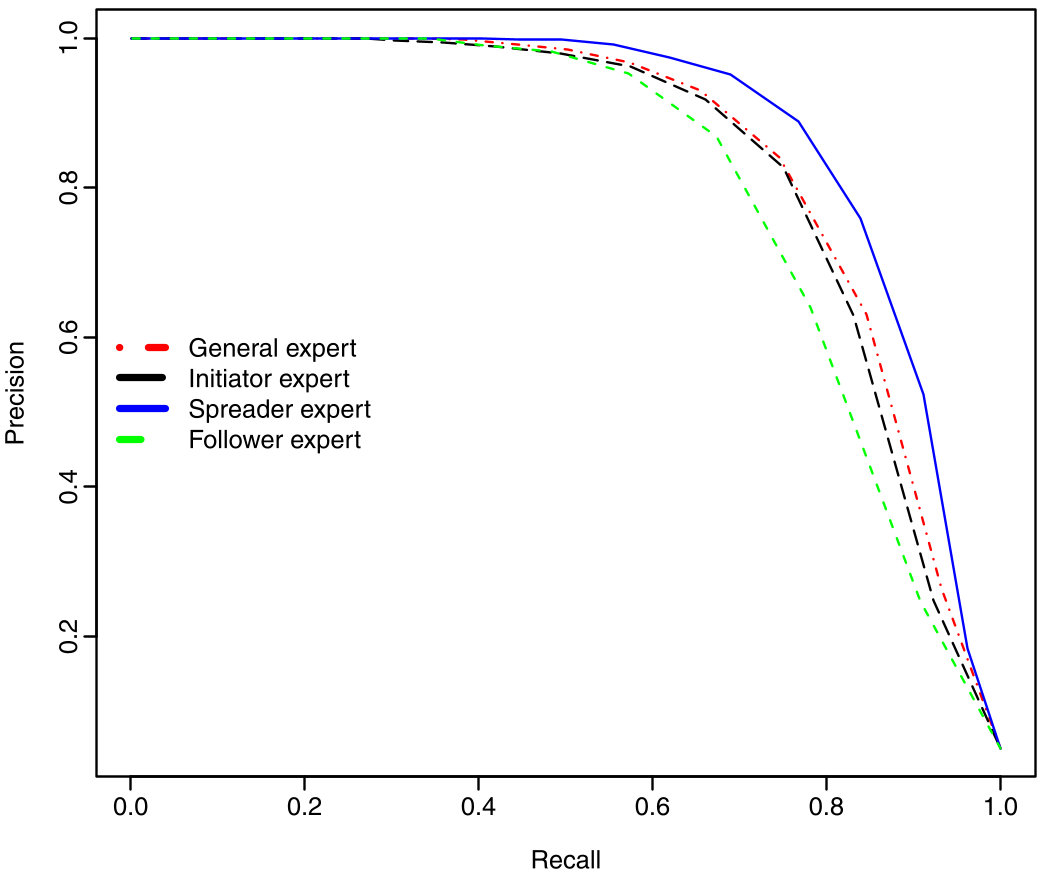
The authors tested their "Spreader Experts" against "Initiator Experts," "Follower Experts," and "General Experts" (who were selected without regard to position).
**Key Findings:**
* **Spreader Experts** achieved the highest Precision-Recall curve, clearly outperforming the others.
* **Initiators** are often "lone wolves" whose taste doesn't always reflect the broader network's appetite.
* **Efficiency**: Using just **2% of users** as Spreader Experts provided the same predictive power as monitoring **33% of the entire OSN population** via random sampling.
## Deep Insight: Why Spreaders?
Why does a user who shares a video *after* someone else provide a better signal than the person who found it first?
The "Spreader" role inherently validates two things:
1. **Viral Potential:** Their act of sharing shows the video has "contagion" power.
2. **Network Centrality:** Since they successfully influenced others, Spreaders likely occupy "sweet spots" in the social graph where communities overlap.
## Conclusion
This research provides a vital update to influence theory. While the "First Mover" (Initiator) gets the credit for discovery, the "First Efficient Repeater" (Spreader) provides the data. For engineers building video recommendation systems or CDN caching strategies, the message is clear: **Watch the bridges, not just the roots.**
**Limitations**: The study is based on Renren (a Facebook-like structure). Future work needs to verify if these dynamics hold in "Interest-based" graphs like TikTok, where the algorithm acts as a "Super-Spreader" regardless of friendship links.