
Steering the Public Mind: Optimal Leader Selection for Precise Opinion Shifting
17757_Shifting Opinions in a Social Network Through Leader Selection.
The paper investigates the French-DeGroot opinion dynamics in social networks with polarizing parties, specifically targeting the "Leader Selection Problem" to shift the average network opinion to a desired value. It introduces the concept of a "leader-equivalent graph" and proposes a greedy algorithm with a bounded search to approximate optimal leader sets for both absolute and influenced leader systems.
TL;DR
In the era of digital polarization, simply maximizing influence is no longer the only goal; sometimes, we need to bring the "average" back to a balanced center. This paper explores how to select a limited set of "leaders" (influencers) to shift a social network's average opinion to a specific target value. The authors prove this is NP-hard, propose a "Domination Score" to measure influence balance, and provide a greedy algorithm with a bounded search that performs near-optimally on real-world datasets like Twitter.
Background: Moving Beyond Influence Maximization
Most social network research focuses on Influence Maximization—the art of making an opinion as popular as possible. But what if a government wants to reach exactly 50% participation in a voluntary program? Or what if a platform wants to "depolarize" a community by shifting the mean opinion from an extreme 0.9 to a neutral 0.5?
This "Fine-grained Opinion Shifting" is significantly harder because it isn't just about "more is better." It requires a delicate balance between opposing forces.
The Core Mechanism: Domination Scores & Leader Equivalence
The authors utilize the French-DeGroot model, where individuals update their opinions based on a weighted average of their neighbors' views. They distinguish between:
- Absolute Leaders: Fixed, unshakable opinions (e.g., official accounts).
- Influenced Leaders: Individuals who have an external source of information but are still affected by peers.
The Leader-Equivalent Graph
To solve this, the authors transform complex social dynamics into a "Leader-Equivalent Graph." By collapsing all leaders of one party into a single "virtual" node, they can calculate the steady-state opinion of any follower as an escape probability in a random walk.
The Domination Score
A standout theoretical contribution is the Domination Score ().
Intuition: In a directed network, the Domination Score of over captures how much time a random walker starting at spends in the network before reaching .
The average opinion when each party has one leader ( and ) is simply: This elegant ratio shows that the network's balance is essentially a tug-of-war between these domination scores.
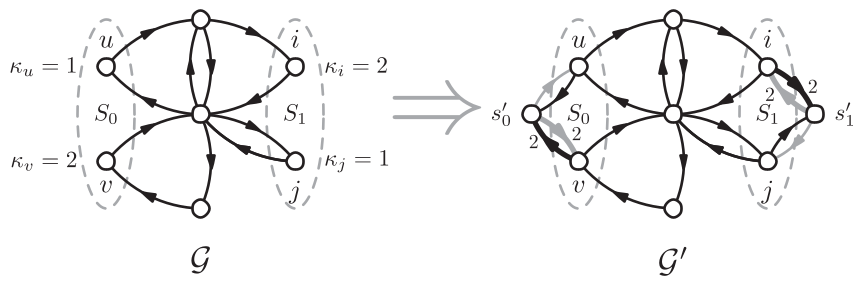 Fig 1: Example of constructing a leader-equivalent graph from an influenced leader system.
The Algorithm: BoundSearch
Since selecting the best leaders to hit a target is NP-hard, the authors treat it as a Submodular Cost Submodular Knapsack (SCSK) problem.
How it works:
- Greedy Step: A standard greedy algorithm selects nodes that increase the average opinion the most.
- Bounded Search: Because we don't know if we should overshoot or undershoot, the algorithm uses a Binary Search on the "upper bound" of the opinion. It narrows down the range of possible average opinions until it finds the leader set that sits closest to the target .
Efficiency Trick
Calculating the steady state for every possible node selection involves inverting large matrices—a computational nightmare. The authors use rank-1 updates (Sherman-Morrison formula), reducing the complexity from a prohibitive scale to a manageable .
Experimental Validation
The authors tested their approach on the Twitter Higgs Retweet Network (13,000+ nodes).
Key Findings:
- Precision: When the target was set to 0.5, the
BoundSearchalgorithm consistently hit results like 0.5009, whereas random selection or basic heuristics failed significantly. - Versatility: The method works effectively for both absolute leaders (hired influencers) and influenced leaders (targeting key community members with external info).
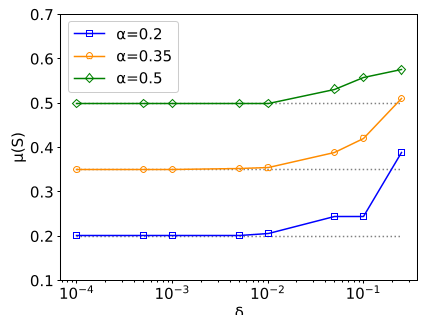 Fig 2: BoundSearch performance vs. Brute-force Optimum in Erdős–Rényi graphs.
Critical Insight & Future Outlook
This work transitions social network control from "blunt force maximization" to "surgical precision steering."
Limitations:
- The model assumes a static network. In reality, social links change (homophily), and people might cut ties with those whose opinions are too different (echo chambers).
- The NP-hardness of the influenced leader selection problem specifically remains an open theoretical question.
Takeaway: For platform designers and social scientists, this provides the mathematical "rudder" needed to navigate community opinions toward healthier, more balanced states rather than just driving engagement to the extremes.