
The Postponement Transition: Why Later Parenthood Is Not a Demographic Crisis
Shifting parenthood to advanced reproductive ages: Trends, causes and consequences
This article is a demographic review by Tomáš Sobotka on the postponement transition, the shift of first parenthood to ever later ages across industrialised countries. It documents trends, causes, educational disparities, and consequences of delayed childbearing, and argues that assisted reproduction cannot offset age-related infertility. The author concludes that the social and economic advantages of late parenthood may outweigh its biological disadvantages, so policy should support childbearing at both younger and older ages without explicitly encouraging early parenthood.
TL;DR
Tomáš Sobotka's 2009 review examines the shift toward later parenthood across all industrialised countries, tracing its causes to the expansion of higher education, the contraceptive pill, and changing family norms, and its consequences for individuals, couples, children, and society. The central quantitative claim is that rising maternal age mechanically depresses observed period fertility: without the ongoing increase in age at childbearing, the EU total fertility rate in 2003-2005 would have been 1.72 rather than the observed 1.48. Against the medical literature's negative framing, Sobotka argues that the social and economic advantages of late parenthood may outweigh the biological advantage of early parenthood, and that assisted reproduction cannot compensate for age-related infertility.
Background and Position in the Field
This is a synthesis and review article rather than a new empirical study. Its position in the literature is that of a corrective: the medical literature, as the author states in the concluding discussion, generally perceives delayed childbearing negatively, emphasizing infertility and negative pregnancy outcomes, while demographic and social research increasingly finds reasons to treat late parenthood neutrally or even positively. The review's contribution is therefore not a dataset but a reframing, and it is honest about the evidence base being uneven. As Sobotka notes at the outset, much of the empirical evidence explicitly focuses on women, because considerably more statistics and studies exist for them and because their biological clock ticks faster. That asymmetry is itself a finding worth flagging.
The Shift Toward Later Parenthood and Its Forces
The empirical pattern and the education gradient
The trend toward later parenthood was first initiated in the early 1970s in Western and Northern Europe, Japan, and the United States, and by the late 1990s had spread to all industrialised societies. At present, as Figure 1 shows, women in Western, Northern, and Southern Europe as well as Japan give birth to their first child on average between ages 28-29, while women in Eastern and South-Eastern Europe still bear their first child at ages 24-26. Fathers are on average two to four years older than mothers at first birth, consistent with their later home leaving and partnership formation. The United States is an important exception, with an earlier first-birth pattern fuelled by relatively high rates of teenage motherhood, and the frequency of births at ages 40 and above has increased sharply since the late 1980s, reversing a long-standing downward trend.
The most striking structural feature is the education gradient. The expansion of higher education, especially among women, constitutes the main driving force of delayed parenthood and contributes approximately one half to the observed rise in the age at first birth, a figure Sobotka attributes to Beets and colleagues (2001). Table 1 gives Norway as the illustrative case:
| Highest achieved education | 1980 | 1990 | 1998 | Change 1980-1998 |
|---|---|---|---|---|
| Primary and lower secondary | 23.3 | 23.9 | 24.0 | 0.7 |
| Upper secondary | 24.0 | 25.3 | 26.4 | 2.4 |
| University, first stage | 26.5 | 28.1 | 29.5 | 3.0 |
| University, second stage | 28.5 | 30.0 | 31.6 | 3.1 |
These are mean ages at first birth among Norwegian women, computed by Lappegård and Rønsen (2005). The table is doing more analytical work than a simple trend display: the group with only primary and lower secondary education barely moved over nearly two decades, gaining 0.7 years, while the university second-stage group gained 3.1 years. In other words, the postponement transition is not a uniform societal shift but a stratified one, driven by the shrinking group of highly educated women. Sobotka reinforces this by noting that the rise of social status heterogeneity in first-birth timing has been most pronounced in countries characterised by larger social disparities, such as England and Wales, Ireland, and the United States, and cites McLanahan (2004) on the increasingly disadvantaged economic position of the low-educated group. The metaphor of the "rush hour" of life is then given a class dimension: in the 1970s and 1980s the concentration of major life events between ages 20 and 30 was universal, but today it remains typical mainly for low-educated segments and some immigrant groups, while for the higher educated the rush hour has moved into the thirties.
The critical window and what it costs
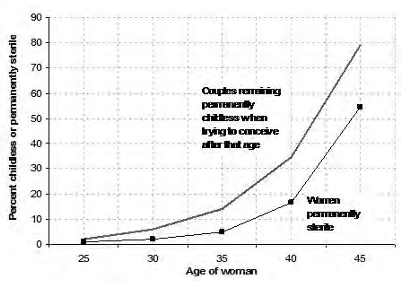
The reproductive biology enters the argument through an explicit trade-off. Sobotka treats ages 36-42 as a critical window for last pregnancy attempts, and reports Leridon's (2008) estimates that at age 40, 17 percent of women are permanently sterile and 35 percent of couples will not eventually be able to have a child when starting pregnancy attempts at that age. These figures are plotted in Figure 2 alongside the percentage of couples remaining childless at age 50 by age at which conception is attempted.
There is a quantitative check on how much this biology matters at the aggregate level. Sobotka cites Kohler and colleagues (2002), who estimated that one year of delay from the mean age at first birth reduced the complete fertility rate of women in different European countries by 1.6 to 5.1 percent. The review immediately qualifies this: the effect was smaller for younger cohorts that experienced motherhood later in life, and a comparative analysis suggests that delayed childbearing has so far played a minor role in the shift to low fertility, with other factors responsible for the very low fertility of Southern Europe, Eastern Europe, and German-speaking countries. This is the pattern of a careful review rather than an advocacy piece, since the author reports the estimate and then reports the evidence that limits its scope.
It is worth being explicit that this article contains essentially no mathematical formalism. Rather than equations, it relies on demographic indicators such as the total fertility rate, adjusted total fertility rate, and mean age at first birth, and on comparative tables and graphs. That choice is appropriate to the material, but it does mean the argument's precision rests entirely on the quality of the underlying national statistics, which Sobotka does not independently audit.
The tempo effect on observed fertility
The most policy-relevant mechanism in the review concerns the distinction between tempo and quantum. Sobotka notes that a shift to later childbearing brings a temporary decline in birth rates even if the number of children women have over their life course does not change, because the interval between generations expands and fewer births fall into each calendar year. Estimates from the Vienna Institute of Demography, shown in Figure 3, quantify how large this distortion is.
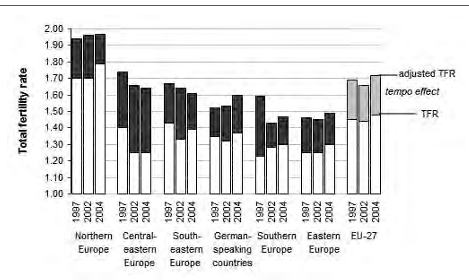
The numbers behind this figure are the sharpest in the review. In the absence of the ongoing increase in age at childbearing, the total fertility rate for the European Union in 2003-2005 would have reached 1.72 instead of the observed 1.48. The gap is largest in Central and Eastern Europe, where the observed TFR was as low as 1.25 while the estimated TFR without the tempo effect was substantially higher at 1.64. Since the adjusted values are computed using the Bongaarts and Feeney (1998) approach, they carry that method's known assumptions about the stability of recent postponement rates, a caveat Sobotka does not dwell on but which the cited source makes explicit.
Why policy is harder than the recommendations suggest
The concluding section offers a stylized wish list: reverse the falling relative income of workers below age 35, make labour markets more flexible and open to young adults, allow broad choice in weekly work time, parental leave duration and its sharing between partners, make institutional childcare inexpensive and accessible with full-day coverage for children under three and school-aged children, enable cheap access to infertility treatment, and support affordable housing. The reasoning behind this list is the heterogeneity argument, and it is where the review's own logic does the most work. Sobotka argues that policies assuming uniform needs and preferences might be counterproductive, giving the concrete example that a policy stimulating an extended period of generous parental leave without offering short work interruption and easily available institutional child care may discourage career-oriented women from having children earlier in life. The paper is explicit that these policies should not aim at reducing the age at childbearing, since there is no clear support for the notion that earlier timing of births should be preferred. This is a genuinely non-obvious position: the same policy package is justified as facilitating both earlier parenthood for those who want it and the recuperation of delayed childbearing at later ages.
Evidence and Its Limits
The core fertility arithmetic is concentrated in one comparison. Sobotka reports that for each cycle initiated with the use of a woman's own oocytes, success rates as measured by the chances of achieving a live birth decline steadily from about age 32, and that in the United States only 16 percent of attempts using fresh non-donor eggs result in live birth at age 40. Leridon's (2004) simulations estimated that after age 40 ART is only marginally more successful than pregnancy attempts through sexual intercourse, and costs per ART child born are prohibitively high after that age. The most interesting technical finding here is that the use of donated oocytes, commonly from much younger women, does not diminish chances of successful delivery with the age of the woman undergoing ART, with success rates around 50 percent per cycle. This is the empirical basis for the suggestion that cryopreservation at younger ages may give women a chance to use their own fertilised oocytes later, combined with the sobering caveat that egg freezing, unlike sperm and embryo cryopreservation, is still in an early stage of technological development with only a few documented successes, so its impact on late birth rates remains low for the next two to three decades.
The evidence quality is uneven in ways that matter for interpretation. The education-gradient claim is supported by a single national case, Norway, and Sobotka himself notes that the pattern is most pronounced in countries with larger social disparities, which implies the Norwegian estimate is a moderate rather than extreme instance. The consequence claims about children point in two directions: overall, late motherhood does not appear to have serious effects on behavioural or physical outcomes of children after controlling for maternal socio-economic status and birth-related risk factors, and adolescent children of older mothers may display better educational achievement and lower drug abuse, but the effect of father's age may be more pronounced, with Saha and colleagues (2009) reporting negative effects of paternal age on neurocognitive measures up to age 7 and links to higher risk of schizophrenia, autism, dyslexia, and Alzheimer disease. The review does not attempt to reconcile these findings into a single net effect, and that is arguably the right call given how heterogeneous the outcome measures are. It should also be noted that the review provides no formal sensitivity analysis or meta-analytic pooling; it is a narrative synthesis, and where it quotes a range such as 1.6 to 5.1 percent for the delay effect on completed fertility, the reader cannot tell from the review alone how the range was derived across countries and cohorts.
Deep Insight and Limitations
The contribution is best understood as a reweighting rather than a discovery. Stein and Susser's formulation, quoted approvingly, is the thesis in one line: the social advantage of late parenthood may outweigh the biological advantage of early parenthood, since older parents are more experienced and knowledgeable, have better economic situations, face lower risk of divorce, and can more easily afford child care. What the review adds beyond this is the structural observation that the institutional and cultural framework of most developed societies favours non-family orientation at younger ages and postponement of stable partnership, so further postponement is likely regardless of rhetoric, and the claim that the late parenthood revolution is not over yet.
The limitations are specific. The empirical backbone on educational heterogeneity rests on Norway, so its generalisation to countries with different welfare and educational systems is asserted through supporting citations rather than demonstrated with comparable data. The quantitative fertility decomposition uses the Bongaarts-Feeney method, whose validity depends on stable recent postponement behaviour, so the adjusted EU figure of 1.72 is a model-based counterfactual rather than a directly observed quantity. The assisted reproduction conclusions are time-stamped to the state of egg-freezing technology around 2007-2009, and the review itself concedes that only a few successful cases had been documented, which means the claim that egg storing will have low impact for two to three decades is a forecast with a short evidentiary base. Finally, the policy wish list is explicitly stylized and, as the author says, drawn from existing research rather than tested; no evaluation design is offered for any of the eight recommendations, so their causal efficacy remains an open empirical question rather than an established result.