
Streamlining Metabolic Assessment: A 1-Hour Model for Hepatic and Extrahepatic Insulin Clearance
L; p=0.92). In conclusion, short IM-IVGTT provides a reliable assessment of hepatic and extrahepatic insulin clearance through such modelbased method. Its application to the study of pGDM women showed no alteration in hepatic and extrahepatic contributions with respect to women who had a healthy pregnancy. Clinical Relevance-This study proves the reliability of short (1 hour) IM-IVGTT to assess hepatic and extrahepatic insulin clearance in women who experienced gestational diabetes
The study validates a model-based method to separately assess hepatic and extrahepatic insulin clearance using a shortened 1-hour Insulin-Modified Intravenous Glucose Tolerance Test (IM-IVGTT). Applied to women with a history of gestational diabetes (pGDM), the method confirms that a 1-hour protocol provides equivalent reliability to the standard 3-hour test for characterizing insulin metabolism.
TL;DR
Researchers have validated a shortened, one-hour version of the Insulin-Modified Intravenous Glucose Tolerance Test (IM-IVGTT) to independently measure how the liver and peripheral tissues clear insulin. Testing this on women with a history of gestational diabetes (pGDM) revealed that the 60-minute data is just as reliable as the traditional 180-minute version, offering a practical tool for early detection of metabolic dysfunction without the clinical burden of long-duration testing.
Background & Motivation: Beyond Total Clearance
Insulin clearance is not a monolithic process; the liver handles approximately 80% of it, while kidneys and muscles manage the rest. In patients with Type 2 Diabetes (T2D), these two components are often "decoupled" or differentially impaired. Women with a history of gestational diabetes (pGDM) are at a high-risk crossroads for T2D.
While previous studies looked at total clearance, they missed the nuanced interplay between hepatic extraction and peripheral disposal. Clinical adoption of sophisticated models has been hindered by the 3-hour test duration, which is impractical for routine postpartum screening. The authors set out to prove that "less is more"—or at least, that "less" (1 hour) is "equal" in accuracy.
Methodology: Mathematical Precision in Kinetics
The core of this research lies in a compartmental mathematical model that describes changes in plasma insulin concentration . The model treats the body as a system where insulin enters via secretion (ISR) or infusion (IR) and exits via two distinct pathways:
- Hepatic Clearance: Regulated by Hepatic Fractional Extraction ().
- Extrahepatic Clearance: Regulated by Peripheral Clearance ().
To make the 1st hour of data sufficient for parameter estimation, the authors optimized the fitting procedure:
- Regularization: They added penalty terms to the least-squares problem to prevent parameters like from collapsing to zero, which is essential when the observation window is limited.
- Linear Dynamics: Unlike some models that assume saturable kinetics, this study utilized linear dynamics, which the authors found to be more robust and physiologically supported for this specific population.
 Eq. 1: The differential equation governing insulin kinetics where is distribution volume and is hepatic extraction.
Experimental Results: The 1-Hour Equivalence
The study analyzed 115 pGDM women and 41 healthy controls. The most striking finding was the statistical equivalence between the 3-hour and 1-hour parameters.
| Parameter | 3-hour (pGDM) | 1-hour (pGDM) | p-value |
|---|---|---|---|
| (L/min) | 0.23 | 0.23 | 0.17 |
| (%) | 49.7 | 50.2 | 0.57 |
| (L) | 2.01 | 2.01 | 0.19 |
Using a Two One-Sided Test (TOST), the researchers confirmed that the margin of error was negligible ( SD), proving that the dynamics captured in the first 60 minutes (which includes the glucose spike and the insulin infusion at minute 20) contain the critical information needed to define the subject's metabolic "fingerprint."
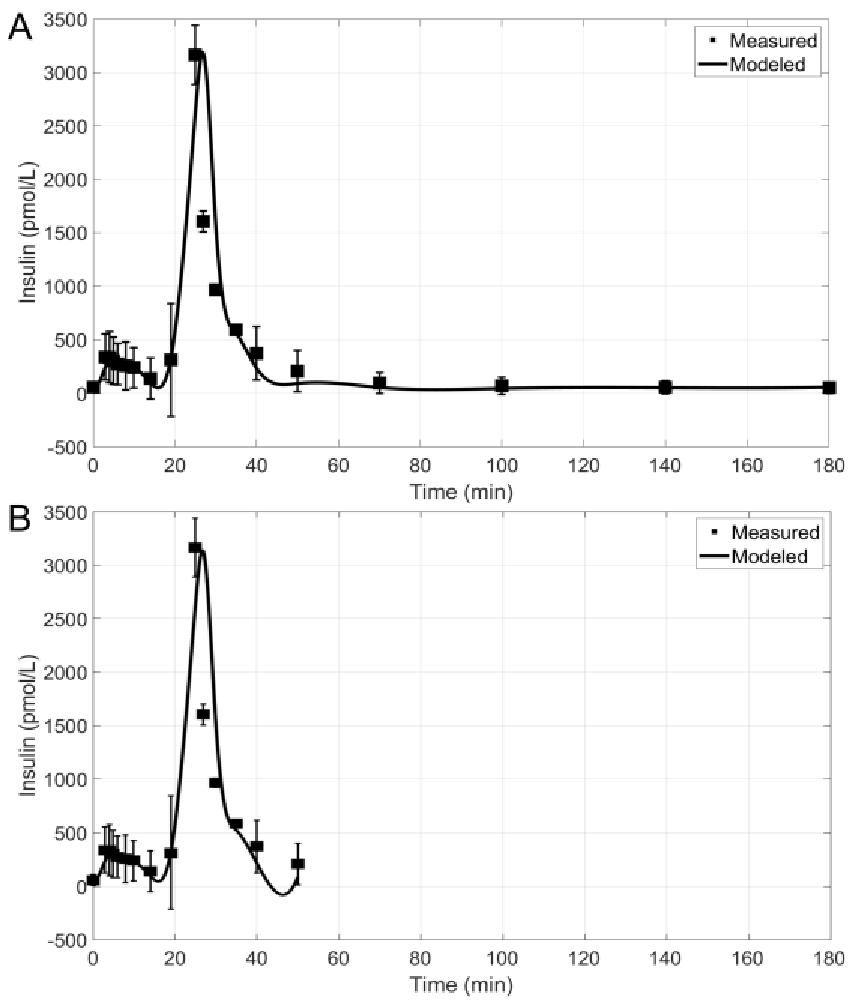 Figure 2: The model (solid lines) accurately tracks measured insulin (dots) in both the full 3-hour (A) and the truncated 1-hour (B) sessions.
Critical Insight: Stability Post-Pregnancy
An interesting biological takeaway is that 4-6 months after delivery, pGDM women showed no significant impairment in either hepatic or extrahepatic clearance compared to controls. This suggests that the immediate postpartum period might be a "window of stability" before potential progression to T2D, making it the perfect time for baseline screenings using this 1-hour optimized method.
Conclusion & Future Outlook
This work bridges the gap between complex physiological modeling and clinical utility. By reducing the test time by 66%, the study makes it feasible to include detailed insulin clearance metrics in standard metabolic check-ups.
Limitations: The model relies on a constant assumed Hepatic Plasma Flow (HPF), which in reality fluctuates during glucose tests. Future iterations could integrate dynamic HPF measurements to further refine accuracy. Nevertheless, for the high-risk pGDM population, this 1-hour model provides a vital, efficient tool for personalized metabolic monitoring.