
Shrink: Reimagining Breast Cancer Risk Assessment via Medical Social Networks
Shrink: A Breast Cancer Risk Assessment Model Based on Medical Social Network
Shrink is a novel breast cancer risk assessment model that leverages medical social network theory and group division algorithms to identify high-risk populations. Unlike traditional fixed-parameter models, Shrink utilizes personal similarity across diverse epidemiological factors to achieve superior predictive accuracy, outperforming the classic Gail model on large-scale Chinese clinical datasets.
TL;DR
Early detection is the "holy grail" of breast cancer survival, yet massive cross-population screening is often financially and logistically prohibitive. This paper introduces Shrink, a risk assessment model that shifts the focus from rigid statistical formulas to a dynamic Medical Social Network. By treating individuals as interconnected nodes based on lifestyle and physiological similarities, Shrink provides a more generalized and accurate way to identify high-risk groups without the need for expensive genetic testing.
The Localization Crisis in Cancer Prediction
For decades, the Gail Model has been the gold standard for predicting breast cancer risk. However, it was built primarily on Western data. Research shows it performs poorly for Chinese women because risk factors—ranging from BMI to reproductive history—diverge significantly across cultures.
The core dilemma is:
- Generality: Existing models are too rigid for global application.
- Cost: Advanced models require genetic markers (like BRCA1/2) that aren't feasible for mass screening in developing nations.
- Methodology: Traditional supervised learning requires strict classification standards that don't always exist for complex etiologies.
Methodology: People as a Network
Shrink's innovation lies in its "Medical Social Network." The authors hypothesize that if individuals share similar lifestyles, environments, and physiological traits, their risk profiles should also be linked.
1. Constructing the Network
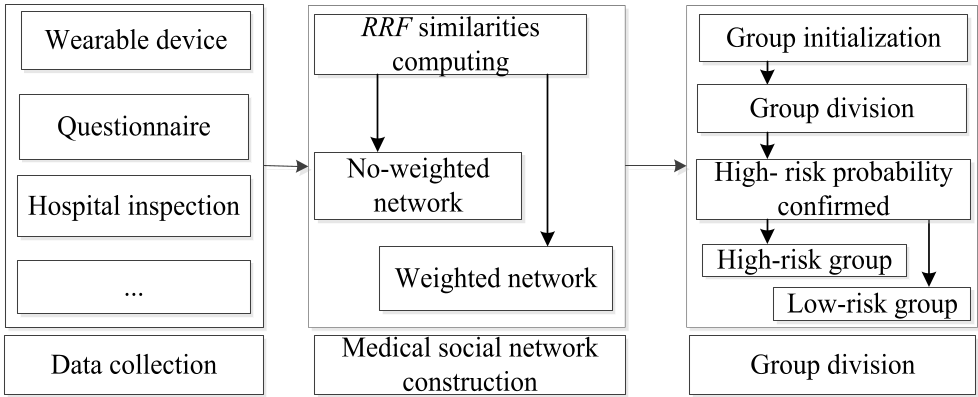
The model calculates a similarity score between two people based on specific Related Risk Factors (RRF). This creates a weighted graph where edge thickness represents how closely two individuals match in terms of factors like age at menarche, miscarriage history, or life satisfaction.
2. Group Division (The "Shrink" Algorithm)
Instead of a simple "yes/no" classifier, the model uses a community detection approach.
- Initialization: It starts with a few known "patient" nodes in a high-risk group and healthy individuals in a low-risk group.
- Optimization: It uses Modularity Gain () to move individuals between groups. If moving a person to the "high-risk" cluster increases the overall network density significantly, they are classified as high-risk.
- Iteration: This process repeats for every RRF (e.g., family history BMI age), narrowing down the groups until "terminal groups" are formed.
Experimental Results: Beating the Gold Standard
The authors validated Shrink using a massive dataset of 103,679 women from Eastern China.
The RRF Sweet Spot
One of the paper's key findings is that more data isn't always better. They tested configurations from 4 to 10 risk factors. The "RRF8" configuration (including family history, history of benign disease, life satisfaction, miscarriage times, age at first birth, BMI, menarche age, and current age) provided the highest accuracy. Adding more factors (like diabetes or urban/rural status) actually led to diminishing returns or noise.
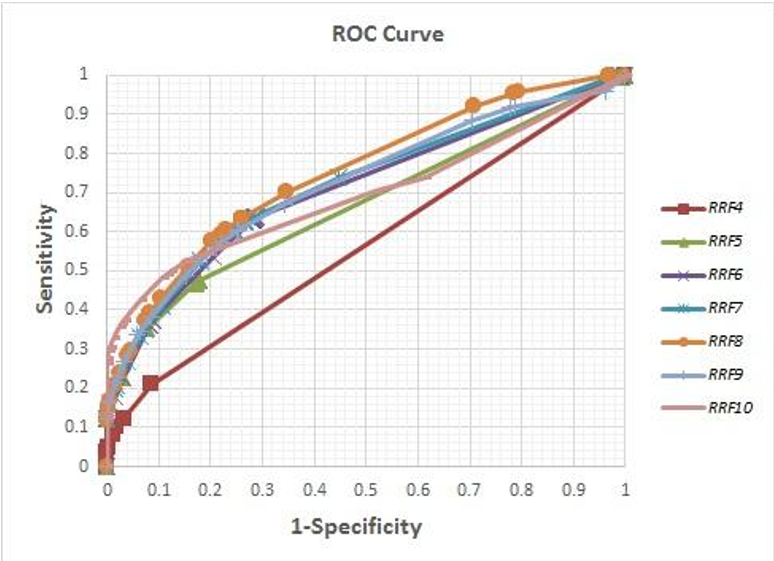
As shown in the ROC curves, Shrink (the prominent curve) demonstrates a much higher area under the curve (AUC) than the Gail model. Even as the data scale increased to over 100,000 cases, Shrink maintained its superior predictive power.
Critical Insight: Why This Matters
Shrink represents a move toward Adaptive Medicine. By using questionnaire-based data rather than clinical biopsies, it allows community hospitals to perform preliminary "risk filtering."
Pros:
- High Generality: The RRFs can be swapped out based on regional health trends.
- Low Cost: Most data is collected via simple surveys.
- Algorithmic Rigor: Using modularity optimization handles the "gray area" of risk better than binary decision trees.
Limitations:
- The model still relies on the quality of self-reported questionnaire data (subject to recall bias).
- While the algorithm is efficient, constructing similarity matrices for millions of people (Big Data scale) requires significant computational resources.
Conclusion
Shrink successfully bridges the gap between social network science and oncology. By recognizing that cancer risk is not just an individual statistic but a pattern shared across similar "social" cohorts, it provides a powerful, localized tool for secondary prevention in the fight against breast cancer.