
To Shut Them Up or to Clarify: Optimal Strategies for Rumor Control in Social Networks
To Shut Them Up or to Clarify: Restraining the Spread of Rumors in Online Social Networks
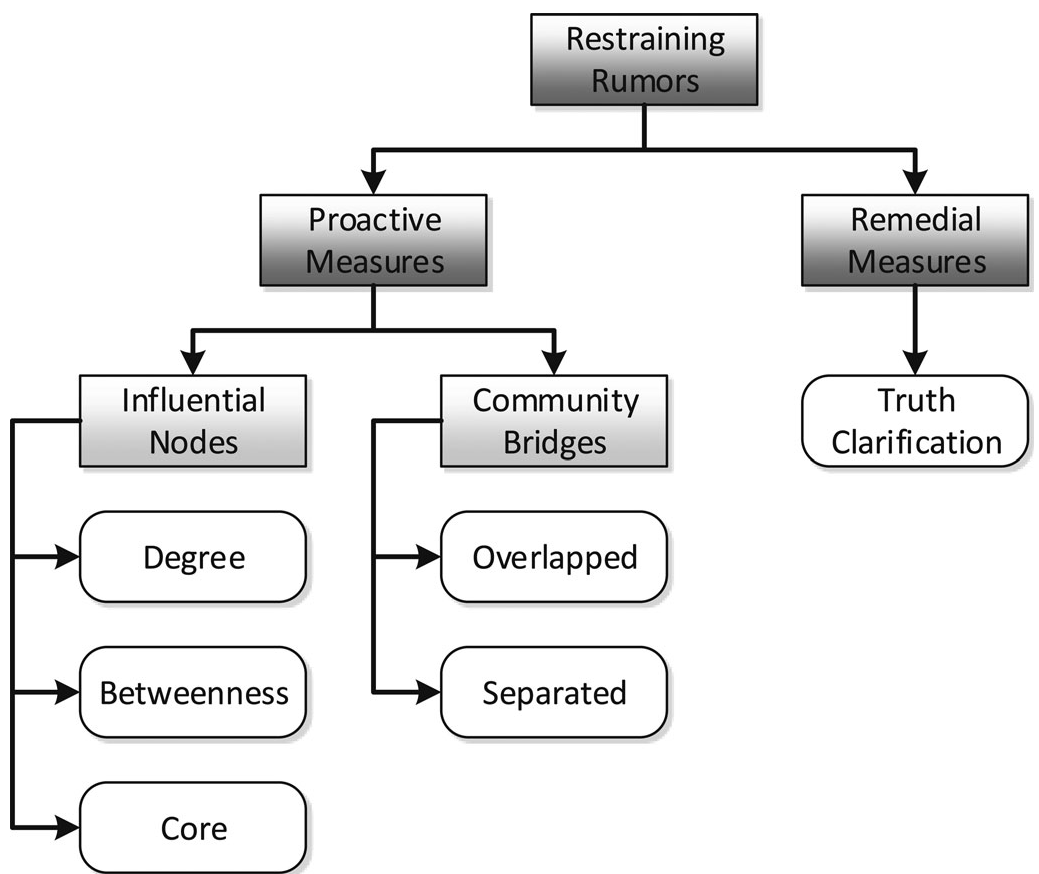
This paper presents a comprehensive mathematical framework to evaluate and compare strategies for restraining rumors in Online Social Networks (OSNs). It specifically analyzes two major approaches: "proactive measures" (blocking influential nodes) and "remedial measures" (spreading truths), concluding that a hybrid strategy is optimal for real-world scenarios.
TL;DR
In the digital age, a single rumor can wipe billions off the stock market in minutes. This paper provides the first rigorous "horizontal" comparison between two camps of thought: Proactive Blocking (silencing influencers) and Remedial Clarification (spreading the truth). The verdict? Use Betweenness for total control, Degree for speed, and always combine your efforts to manage both the peak panic and the long-term spread.
Background: The Double-Edged Sword of OSNs
Online Social Networks (OSNs) are powerful tools for information dissemination, but they are equally efficient at spreading disinformation. Historically, researchers have argued over whether it is better to block rumors at the source or to fight them with "truth." However, these evaluations usually happen in silos. This paper bridges that gap by establishing a mathematical platform for a head-to-head showdown between these methods using real-world data from Facebook and Google+.
Motivation: The Evaluation Dilemma
Why is it so hard to stop a rumor?
- Lack of Standards: There was no universal metric to compare a "blocking" strategy vs. a "clarification" strategy.
- Negativity Bias: In psychology, "rumors have wings while truth stays indoors." People are naturally more inclined to share sensationalist lies than boring corrections.
- Resource Constraints: In the real world, you cannot block 30% of a network (it violates rights and is impractical), and you have a limited budget for truth campaigns.
Methodology: The Propagation Model
The authors propose a discrete-time model where each node moves through states: Susceptible (Sus.), Defended (Def.), Infected (Inf.), and Recovered (Rec.).
A key innovation is the "Minority-is-Subordinate-to-Majority" (M-S-M) choice model. Instead of blindly believing everything, nodes calculate the ratio of rumor vs. truth they receive from their neighbors. This reflects the social reality that people are influenced by the consensus of their immediate circle.
Key Findings: The Battle of Metrics
1. Degree vs. Betweenness
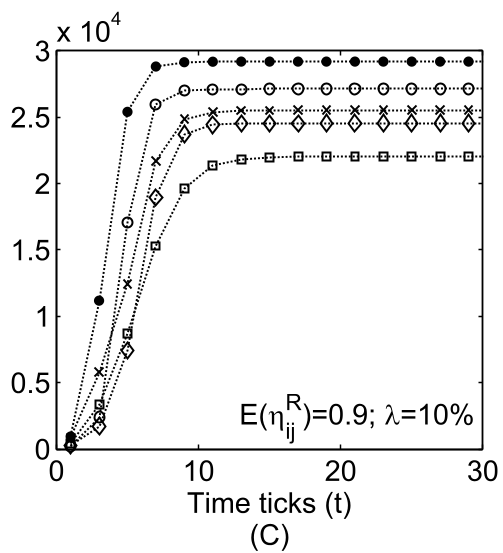
- Short-term King: The Degree measure (blocking nodes with the most connections) works best in the "early stage." The authors' "Contagious Time" analysis proves that high-degree nodes get infected much earlier than others.
- Long-term Master: The Betweenness measure (blocking nodes that act as bridges between communities) is more efficient at reducing the final number of infected users.
2. The Limits of Truth
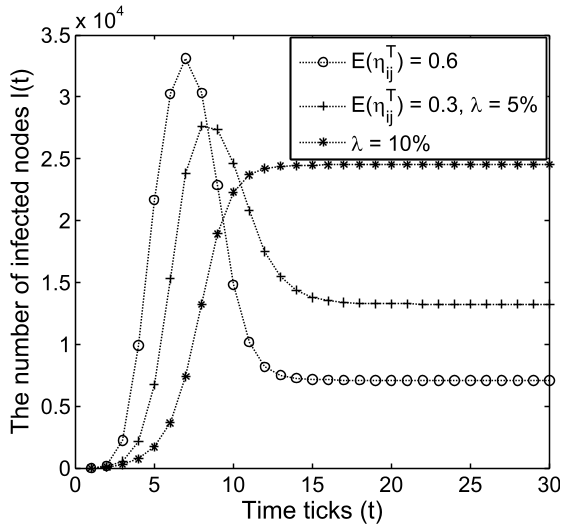
Spreading the truth is essential but flawed as a standalone strategy. Even if you start spreading the truth shortly after a rumor (t=3), the "peak" number of infected users remains high because rumors spread faster than corrections can be processed.
3. The "Hybrid" Solution
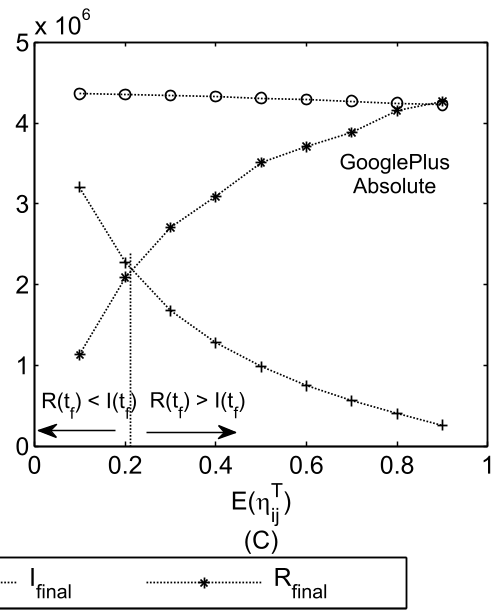
The most profound takeaway is the Numeric Equivalence between blocking and clarification. The study shows that you can achieve the same results by replacing a high defense ratio (silencing people) with a higher probability of truth-spreading. For example, if you can't block 10% of users due to ethics, you can block 5% and spend the remaining budget on a more effective truth campaign.
Deep Insight & Conclusion
This paper shifts the conversation from "which method is best" to "how to leverage them together."
- Takeaway: To effectively manage a crisis, a network administrator should use proactive blocking to "lower the peak" (I_max) and prevent system-wide panic, while simultaneously launching a remedial truth campaign to "clean up" the residual infection in the long run.
- Limitations: The model assumes a static network topology. In modern OSNs, edges are dynamic, and the cost of "blocking" users is not just financial but also social (reputation loss).
Ultimately, the work proves that we don't need to choose between "shutting them up" or "clarifying"—the most practical strategy is to do both, calculated carefully through the lens of math.