
Shutter: Safeguarding Enterprise Secrets at the Social Media Gateway
Shutter: Preventing Information Leakage Based on Domain Gateway for Social Networks
This paper introduces Shutter, a high-performance domain gateway system designed to prevent sensitive information leakage via Online Social Networks (OSNs). It utilizes a fine-grained element parser and a layered trie-based rule matcher to inspect HTTP/HTTPS traffic at massive scales, achieving throughputs of up to 38Gbps.
TL;DR
As Online Social Networks (OSNs) become omnipresent in professional environments, the risk of accidental information leakage (e.g., leaking project names via comments) has skyrocketed. Shutter is a specialized domain gateway that moves beyond blunt "block-all" policies. By leveraging a high-speed layered trie and an OSN-aware parser, it inspects fine-grained user actions—who is posting what to whom—at speeds exceeding 38Gbps, ensuring security without sacrificing network performance.
The Blind Spots of Traditional Gateways
Current NIDS (Network Intrusion Detection Systems) like Snort or Bro are built for protocol-level security. They are excellent at stopping known exploits but "blind" to the semantic context of social media.
- Reassembly Bottlenecks: OSN posts are long. Traditional state-machine parsers try to reassemble every TCP segment before inspection, consuming massive CPU and memory.
- Semantic Complexity: Standard firewalls see a "POST request." They don't see "Alice is commenting on Bob’s wall about Project X."
- Update Latency: Highly optimized DFA-based matchers often require a full "rebuild" of the state machine whenever a single security rule is added, leading to unacceptable downtime in dynamic environments.
Methodology: Semantic-Aware Parsing & Layered Tries
The authors proposed a shift in perspective. Instead of parsing everything, Shutter identifies "Traffic Marks"—specific name-value pairs (like c_user, comment_text, object_id) that define the context of a request.
1. The Quadruple Model
Shutter defines every OSN interaction as a quadruple: .
- Subject: Who is the user?
- Action: What are they doing (Comment, Like, Post)?
- Object: Who/What is the target?
- Content: What is the actual text or data?
2. Element Parser & Architecture
The Element Parser utilizes the characteristics of OSN requests to skip futile fields. For HTTPS traffic, it uses a transparent proxy approach to decrypt packets at the gateway before routing them through the core engine.
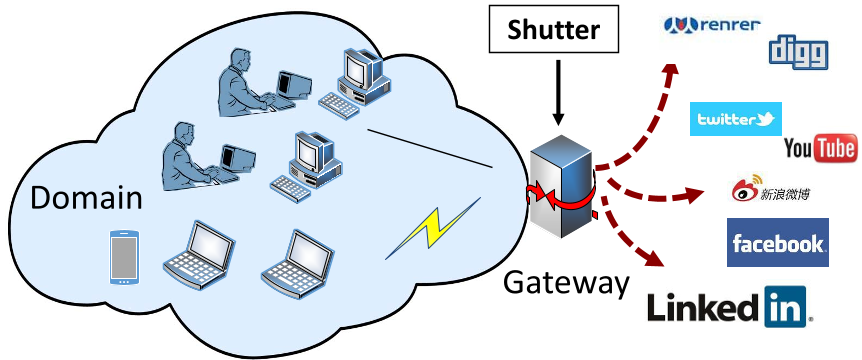 Fig 1: The Domain Environment where Shutter acts as the intelligent mediator between the internal network and OSN sites.
3. The Power of the Layered Trie
To solve the rule update problem, Shutter uses a Layered Trie. Unlike DFAs used in NetShield or ROOM, a Trie allows for search time (where is the length of the record) while allowing nodes to be added or removed without recomputing the entire structure. This enables Shutter to handle 160,000 rule updates per second.
Performance Benchmarks
Shutter was tested against real traffic from Renren, Weibo, Facebook, and Twitter.
- Throughput: In HTTP environments, it reached 38-60 Gbps, significantly outperforming Nginx. In encrypted HTTPS environments, it remained strong at 14-18 Gbps.
- Memory Efficiency: By only storing specific header fields instead of full payloads during parsing, it reduced memory overhead per request to just 0.12KB.
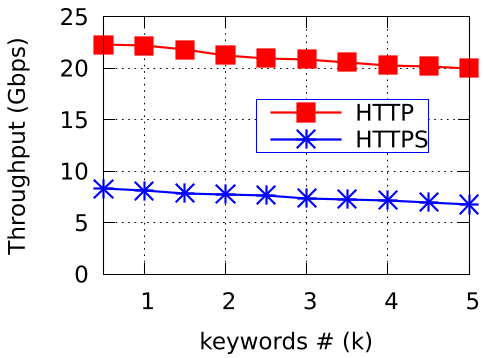 Fig 2: Scalability testing shows that throughput remains nearly constant even as the number of security rules (triads) increases.
Critical Analysis & Future Outlook
Shutter represents a significant leap in semantic network security. By focusing on "Action" and "Object" rather than just "Protocol," it provides the granularity required for modern corporate governance.
Limitations:
- Proxy Dependency: The HTTPS inspection requires a proxy that mimics certificates. While effective, this can be complex to deploy at a massive scale and raises separate internal privacy concerns.
- Evasion: Highly clever users could potentially bypass keyword-based "Content" filters using coded language or obfuscation, suggesting a future need for LLM-based semantic analysis within the Shutter framework.
Conclusion: If you are building network infrastructure for a high-security organization, Shutter's approach—combining specific traffic mark extraction with flexible trie-based matching—is the current SOTA for balancing speed and fine-grained control.