
ShutterRoller: Shielding Social Privacy at the Gateway with High-Speed Precision
ShutterRoller: Preserving Social Network Privacy towards High-Speed Domain Gateway
This paper introduces ShutterRoller, a domain gateway-based privacy preservation system designed to detect and prevent social network privacy leakage in high-speed (10Gbps) environments. It utilizes a multi-threaded packet reassembly framework and a customized application-layer inspection engine to achieve fine-grained detection of user behaviors and sensitive content.
TL;DR
ShutterRoller is a sophisticated domain gateway system designed to stop Online Social Network (OSN) privacy leaks before they leave the local network. By redefining how packets are reassembled and inspected, it achieves 940MBps throughput and 93%+ detection accuracy, bridging the gap between high-speed networking and fine-grained content analysis.
The Blind Spot of Modern Gateways
As social networks become the primary medium for information exchange, the risk of accidental privacy leakage—ranging from confidential corporate data to personal metadata—has skyrocketed. While social media platforms offer privacy settings, they are often too simplified or left at "default" by users.
Current enterprise defenses like Network Intrusion Detection Systems (NIDS) are ill-equipped for this task. They typically look at individual packets (PDUs). However, detecting a privacy leak requires seeing the "whole picture"—the complete HTTP message. When you try to reassemble these messages in a 10Gbps environment, traditional systems either crash under the load or introduce unacceptable latency.
The ShutterRoller Solution: Methodology
ShutterRoller addresses these challenges through two core innovations: a high-efficiency network framework and a customized social feature inspection engine.
1. Multi-Threaded Restoration & The "Least Packets" Strategy
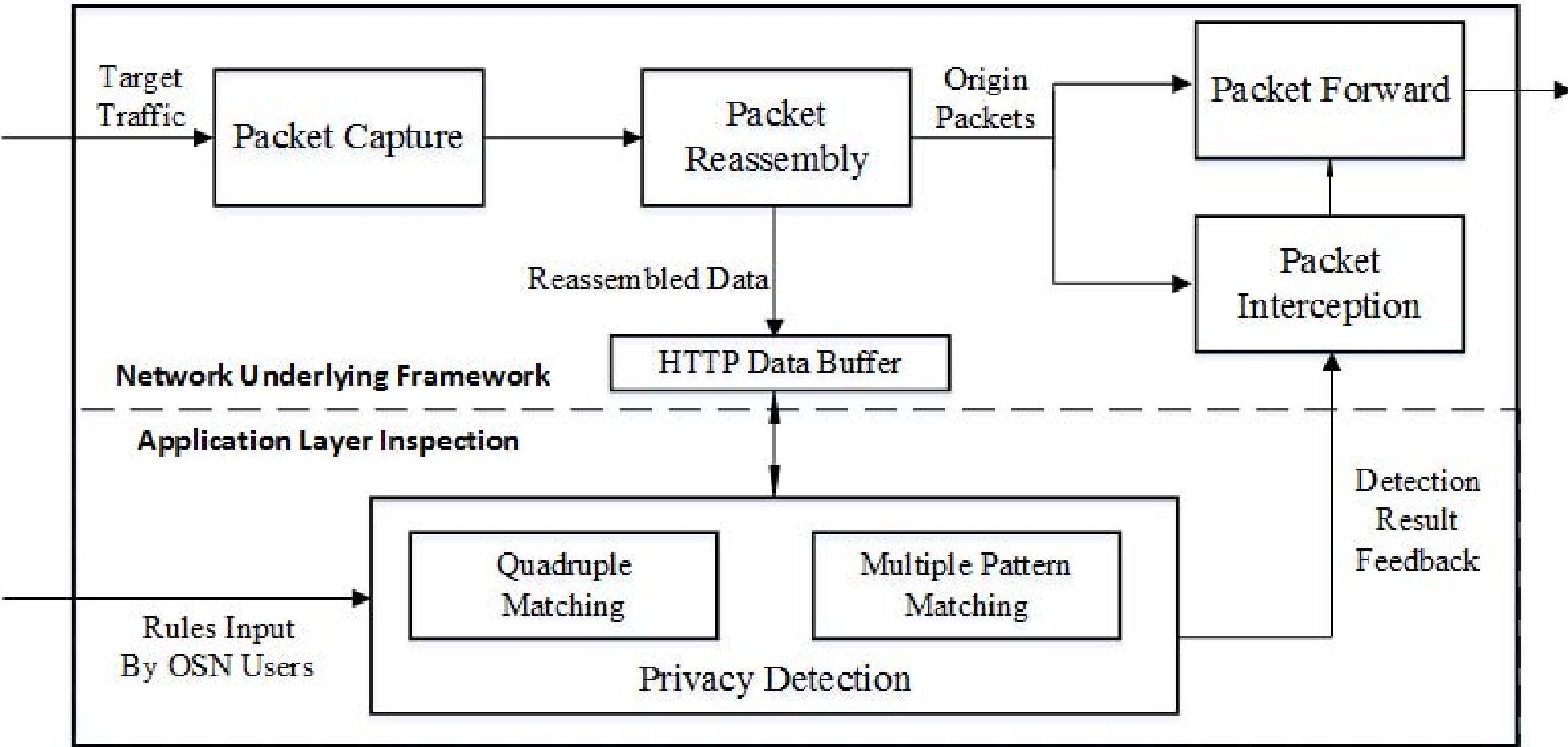
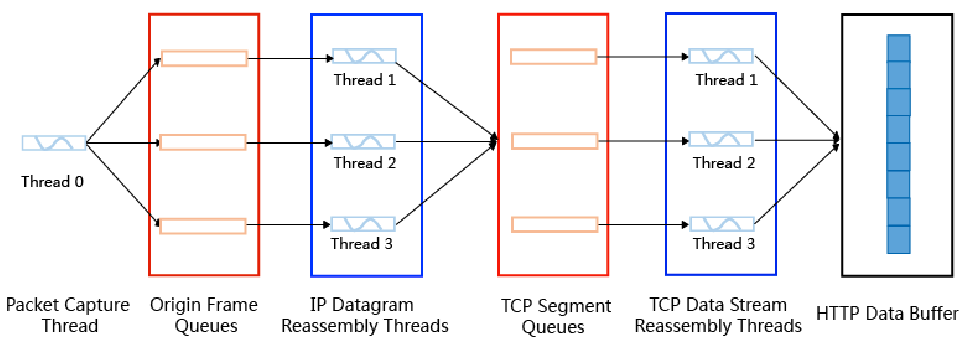
To handle 10Gbit Ethernet, ShutterRoller utilizes Netmap for kernel bypassing and zero-copy packet I/O. The system employs a multi-threaded reassembly algorithm that hashes traffic flows to specific CPU cores to ensure thread affinity and balance.
Crucially, it introduces the Least Packets Interception Strategy. Instead of buffering an entire stream, it intercepts only one critical packet per TCP connection. This holds up the final delivery to the OSN server just long enough for the inspection engine to give a "green light," significantly reducing memory overhead.
2. Fine-Grained Social Feature Inspection
ShutterRoller doesn't just look for keywords; it understands the context of social interactions defined as a Quadruple: <User, Action, Resource, ROwner>.
- Content Matching (Double-DFA): To match sensitive keywords without pausing the system during rule updates, ShutterRoller uses a double-DFA scheme. While one DFA is active, the other is updated in the background, followed by a near-instantaneous swap.
- Behavioral Matching (Prefix Tree): The quadruple attributes are matched using a Prefix Tree (Trie), allowing for efficient fuzzy matching with wildcards (e.g., blocking any "Action" by a specific "User").
Experimental Performance
Testing against real network traffic datasets revealed that ShutterRoller's sweet spot lies with 4 reassembly threads, where it hits the peak throughput of 944.23 MBps.
| Metric | Performance Value |
|---|---|
| Max Throughput | ~940 MBps |
| Average Latency | < 220 ms |
| Detection Accuracy | 93.2% - 98.5% |
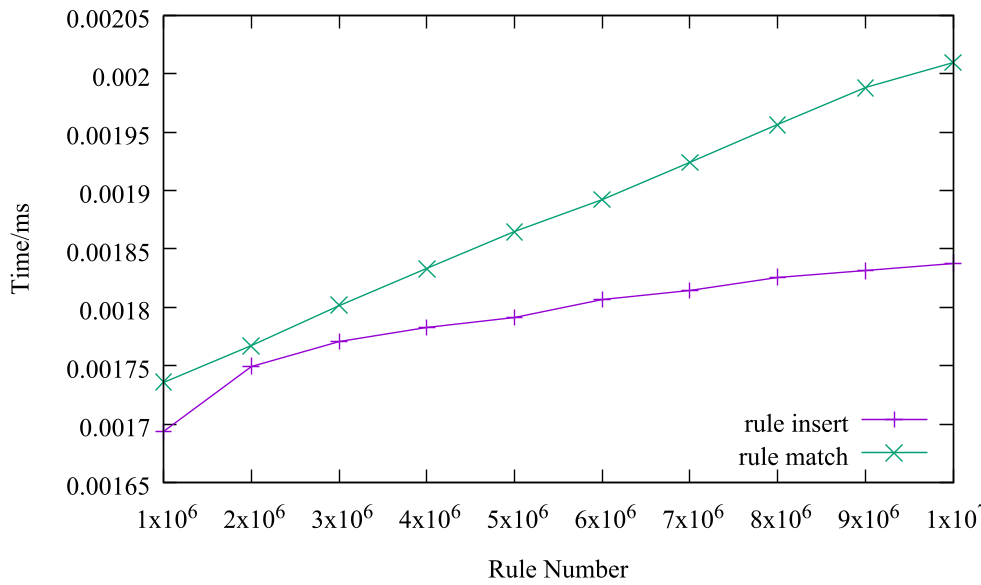
The evaluation of the matching engines (Fig 10) shows that the Prefix Tree remains extremely stable; even with 10 million rules, matching takes a mere 0.002ms. This proves the system's scalability for large-scale enterprise deployments.
Deep Insight & Conclusion
The brilliance of ShutterRoller lies in its asynchronous architecture. By decoupling packet capture from the complex HTTP parsing and rule matching using message queues and buffers, it avoids the "head-of-line blocking" that plagues traditional DPI systems.
Limitations: While highly effective, the paper primarily discusses HTTP. In an era where HTTPS (encrypted traffic) is the standard, ShutterRoller would require integration with SSL/TLS termination proxies to maintain its visibility into the application layer.
Final Takeaway: ShutterRoller shifts the paradigm from "detecting attacks" to "protecting data," providing a blueprint for how future gateways can handle semantic-heavy traffic at line-rate.