
Sig-SDEs: Bridging Classical Quantitative Finance and Generative Machine Learning
Sig-SDEs model for quantitative finance
This paper introduces the Sig-SDE model, a novel quantitative finance framework that integrates classical Stochastic Differential Equations (SDEs) with signature-based generative modeling. By modeling asset volatility as a linear functional of the path signature of a Brownian motion, the authors achieve SOTA efficiency in calibrating complex exotic derivatives and simulating market scenarios.
TL;DR
The Sig-SDE model is a breakthrough framework that solves the "efficiency vs. flexibility" trade-off in financial modeling. By using path signatures to represent volatility, it provides a universal approximator for asset dynamics that can be calibrated to exotic options using simple linear algebra rather than expensive deep learning optimizations.
Background: The Calibration Crisis
In quantitative finance, models must be "calibrated" to match market prices of traded options. We usually face a dilemma:
- Simple Models (e.g., Black-Scholes): Easy to compute but cannot capture "volatility smiles" or path-dependent complexities.
- Neural SDEs: Highly flexible but require thousands of Monte Carlo simulations and gradient descent steps, making them too slow for real-time trading environments.
The authors of "Sig-SDEs model for quantitative finance" occupy the "middle ground," offering a model that is as flexible as a Neural Network but as fast as a linear regression.
Methodology: The Power of the Signature
The core innovation is modeling the volatility process as a linear functional of the signature of a Brownian motion :
Why Signatures?
The signature of a path is a collection of iterated integrals that provides a "basis" for the space of functions on paths. According to the Stone-Weierstrass Theorem, any continuous function of a path can be approximated by a linear combination of its signature components. In Sig-SDEs, this means we can approximate any volatility surface or path-dependent dynamic simply by finding the right weights .
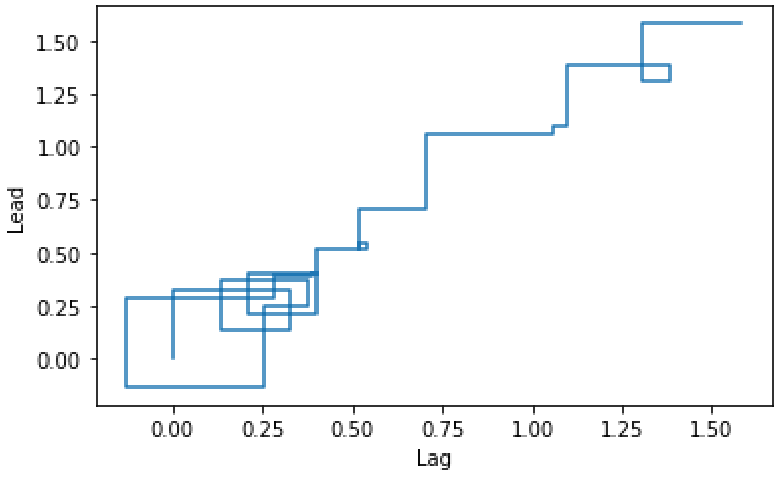
The Technical Secret: Lead-Lag Transformation
To handle the Itô integrals inherent in finance, the authors use a Lead-Lag transformation. This trick allows stochastic integrals to be expressed as Stratonovich integrals, which are perfectly compatible with the linear structure of signatures.
Experiments: Beyond Vanilla Options
The researchers tested the model by calibrating it to a complex dataset including:
- Vanilla Calls
- Variance Options (dependent on quadratic variation)
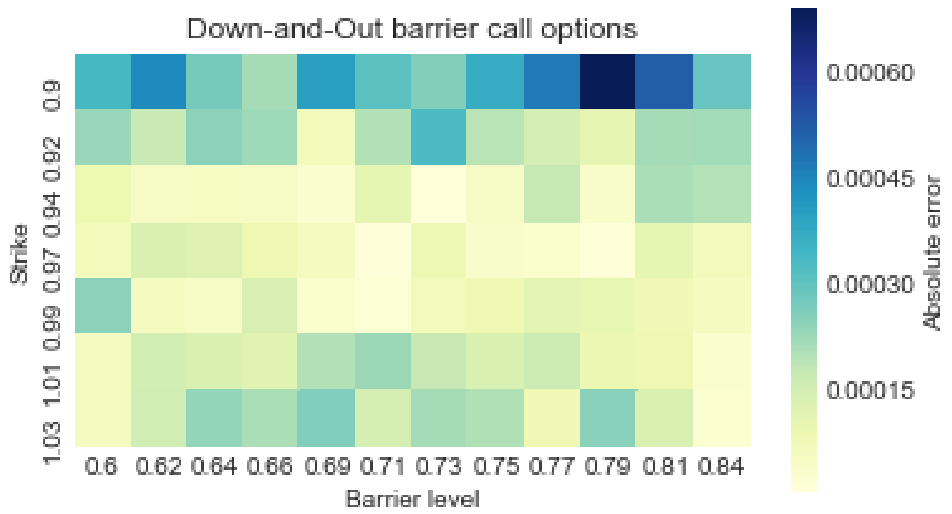
- Down-and-Out Barrier Options (path-dependent)
Results
With an order signature (just 31 parameters), the model achieved near-perfect fitment. More impressively, when asked to price Down-and-In Put Options (which it hadn't seen during calibration), the Sig-SDE produced highly accurate results, proving its incredible generalization capability.
Deep Insight: Why it Works
The true "magic" of Sig-SDE lies in Proposition 6.2. It provides a closed-form expression for the expected signature of the model. This means that pricing an option becomes a simple dot product: This completely removes the need for Monte Carlo simulations during the calibration loop, leading to a massive speed-up compared to traditional Neural SDEs.
Conclusion and Future Outlook
The Sig-SDE model represents a shift toward "Robust Finance." It provides a mathematically rigorous way to handle the high dimensionality of market data while maintaining the transparency and speed required for production systems.
Limitations: The number of terms in a signature grows exponentially with the order and the number of assets . Future research into "Sparse Signatures" or "Log-Signatures" will be essential for scaling this to massive multi-asset portfolios.
Key Takeaway: If you are still using heavy GRUs or LSTMs for financial path generation, it's time to look into the linear elegance of Path Signatures.